Achieve Flawless, Comfortable Lashes Without Redness or Itching: The Science of Gentle Adhesion

UNDERSTANDING THE SENSITIVITY OF THE EYELID AREA
Your eye area is unique because it possesses the thinnest skin on the entire body, and it is a highly sensitive mucus membrane. This means it is designed to absorb and react to external substances. When you experience redness, itching, swelling, or tearing after applying lashes, it is your body’s immediate, valid signal that something in the product—be it the adhesive, the fibers, or the band material—is causing a reaction.
The primary culprits in lash irritation often stem from harsh chemicals found in traditional adhesives, such as cyanoacrylate or formaldehyde. However, the lash fibers themselves can also be problematic. Certain synthetic materials may have sharp edges or be coated in dyes that can leach into the delicate skin, triggering inflammation.
THE CHEMISTRY OF LASH COMPATIBILITY: WHAT TO LOOK FOR
To achieve comfortable wear, you must look beyond marketing terms. The term "hypoallergenic" is not a legal guarantee of safety; it simply indicates a product is less likely to cause a reaction. True compatibility relies on material science.
For sensitive eyes, the material composition of the lash fiber is critical. Medical-grade silicone or silk fibers are generally preferred because they are inherently smooth, lightweight, and lack the sharp textures found in some plastics. Unlike materials that absorb natural oils, these gentler fibers do not create a breeding ground for bacteria that can lead to secondary irritation over time.
Furthermore, the band structure plays a significant role. A band that is too thick or too rigid can cause physical friction against the lash line, leading to redness regardless of chemical sensitivity. The ideal band should be flexible enough to conform to the natural curve of your eyelid without digging in.
ACTIONABLE GUIDANCE: THE 24-HOUR PATCH TEST PROTOCOL
Just as you would test a new skincare serum, you must test any lash product before applying it to your eyes for an event. This proactive approach prevents discomfort on the day you need your look to be perfect.
- Step 1: Carefully remove one lash from the pair you intend to test.
- Step 2: Affix the lash band against the inside of your wrist or the area behind your ear. Do not place it on your actual eyelid yet.
- Step 3: Secure the test lash with a small piece of medical tape if necessary to ensure it stays in place.
- Step 4: Leave the test in place for a full 24 hours. If you observe any signs of redness, bumps, or persistent itching, discontinue use of that specific product on your eyes.
If you are using a separate adhesive, test that component separately by applying a tiny dot to your wrist and waiting 24 hours to ensure no reaction occurs before proceeding to the full eye test.
MASTER APPLICATION TECHNIQUES TO MINIMIZE FRICTION AND IRRITATION
Even with the gentlest materials, the application process itself can be a source of irritation. Adhering to these three fundamental rules ensures a smoother experience.
- Wait for Adhesion: Do not place the lash while the adhesive is wet. Allow 30 to 45 seconds for the adhesive to become tacky. This ensures the bond is secure without the glue migrating into the tear ducts or eyelid skin.
- Press, Do Not Slide: Once positioned, gently press the lash onto the lash line using your finger. Avoid sliding the lash around, as this action creates unnecessary friction against the delicate skin.
- Removal Protocol: Never attempt to pull a lash off when it is dry. Use a cotton swab dipped in a gentle, oil-based eye makeup remover. Apply the swab along the band, wait about 10 seconds, and the lash should release naturally.
YOUR SHOPPING CHECKLIST FOR SENSITIVE EYES
Armed with this knowledge, you can now evaluate any lash product based on these critical criteria, moving beyond vague marketing claims.
- Fiber Material: Prioritize silk or medical-grade silicone. Actively look to avoid PVC or standard nylon compositions.
- Band Construction: The band should be thin, flexible, and ideally clear or a very light brown. A thick, opaque black band is often an indicator of potential physical irritation.
- Adhesive Transparency: If the product uses built-in adhesive, investigate the ingredient list thoroughly. If you are using external glue, confirm it is explicitly latex-free.
- Allergy Screening: Always confirm the adhesive is labeled as latex-free, as this is a very common trigger for eye irritation.
THE NATURAL SOLUTION: PHANSTA LASHES
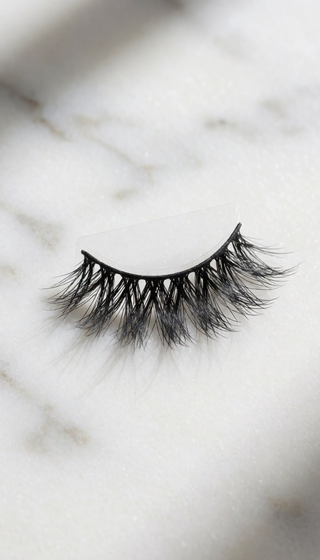
You have mastered the science of lash compatibility—understanding material safety, the importance of patch testing, and the correct application mechanics. If you are seeking a lash that inherently meets every single one of these criteria—featuring gentle, medical-grade fibers, a flexible band, and a rigorously tested, latex-free adhesion system—PHANSTA LASHES was engineered specifically for this need. We focused on sourcing the most biocompatible materials so that you never have to compromise between a beautiful look and the comfort of your eyes.
FREQUENTLY ASKED QUESTIONS
Are glue-free lashes safe for sensitive eyes?
Answer: Yes. PHANSTA LASHES are hypoallergenic, latex-free, and fragrance-free. They apply using a micro-adhesion system that eliminates the need for liquid adhesive, which is the most common lash irritant. Always perform a patch test on your inner arm for 24 hours before first use.
How long do glue-free lashes last per wear?
Answer: With clean, dry lids at application, PHANSTA LASHES hold comfortably through a full day, including workouts and light rain when using the waterproof version. Longevity is primarily dependent on proper, clean application.
Can you really reuse PHANSTA LASHES 30+ times?
Answer: Yes, when maintained correctly. Gently peel them off by lifting from the outer corner, wipe the band with a damp swab after each wear, and store pairs curved-side-up in the tray. Never soak the band in remover.
Do PHANSTA LASHES damage natural lashes?
Answer: No—unlike pulling off dried glue, PHANSTA LASHES peel away cleanly without tugging on natural hairs. Removal should always be done gently by lifting from the outer corner.
How much do PHANSTA LASHES cost?
Answer: PHANSTA LASHES are priced at $59 per pair, which works out to under $2 per wear when factoring in their reusable nature over 30+ wears.
FIND THE PERFECT LASH FOR EVERY MOMENT
Explore our occasion-specific lash guides:
EXPERIENCE THE DIFFERENCE
Join thousands of women who have made the switch. No adhesive, no damage, no salon appointments — just beautiful lashes in seconds.
SHOP PHANSTA LASHES — GLUE-FREE, 30+ WEARS →