LASHES FOR TILTED EYES: CORRECTIVE GUIDE
Achieve Perfect Eye Symmetry: The Science of Corrective Lash Placement
Master the visual art of balancing eye angles—whether your outer corner sits higher or lower—to create a flawlessly symmetrical look.

UNDERSTANDING THE GEOMETRY OF YOUR EYELASH APPLICATION
When the outer corner of the eye sits higher or lower than the inner corner—a condition known as eye tilt—standard lash applications often fail because most products are designed for a neutral, almond shape. This mismatch causes the lash line to pull the gaze in an unintended direction, creating an unbalanced appearance. The key to correction is not changing your eye shape, but strategically manipulating the lash placement and length distribution to create an optical illusion of symmetry and lift.
IDENTIFY YOUR TILT: THE 30-SECOND VISUAL CHECK
To determine your starting point, stand in front of a mirror and look straight ahead. Imagine a straight horizontal line drawn across your face connecting the inner and outer corners of your eye. If the outer corner is positioned higher than the inner corner, you have an upward tilt. If the outer corner sits lower than the inner corner, you have a downward tilt. If they align perfectly, you are neutral.
THE SCIENCE OF CORRECTION: LENGTH DISTRIBUTION VS. ANGLE
The most common mistake is assuming that longer lashes always equal more lift. In reality, the placement of the longest fibers dictates the visual trajectory of the eye. For a downward tilt, applying lashes that are longest at the outer edge can actually drag the eye further down. The corrective approach requires reversing this logic.
STRATEGIES FOR DOWNWARD TILTS (LIFTING THE OUTER CORNER)
When the outer corner dips, the goal is to create an upward sweep illusion. Instead of using lashes longest at the outer edge, focus on lashes that peak in the center and taper gently toward the ends. When applying, do not adhere strictly to your natural outer lash line. Instead, position the lash slightly higher—approximately 1 to 2 millimeters above the natural line—to physically lift the visual appearance of the eye.
STRATEGIES FOR UPWARD TILTS (GROUNDING THE SWEEP)
If your eye naturally sweeps upward, the goal is to ground that sweep so it looks intentional rather than exaggerated. You should select lashes that are longest at the outer corner but possess a flat or very slight curl. Avoid lashes with a strong, upward-pointing curl, as this will amplify the tilt. Apply these lashes directly on your natural lash line, following the existing angle to balance the upward motion.
ACTIONABLE PLACEMENT TRICKS (NO NEW PRODUCTS REQUIRED)
Before investing in new products, try these placement adjustments with what you already own. For a downward tilt, carefully trim the outer 2-3 fibers of your current strip; this reduces visual weight on the droopy corner. For an upward tilt, press the lash band firmly against the outer corner for about 10 seconds post-application to help the band conform to your natural angle. Furthermore, consider switching from black adhesive to a dark brown or clear one, as black lines can emphasize the angle of the tilt.
WHAT TO LOOK FOR IN A CORRECTIVE LASH SOLUTION
When seeking a solution, the features matter more than the marketing claims. You must look for three primary attributes: a flexible band that allows for precise placement adjustment; a length distribution profile that matches your specific tilt (centered vs. outer-heavy); and a matte finish, as glossy bands tend to catch light and draw attention to the eye's angle rather than blending into the lash line.
THE NATURAL ANSWER: these lashes
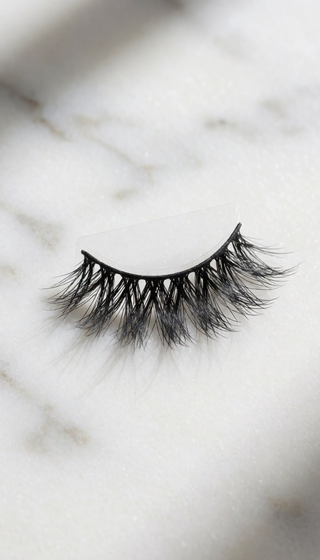
these lashes was engineered with the understanding that one size does not fit all. We designed our lashes with corrective placement in mind. Our bands are crafted from a soft, moldable material, allowing you to physically shape the lash to your unique eye angle before application. With a curated selection of styles featuring both center-heavy and outer-heavy options, you can select the precise geometry needed to achieve balance, regardless of whether you have an upward or downward tilt.
FREQUENTLY ASKED QUESTIONS
Question?
Lashes are a temporary cosmetic enhancement. They create the illusion of lift or balance while worn but do not alter the underlying muscle structure of the eye. For lasting results, consistent application of the correct style is key to maintaining the desired visual effect.
Question?
For a downward tilt, aim for lashes between 10-12 mm with a center-heavy distribution. For an upward tilt, 8-10 mm lashes with an outer-corner focus work best. Avoid extreme lengths that can pull the eye out of its natural proportion.
Question?
It is recommended to use eyeliner sparingly. A very thin line along the upper lash line can help blend the lash band seamlessly. However, avoid aggressively winging the liner in the same direction as your eye tilt, as this will emphasize the imbalance.
Question?
The key to corrective lashes is the band flexibility. Look for styles that allow you to mold the lash to your specific angle. these lashes offers styles designed to accommodate these necessary adjustments for optimal visual correction.
Question?
Always prioritize comfort and adhesion. Since these lashes utilizes a glue-free micro-adhesion technology, the process is gentle on the eye while providing the necessary hold to maintain the corrective shape throughout your wear time.
📚 Browse our complete library of lash guides →
📚 Browse our complete library of lash guides →
FIND THE PERFECT LASH FOR EVERY MOMENT
Explore our occasion-specific lash guides:
📚 Browse our complete library of lash guides →
Experience the Difference of PHANSTA LASHES
Quick to apply, gentle on eyes, beautiful all day. Reusable 30+ wears per pair.
SHOP PHANSTA LASHES — GLUE-FREE, 30+ WEARS →