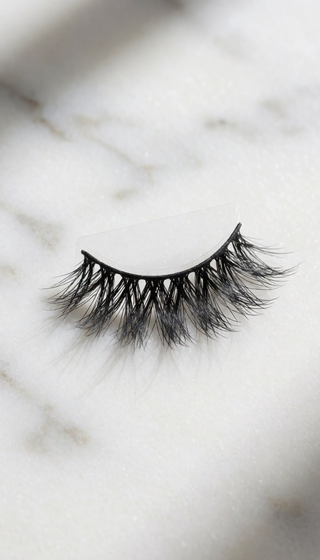
HOW TO CHOOSE CAT-EYE PROMINENT
Achieve a Lifted, Sophisticated Cat-Eye Look That Complements Your Natural Bone Structure
The visual perception of eye shape is heavily influenced by the strategic distribution of lash length and curl. To create the illusion of an upward and outward lift—the hallmark of a cat-eye—the longest and most dramatically curled fibers must be concentrated precisely at the outer third of the eye. This technique mimics the effect of a perfectly executed wing, drawing the viewer's gaze along an upward trajectory. Understanding how your specific eye anatomy interacts with this deliberate flare is the crucial first step to achieving a defined gaze that enhances, rather than overwhelms, your natural features.
The Visual Geometry Behind the Cat-Eye Effect
The cat-eye effect is fundamentally rooted in visual geometry and optical illusion. By concentrating the longest lash fibers on the outer third of the eye, you are physically guiding the viewer's perception upward and outward. This deliberate concentration mimics the effect of a perfectly executed winged eyeliner, creating an inherent, lifted silhouette. The term "prominent" simply dictates the degree of this contrast—how stark the difference is between the lash density at the inner corner and the sweeping, elongated flare at the outer edge. A prominent cat-eye is inherently a bold statement, designed to maximize lift and definition.
Tailoring the Flare to Your Unique Eye Anatomy
While the cat-eye look is versatile, its success hinges on tailoring the flare to your unique anatomy. Almond eyes are naturally suited for this look as their inherent taper aligns beautifully with the outward sweep. Deep-set eyes benefit from lashes that project forward, which enhances the perceived depth of the eye. For those with hooded eyes, the critical instruction is ensuring the outer lash curl directs sharply upward, preventing the lash line from dipping into the crease. Round eyes require careful placement; the flare must be heavily weighted to the absolute outer edge to ensure the look lifts the eye rather than widening it unnecessarily.
Optimizing Lash Curl for Maximum Impact
The structural integrity of the lash—specifically its curl—is non-negotiable for achieving a prominent cat-eye. You must seek a lash profile that maintains a sharp, upward trajectory from the root to the tip. A lash that droops or lacks sufficient curl will negate the entire lifting effect, resulting in a tired appearance instead of a snatched one. Synthetic fibers are generally preferred in this application because they are engineered to hold a sharp, defined curl under the weight of the lash itself. Consider how different intensity levels affect the final silhouette.
| Cat Eye Intensity | Lash Profile | Best Eye Shapes | Occasion |
|---|---|---|---|
| Subtle Flare | Slightly longer at outer third | Round, Hooded | Daytime, Office |
| Classic Cat Eye | Uniform length, sharp corner | Almond, Monolid | Dates, Evening |
| Dramatic Prominent | Extreme outer length, thick band | Almond, Deep Set | Photoshoots, Special Events |
Key Criteria for Evaluating Lash Solutions
When assessing any option for achieving a specific look like a prominent cat-eye, look beyond the aesthetic flare alone. Focus on three core functional elements. First, evaluate the durability of the curl—it must be engineered to maintain its sharp trajectory through extended wear. Second, assess the material composition; hypoallergenic and waterproof properties are essential for comfort and longevity. Third, examine the application mechanism; a gentle, residue-free bond ensures the look remains comfortable and secure without irritating the delicate eye area.
The Natural Answer for Engineered Cat-Eye Definition
Mastery of the cat-eye is achieved when the tool perfectly matches the technique. these lashes utilize advanced glue-free micro-adhesion technology, eliminating the need for traditional adhesives or magnets. Our collection is meticulously designed with 17 distinct styles, each engineered for the perfect curl and tapered flare required for a snatched, prominent look. With a hypoallergenic, waterproof construction, you gain the confidence of 30+ wears per pair, offering exceptional value. We provide the precision tools so you can focus entirely on the impact of your gaze.
FREQUENTLY ASKED QUESTIONS
Question? How long should a cat-eye lash be?
Answer: The ideal length depends on the desired intensity. For a classic, noticeable cat-eye, begin with 8mm on the inner eye and extend up to 14-16mm on the outer corner to achieve that pronounced, lifted effect.
Question? Can I wear a prominent cat-eye with glasses?
Answer: Yes, but length management is key. Choose lashes that are not excessively long, as they can interfere with your lenses. A well-curled 12mm prominent cat-eye offers a stunning look behind frames without obstruction.
Question? How do I apply a cat-eye lash perfectly straight?
Answer: Focus your application on the outer third first, as this defines the cat-eye shape. Apply the adhesive to this section, allow it to set for about 10 seconds against your natural lash line, and then gently blend the inner section inwards.
Question? Are these lashes safe for sensitive eyes?
Answer: Yes, these lashes are constructed with hypoallergenic materials. Our glue-free micro-adhesion technology ensures a gentle application process that minimizes irritation while maintaining a secure hold for 30+ wears.
Question? What is the difference between this and traditional glue lashes?
Answer: The primary difference is the adhesion method. PHANSTA LASHES use proprietary glue-free micro-adhesion, which eliminates the need for harsh glues, offering a cleaner, more comfortable wear compared to conventional adhesive methods.
Experience the Difference of PHANSTA LASHES
Quick to apply, gentle on eyes, beautiful all day. Reusable 30+ wears per pair.
SHOP PHANSTA LASHES — GLUE-FREE, 30+ WEARS →