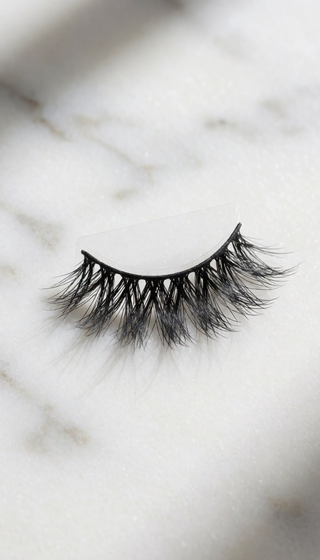
FALSE LASHES FOR HOODED EYES: LOW PLACEMENT, SHORTER LENGTH
HOODED EYES, VISIBLE LASHES: THE TWO ADJUSTMENTS THAT FIX THE FIT
If your strip keeps vanishing when you open your eye, the strip is not the problem — the placement is. Here is exactly what to change.
You apply a strip, look in the mirror, and half of it has disappeared behind the fold. Nothing is wrong with your technique and nothing is wrong with your eye. The strip is simply sitting in the one place a hooded lid covers: the skin above the lash line.
Two changes solve it. First, the band goes on the lash line itself, not above it. Second, the strip gets shorter — both the style you choose and the physical length you keep after trimming. Do those two things and a hooded eye holds lashes as well as any other eye shape.
The reasoning matters more than the rule, because hooded lids vary. Some folds sit low and heavy, others only cover the outer third. Once you understand what the crease is doing, you can adjust for your own eye instead of copying a tutorial written for someone with visible lid space.
Set the strip on the lash line, not above it, and choose a style toward the lower end of the 13–18 mm range. On a hooded eye the fold hangs over the line, so a strip placed high is covered the moment you look straight ahead.
Then trim the outer overhang. A strip that runs past your outer corner has nothing to hold it down, and that loose tail is what drops into the crease.
WHY THE CREASE SWALLOWS MOST STRIPS
A hooded lid has skin that folds down over the crease and, in many cases, over the lash line itself. When the eye is closed, that skin is stretched flat and you can see plenty of room to work. When the eye opens, the fold drops and the visible lid shrinks to a narrow band.
That is why lashes that look perfect with your eye shut can look like a thin dark line — or nothing at all — once you look straight ahead. The strip has not moved. The skin has.
Two consequences follow from this:
- Height is wasted above the line. Any band, glue line or lash base sitting more than a millimetre or two above the roots is in territory the fold owns.
- Length is wasted past the corner. The outer tail of a full strip extends beyond where your natural lashes end. There is no lash line under it, so it has nothing to grip and it curls up into the crease.
Everything else — curl, density, band thickness — is a secondary variable. Get placement and length right first and the rest becomes a matter of taste.
WHERE THE BAND HAS TO LAND
Most tutorials put the strip just above the lash line. On a hooded lid that is the one place it cannot go. The fold sits over the line, so anything above it disappears when the eye opens and lifts under the crease when you blink.
Press the band onto the line itself, close to the roots without touching the waterline. Open your eye and look straight ahead in a mirror. If you see band and no lashes, the strip is too high. Peel it off and set it lower; a soft, flexible band takes a second press without losing grip.
Order matters more here than on an unhooded eye, because you are working in a narrow strip of visible skin. Wash your face first, then do your makeup, then put the lashes on. A band pressed onto moisturiser, primer or powder will not bond, and on a hooded lid a weak bond shows up immediately as a lifted inner or outer corner.
Once the position is right, a strip goes on in about 5 seconds per eye.
MEASURE FIRST, THEN TRIM THE OUTER OVERHANG
A full strip is longer than most eyes. On a hooded lid the surplus is the problem: the tail past your outer corner has no lash line under it, so it lifts and hangs into the fold.
Measure the strip against your line before you press it on. Hold it in place with the inner end where you want it, then look at where the outer end lands. If it extends past your last natural lash, trim the outer end in steps of no more than 1 cm, keeping the outer curve intact so the silhouette still tapers.
If the inner end crowds the nose, take a little off that end too. Check the fit again with the eye open, not closed — this is the single most common mistake. A strip that fits beautifully on a closed lid can still be a centimetre too long for the space you actually have.
Trim in small increments. You can always take more off; you cannot put it back.
CHOOSING LENGTH AND DENSITY FOR A HOODED LID
Length is the variable that decides whether your lashes are visible at all. On a hooded eye, a style that is too long for your lid vanishes when you open your eye even with the band sitting perfectly on the line, because the fold covers the upper portion of the lash.
Work toward the lower end of the 13–18 mm range and go up only if you can still see the tips with your eye open. Every style in a well-built range typically carries the same natural curl, so the variable you are actually choosing between is length, density, taper and where the longest lashes sit — not curl.
Density decides how much band you see. A band is thin but not invisible, and on some hooded eyes it reads as a soft liner line. A style with more separation between the lashes shows the band less than the densest option. That is a look, not a fault, but choose with it in mind.
Where the longest lashes sit also matters. A style that peaks in the centre opens the eye; a style that peaks at the outer corner elongates it. On a hooded lid, a centre or mid-outer peak usually reads as more visible when the eye is open.
WHEN THE STRIP SLIDES OR KEEPS DISAPPEARING
A band that keeps sliding down into the crease has usually lost its grip rather than its position. Rinse it with warm water and dry it with a hair dryer to refresh the hold, then try again. In cold weather, warm the strips with a hair dryer before wearing — a cold band is a stiff band and a stiff band does not conform to a curved lash line.
If the strip is holding but you still cannot see it, the problem is length, not adhesion. Drop down a size or two and re-check with the eye open.
Treat lashes as a day pair. Take them off at the end of the day; they do not survive a night's sleep, and sleeping in them is what shortens their usable life. Store them in the case, keep them away from oil-based products, and clean the band gently between wears.
Finally, be honest about the shape of your fold. If your lid covers the lash line almost completely, no strip will show much — and that is a lid characteristic, not a failure of the product or your application.
WHAT TO LOOK FOR IN A HOODED-EYE LASH
With the mechanics clear, here is the checklist to judge any lash against — whatever brand you end up choosing.
- A band that presses onto the line and can be re-pressed. You will reposition on the first try, and probably the second. A band that only gives you one shot is the wrong band for this eye shape.
- Length options at the shorter end. If the range starts at 15 mm and goes up, it was not designed with hooded lids in mind.
- Visible separation between lashes. Density hides the band; separation disguises it.
- A trim-friendly outer curve. You need to shorten the strip without the silhouette collapsing into a blunt wall.
- Reusability with a refresh routine. A pair you can clean and re-press is worth more than three pairs you throw away.
- No glue, no magnets, no liner. Each of those adds a step, a drying time or a potential irritant right where a hooded lid is most sensitive.
Hold any option against those six points and the shortlist gets short fast.
Seventeen styles built to sit on the lash line rather than above it — glue-free micro-adhesion, 30+ wears per pair, about five seconds per eye.
Everything above describes a lash that presses onto the line, comes in short lengths, trims cleanly at the outer corner, and can be re-pressed when you get the placement wrong the first time. That is the specification PHANSTA LASHES was built to.
PHANSTA LASHES: LASHES YOUR HOOD CAN'T SWALLOW
The band uses micro-adhesion — no glue, no magnets, no liner — so there is no drying time and nothing wet near the waterline. The strip presses on, lifts off if you need to reposition, and presses back down. Seventeen styles run across the length and density range, including the shorter, more separated options a hooded lid needs.
Three things people ask before they commit:
- Will it irritate my eyes or damage my lashes? The band is hypoallergenic and waterproof, and it attaches by micro-adhesion rather than adhesive. Nothing is glued to your natural lashes, so there is nothing to pull off at the end of the day.
- How long does a pair actually last? 30+ wears with the care routine above — rinse, dry, store in the case, never sleep in them.
- Is it worth the outlay? A pair is $59. Across 30+ wears that works out under $2 per wear, which is roughly the cost of a single drugstore strip you throw away once.

PHANSTA Lashes
17 styles, $59 a pair, 30+ wears. Glue-free, hypoallergenic, waterproof.
SEE THE 17 STYLESIf the placement and the trim are right and it still does not suit your eye, the 30-day money-back guarantee covers it.
FREQUENTLY ASKED QUESTIONS
How do I stop the outer corner lifting on a hooded eye?
Trim the outer end so the last lash lands at your corner. A tail hanging past it has no lash line to hold it and will lift into the fold. Measure with the eye open, trim in steps of no more than 1 cm, and keep the outer curve so the taper survives.
Do I need a different curl for hooded eyes?
No. Curl is rarely the deciding variable. What changes between styles is length, density, taper and where the longest lashes sit. On a hooded lid, length and placement do almost all of the work — a shorter strip set on the line beats a longer one set higher every time.
Why does the band show as a dark line on my lid?
The band is thin but not invisible, and on some hooded eyes it reads as a soft liner line. A style with more separation between the lashes shows it less than the densest option. If the line bothers you, choose a sparser style rather than a shorter one.
How short should I trim a strip for a hooded eye?
Short enough that the outer end stops at your last natural lash. Hold the strip against your line, mark where your lashes end, and trim from the outer edge in small increments. Most people remove between 2 and 5 mm, but measure rather than guess.
Can I wear false lashes if my lid folds over the lash line completely?
Yes, but expect a subtle result. When the fold covers the line almost entirely, only the tips show with the eye open. Choose the shortest length in the range, set the band directly on the line, and treat the effect as an enhancement rather than a dramatic change.
Lashes that sit on the line instead of behind the fold.
17 styles, $59 a pair, 30+ wears — under $2 per wear. Glue-free micro-adhesion, hypoallergenic, waterproof, no magnets and no liner.
SHOP PHANSTA LASHES — GLUE-FREE, 30+ WEARS →STILL COMPARING OPTIONS? Explore our guides on finding your perfect lash, magnetic vs strip, and sensitive eyes.
FIND THE PERFECT LASH — Not sure which style suits you? Take the 30-second lash finder quiz →
NOT SURE ABOUT YOUR EYE SHAPE?
Find your eye shape and get personalized lash recommendations:
FIND THE PERFECT LASH FOR EVERY MOMENT
Explore our occasion-specific lash guides:
EXPERIENCE THE DIFFERENCE
Join thousands of women who have made the switch. No glue, no damage, no salon appointments — just beautiful lashes in seconds.
SHOP PHANSTA LASHES →