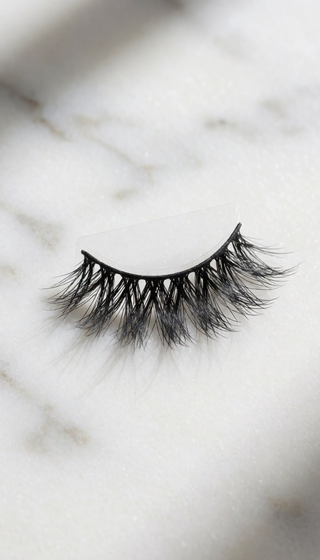
LIFTING THE GAZE: FLARED LASH SOLUTIONS FOR DOWNTURNED EYES
Visually Lift the Outer Corner of Downturned Eyes
If your outer eye corner appears to drop below the inner corner, you are dealing with an inferior canthal tilt. The goal of cosmetic correction is to introduce an upward visual vector that optically counteracts this natural downward pull, creating the illusion of a lifted gaze without altering your natural anatomy.

Understanding the Anatomy of the Downturned Eye
The visual perception of a downturned eye is rooted in the lateral canthus—the outer corner of the eye. When this point slopes downward, it sets a resting expression that can be perceived as soft or heavy. The correction required is purely optical; it involves strategically placing elements to shift the visual weight upward, creating a perceived lift.
How Lash Structure Creates an Optical Lift
A flared lash style achieves its effect through a deliberate gradient in length and curve. By anchoring the inner eye with shorter, more subtle strands (typically 6mm to 8mm), you maintain a balanced base. The key to the lift is then achieved by progressively increasing the length of the lashes toward the outer corner, often reaching 12mm to 14mm. This intentional length gradient mimics the structure of a naturally lifted eye by creating a visible upward sweep.
- Balanced Inner Corner: Short strands at the inner corner prevent the eye from appearing weighed down or overly dramatic.
- Outer Vector Lift: The increased length at the outer edge physically stretches the visual line upward, directly countering the natural downward tilt.
- Curvature Impact: Utilizing an L-curl gradient ensures that the lift is not just a straight line, but a visible, sweeping curve that persists throughout the wear cycle.
Precision in Application for Maximum Correction
The effectiveness of this optical correction relies heavily on precise placement. The lash band must be applied flush against the natural lash line, extending seamlessly from the inner to the outer corner. Any gap, particularly at the outer edge, creates a shadow that visually reinforces the downturn rather than lifting it. For optimal alignment, it is helpful to check the placement using a mirror positioned below eye level to clearly view the full outer corner.
- Apply the lash starting at the outer corner first to establish the primary lift vector.
- Ensure the band follows the natural contour of the lash line, avoiding a rigid, straight application.
- Allow the bond to fully activate for a minimum of 15 seconds before opening the eye completely to ensure secure adhesion.
Selecting the Right Lash System for Your Needs
When choosing a lash system, look for a design that incorporates a significant flare on the outer edge, often utilizing a reinforced strip structure. The ideal system will feature a density (like 4D fiber) that allows the flare to maintain its structural integrity without needing supplemental products like liquid liner to artificially thicken the appearance. Furthermore, the curl profile must be an L-curl or M-curl to provide the necessary upward trajectory.
Factors to Consider When Choosing a Lash Solution
Beyond the flare, consider the adhesion mechanism. For those concerned about irritation or damage, systems that rely on micro-adhesion technology are preferable to traditional glue. These systems are designed to adhere securely to the natural lash without harsh chemicals. Durability is also key; look for systems rated for multiple wears to ensure consistent results over time. Finally, verify that the product is hypoallergenic, especially if you have sensitive eyes.
The these lashes Difference: Engineered for Lift and Comfort
these lashes have engineered its collection specifically to address the visual needs of the downturned eye. Our styles feature the precise L-curl gradient and reinforced outer flare necessary to create an immediate, visible lift. Utilizing advanced micro-adhesion technology, we ensure that this structural lift is achieved without the use of harsh glues, making the experience comfortable and safe for sensitive eyes, while providing the durability you need for 30+ wears.
FREQUENTLY ASKED QUESTIONS
Are downturned eyes the same as hooded eyes?
No. Hooded eyes are characterized by excess skin folding over the eyelid crease. Downturned eyes specifically refer to the downward slope of the outer corner of the lash line. A flared lash is the targeted cosmetic solution for correcting that specific canthal tilt.
Can I use a straight lash on a downturned eye?
Using a straight lash will likely follow the existing downward trajectory of your natural lash line, which can inadvertently make the downturn appear more pronounced. To achieve the necessary visual lift, an L-curl or M-curl is essential to create the required negative space and upward vector.
Can I cut the lash band for a tighter fit?
Yes, you can customize the fit. However, when trimming, always cut the band from the outer corner, never the inner corner. Removing the short strands from the inner side compromises the balanced profile needed to achieve the desired downturned lift effect.
How long do these adhesive lashes last?
PHANSTA LASHES are designed for extended wear. With our micro-adhesion technology, users can expect 30+ wears from a single set, providing consistent, long-lasting results without the need for daily reapplication or harsh adhesives.
Are these lashes safe for sensitive eyes?
Yes, PHANSTA LASHES are formulated to be hypoallergenic. We utilize a glue-free micro-adhesion system, which minimizes irritation and ensures a gentle experience for even the most sensitive eyes.
📚 Browse our complete library of lash guides →
NOT SURE ABOUT YOUR EYE SHAPE?
Find your eye shape and get personalized lash recommendations:
No adhesive, no damage. Just beautiful lashes.
SHOP PHANSTA LASHES — GLUE-FREE, 30+ WEARS →STILL COMPARING OPTIONS? Explore our guides on finding your perfect lash, magnetic vs strip, and sensitive eyes.
FIND THE PERFECT LASH — Not sure which style suits you? Take the 30-second lash finder finder →