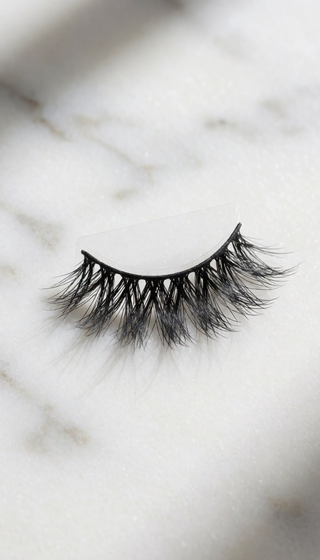
CHOOSE A LASH METHOD THAT PROTECTS YOUR NATURAL LASH CYCLE FOR YEARS
False lashes vs magnetic lashes vs extensions — compared by adhesion, weight, upkeep, and follicle health, so you can protect the lashes you already have.
The lash method least likely to thin your natural lashes is the one that avoids solvent adhesive, adds the least weight, and comes off without tugging. That sounds simple, but most comparisons focus on the day-one look and skip the part that matters: what repeated wear does to the follicle over months.
NOT SURE ABOUT YOUR EYE SHAPE?
Take our 60-second quiz to find your perfect lash match — no glue, no commitment.
TAKE THE QUIZ →Your natural lashes grow in cycles — growth, transition, rest, then shedding — and most people lose roughly one to five lashes a day as part of normal renewal. Any method that pulls, weighs down, or chemically irritates the follicle disrupts that cycle quietly. The damage usually shows up months later as visible thinning, not as an immediate warning.
If you have fought with sticky adhesive, red lids, or a salon schedule that swallowed your calendar, you are not doing it wrong. The choice becomes much clearer once you understand how adhesion, weight, and upkeep interact with the way lashes actually grow.
THE SCIENCE OF LASH ATTACHMENT: HOW EACH METHOD INTERACTS WITH YOUR GROWTH CYCLE
Every lash technique relies on a different physical principle: chemical bonding, magnetic attraction, or glue-free micro-adhesion. That hidden interaction separates a sustainable daily habit from a damaging routine, regardless of how good the result looks in a mirror.
Physical weight matters. A typical strip lash band carries measurable mass, and magnetic systems add metal on top of it. Over many hours, that constant downward force is something fine or sparse natural lashes register immediately. Bond strength must also be balanced against skin sensitivity: the strongest bond is not automatically the best bond, because a hold that is too aggressive can take natural lashes with it on removal.
The growth cycle makes the trade-off concrete. Because shedding is continuous and staggered across the lash line, repeated pulling or chemical stress compounds silently. The follicle cannot signal distress until thinning becomes visible, which is exactly why method choice matters more than the day-one look.
TRADITIONAL STRIP LASHES: THE ADHESIVE BOND
Traditional false lashes use a specialised adhesive to secure a pre-made band of fibres along the natural lash line. The method offers high versatility in style and density, from subtle enhancement to full glam, and it is usually the most accessible way to experiment. Application requires a brief waiting period for the adhesive to reach optimal tack, plus a steady hand for the first few attempts.
The chemical composition of the glue is the most critical factor. Solvents in many lash adhesives can trigger contact dermatitis, redness, or itching, making the adhesive itself the most common point of failure for daily wear. Latex-based formulas are a frequent culprit for reactive eyes. If your eyes are sensitive, patch-test a new adhesive on the inner arm twenty-four hours before first use, never share a tube, and replace it well before the tube gets stringy.
MAGNETIC LASHES: WEIGHT, ALIGNMENT, AND LINER SENSITIVITY
Magnetic lash systems replace liquid glue with small embedded magnets, applied as strips that align around the natural lashes so magnetic attraction holds them in place. The design eliminates drying time and removes the risk of solvent irritation entirely, which is why the category grew quickly among people who react badly to adhesive.
The trade-off is physical mass. Magnets exert a constant downward pull on the natural lash, and on lashes that are naturally fine or sparse, that sustained weight can lead to discomfort or premature shedding by the end of a long day. Some two-piece systems also require a magnetic eyeliner along the lid, adding another product that sensitive eyes may not tolerate. Application is generally faster than adhesive strips, though proper alignment still takes practice.
SALON EXTENSIONS: THE TIME-AND-UPKEEP TRADE-OFF
In the extension method, a trained professional applies individual synthetic fibres to each natural lash using a semi-permanent adhesive, creating a seamless effect that mimics natural growth patterns. It delivers the most natural-looking result of the three — but only with consistent upkeep and correct technique.
The commitment is real: a full set takes 90 to 120 minutes in the chair, and maintenance requires professional fills every two to three weeks. You must avoid oil-based products and waterproof mascara, which can degrade the bond, and you should never pick or pull at the fibres yourself. Technique matters enormously — overweighted fans or bonds placed too close to the lid are the usual causes of stress on natural lashes, not the concept of extensions itself.
COMPARE ADHESION, WEIGHT, AND UPKEEP AT A GLANCE
| Method | Adhesion | Weight on lash | Upkeep |
|---|---|---|---|
| Strip lashes | Liquid adhesive | Band mass | Daily apply and remove |
| Magnetic lashes | Embedded magnets (sometimes plus liner) | Band mass plus magnets | Daily apply and remove |
| Salon extensions | Semi-permanent professional adhesive | Fibre weight per natural lash | Fills every 2–3 weeks |
REMOVAL, RECOVERY, AND TRUE COST OF OWNERSHIP
THE REMOVAL PROTOCOL
The way you remove lashes is just as vital as how you apply them. Never peel lashes off while they are dry — always soften the bond first with a gentle, oil-free remover or warm water, then slide the enhancement away from the lash line. Pulling or twisting rips out natural lashes, and repeated trauma is a leading cause of long-term lash loss across every category. After use, clean the band thoroughly and store the lashes in a dedicated case to keep them hygienic and ready for reuse.
With salon extensions, never pick or pull at the bonded fibres yourself. If you notice shifting bonds or feel tension on your natural lashes, professional removal is necessary. Give your natural lashes a recovery period between sets — even two to three weeks — so the follicle cycle can reset and cumulative stress does not build.
CALCULATING TRUE COST PER WEAR
The upfront expense of a lash set rarely reflects the true cost of ownership. For reusable strips, divide the cost by the realistic number of wears the band can handle — a set rated for dozens of wears delivers a far lower cost per day than a cheap set designed for a single use. With salon services, weigh the application cost against recurring fills: at every two to three weeks, that is roughly seventeen to twenty-six appointments a year, plus travel time and the occasional full replacement set.
RISK VS. ROUTINE: THE MAINTENANCE TRADE-OFF
Every method carries distinct risks. Adhesive products carry chemical irritation risk; magnetic and extension methods shift the risk toward physical stress — the constant weight of magnets or the tension of a bonded fibre. Neglecting removal is a common cause of lash loss in every category. The safest method is ultimately the one whose maintenance routine you will actually follow, consistently, for years.
MATCHING THE METHOD TO YOUR LASH TYPE AND ROUTINE
Fine, sparse, or post-extension lashes need the lightest possible option — anything that adds mass or requires a solvent bond is a poor fit. Reactive or allergy-prone eyes should rule out adhesive and magnetic liner entirely and look for a hold that relies on neither. Anyone with a packed calendar should weigh appointment frequency as heavily as the look itself, because a method you cannot maintain consistently becomes a source of stress rather than a shortcut.
A practical test: imagine the routine on your worst week, not your best one. If the method still fits — no appointment to reschedule, no drying time to protect, no adhesive to re-buy — it is likely sustainable. If it only works on a calm Sunday, it will quietly erode your natural lashes the rest of the month.
WHAT TO LOOK FOR IN A SUSTAINABLE LASH SOLUTION
Use five criteria to filter any lash method before you commit. First, adhesion without solvent: the hold should not depend on a wet glue that can irritate the lid. Second, low, evenly distributed weight: the lash line should not feel pulled down by the end of the day. Third, removal without tugging: the lash should release cleanly with warm water or a gentle remover, not force. Fourth, a maintenance schedule you can realistically keep. Fifth, reusability, because a set that can be worn many times changes the long-term math.
- Adhesion: no solvent adhesive, no aggressive bond that grips the follicle.
- Weight: minimal mass, distributed so fine lashes are not strained.
- Removal: releases without peeling, twisting, or pulling.
- Upkeep: fits your actual routine, not an ideal one.
- Reuse: holds shape and hygiene across many wears.
If a method fails any one of those tests, the damage compounds quietly. The ideal system holds securely with minimal mass, avoids wet adhesive and magnetic hardware, and comes off without trauma.
THE METHOD THAT PASSES ALL FIVE TESTS: PHANSTA LASHES
This is where PHANSTA LASHES fits the criteria above. Instead of glue, magnets, or liner, PHANSTA LASHES use glue-free micro-adhesion — a dry, mechanical hold that sits along the lash line without solvent, without metal hardware, and without a wet drying period. The result is a lash that goes on in seconds per eye and lifts away with warm water, no peeling and no tugging at the follicle.
The range covers 17 styles, from barely-there natural to full volume, so the method can be matched to your eye shape rather than the other way around. Each set is hypoallergenic and waterproof, rated for 30+ wears, and at $59 that works out to under $2 per wear — the reusability criterion doing the heavy lifting on long-term cost. No appointments, no fills, no adhesive to replace.
THE THREE THINGS PEOPLE ASK BEFORE SWITCHING
- Will it irritate my eyes or need glue? No glue, no magnets, no liner. The hold is micro-adhesion, and the lashes are hypoallergenic — the two most common reasons people abandon adhesive and magnetic systems simply do not apply.
- How long will a set actually last? 30+ wears per set with normal care — clean the band after each use and store it in its case. That is months of wear from one pair, not a single night.
- Is it worth the upfront cost? At $59 for 30+ wears, it lands under $2 per wear — less than a single salon fill, and there is no recurring appointment to budget for.

FREQUENTLY ASKED QUESTIONS
Are glue-free lashes gentler than strip lash adhesive?
For most people, yes. Strip adhesive relies on a solvent bond that has to be softened before removal, and that step is where tugging happens. A glue-free micro-adhesion hold releases with warm water, so there is no dried glue to pull against the natural lash or the lid.
Do magnetic lashes damage natural lashes?
The magnets themselves are not the main concern — the added weight is. Magnetic strips carry band mass plus metal, and that constant downward pull can strain fine lashes over a long day. If your lashes are sparse or you wear lashes daily, a lighter attachment method is usually the safer choice.
How often do salon extensions need maintenance?
Fills are typically needed every two to three weeks as natural lashes shed and the bond grows out. That works out to roughly seventeen to twenty-six appointments a year. Skipping fills or picking at loose fibres is what causes most extension-related lash damage, not the extensions themselves.
What is the real cost per wear of each method?
Divide the upfront cost by the number of wears you realistically get. Single-use strips are cheap per pack but expensive per wear; extensions carry recurring fill costs plus travel time. A reusable set rated for 30+ wears spreads the cost far thinner over a year of daily use.
Can I wear lashes every day without thinning my natural ones?
Yes, if the method avoids solvent adhesive, keeps weight low, and comes off without force. Daily wear is not the problem — repeated pulling and chemical irritation are. Whatever you choose, soften the bond before removal, never peel dry, and clean and store the set between wears.
STILL COMPARING OPTIONS? Explore our guides on finding your perfect lash, magnetic vs strip, and sensitive eyes.
FIND THE PERFECT LASH — Not sure which style suits you? Take the 30-second lash finder quiz →
17 styles · $59 · under $2 per wear · seconds per eye, no glue, no magnets, no liner.
NOT SURE ABOUT YOUR EYE SHAPE?
Find your eye shape and get personalized lash recommendations:
FIND THE PERFECT LASH FOR EVERY MOMENT
Explore our occasion-specific lash guides:
EXPERIENCE THE DIFFERENCE
Join thousands of women who have made the switch. No glue, no damage, no salon appointments — just beautiful lashes in seconds.
SHOP PHANSTA LASHES →