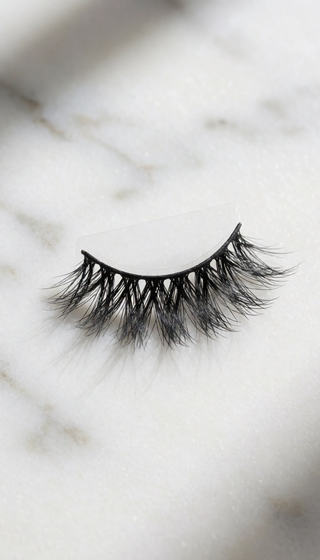
PICK THE PERFECT LASH STYLE FOR YOUR EYE SHAPE — DOLL-EYE OR CAT-EYE
Choosing between doll-eye and cat-eye lashes comes down to one thing: where the longest fibers sit on the band. Doll-eye lashes are longest through the center or inner half of the band, which opens the eye and makes it look rounder and wider. Cat-eye lashes are longest at the outer corner, which lifts the eye and creates a subtle winged effect. If you want a bright, wide-awake look, go doll-eye. If you want lift and elongation, go cat-eye. The right choice depends on your natural eye shape, the look you're after, and how much daily effort you want to spend. Here's how to decide — plus how to apply either style so it actually lasts.
WHAT DOLL-EYE LASHES DO
Doll-eye lashes place their longest fibers in the center or slightly toward the inner third of the lash line. This placement mimics the natural growth pattern of a wide-open eye: light catches the center, the iris appears larger, and the whole eye reads as rounder and more awake.
The style works by adding volume where the eye is already widest, so the effect is soft and blended rather than dramatic. It's the go-to choice when the goal is openness rather than length — think fresh, youthful, wide-eyed rather than sultry.
Doll-eye styles tend to suit:
- Round eyes that need more length than width
- Close-set eyes, since center volume draws attention inward
- Anyone who finds winged or outer-corner styles too dramatic for daily wear
- Short or sparse natural lashes that need fullness across the whole band
WHAT CAT-EYE LASHES DO
Cat-eye lashes keep the inner corner short and gradually build length toward the outer corner, ending in a defined flick or cluster at the edge. That outer weight visually pulls the eye upward, creating the lifted, feline silhouette the style is named for.
Because the length sits at the outer corner, the eye appears longer and slightly almond-shaped. The effect ranges from subtle — a gentle taper with a small flick — to bold, with dramatic outer clusters that replace eyeliner entirely.
Cat-eye styles tend to suit:
- Downturned eyes that need lift at the outer corner
- Hooded eyes, where outer-corner length stays visible when the lid is relaxed
- Almond eyes that want more drama without changing their natural balance
- Anyone who wants a winged effect without drawing eyeliner every morning
MATCH EACH STYLE TO YOUR EYE SHAPE
Neither style is universally better — each corrects a different feature. Use this quick guide:
- Round eyes: doll-eye adds balanced fullness; a soft cat-eye taper also works if you want slight lift.
- Almond eyes: both styles work; choose based on mood — doll-eye for openness, cat-eye for drama.
- Hooded eyes: cat-eye wins. Length at the outer corner stays visible even when the lid covers the center.
- Monolids: cat-eye's outer flick creates definition where a center-heavy style can disappear.
- Downturned eyes: cat-eye lifts; avoid styles that are longest in the center, which can emphasize the drop.
- Close-set eyes: doll-eye's center volume draws the eye inward and balances spacing.
- Wide-set eyes: a gentle cat-eye elongates without pulling focus outward.
Still unsure? Apply one style, look straight into a mirror, then swap. The style that makes your eyes look more open — not just more decorated — is the one to keep. It also helps to photograph both styles in natural light; camera light reveals balance that bathroom lighting hides.
DOLL-EYE VS CAT-EYE: SIDE-BY-SIDE COMPARISON
| Feature | Doll-Eye | Cat-Eye |
|---|---|---|
| Longest point | Center / inner half | Outer corner |
| Main effect | Opens, rounds, widens | Lifts, elongates, wings |
| Best for | Round, close-set eyes | Hooded, downturned, monolid |
| Drama level | Soft to moderate | Moderate to bold |
| Eyeliner needed? | Optional | Often replaced by the flick |
One more variable: density. A dense doll-eye reads glamorous but can weigh down a fine natural lash; a wispy cat-eye reads natural but may not show on deep-set eyes. Match density to your natural lash fullness, not to the look in the photo.
APPLICATION TIPS FOR BOTH STYLES
- Measure before you trim. Hold the band against your lash line and trim from the outer corner only — cutting the inner corner ruins the fit.
- Let the band reach room temperature. Thirty seconds out of a cold drawer helps any band — adhesive or micro-adhesion — grip evenly along the whole lash line.
- Press, don't slide. Set the band in place and press down in sections — inner, center, outer — for five seconds each.
- Check the outer corner first. Most lifts happen because the outer edge wasn't fully seated; press it again before mascara.
- Use an applicator, not fingertips. A lash tool or tweezers gives you the precision that placement-dependent styles demand.
- Remove gently. Lift the band up and away from the lash line rather than pulling the fibers, and store the pair in its tray to keep the curve.
COMMON MISTAKES TO AVOID
- Trimming from the inner corner — it shortens the fibers your style depends on.
- Wearing the cat-eye flick on the wrong eye — the longest cluster always faces the outer corner.
- Ignoring band stiffness — a rigid band gaps on curved lids no matter how good the fibers look.
- Overloading adhesive — extra product only makes removal harder and shortens the life of the pair.
- Choosing drama over wearability — the best style is the one you'll actually put on at 7 a.m.
WHAT TO LOOK FOR IN A LASH STYLE
Once you know which style suits you, evaluate any lash against five criteria:
- Band flexibility — a soft, flexible band curves to your lid and stays put without gaps.
- Fiber placement — the longest fibers should sit exactly where your chosen style needs them: center for doll-eye, outer corner for cat-eye.
- Reusability — quality fibers and a sturdy band survive repeated removal and cleaning, which is where real value per wear comes from.
- Attachment method — traditional glue works but irritates sensitive eyes and slows down every routine. Glue-free micro-adhesion bands that grip without adhesive have become the standard for anyone wearing lashes daily.
- Style range — a collection that offers both doll-eye and cat-eye cuts lets you switch looks without relearning application.
If a lash checks the first three boxes but still needs glue to stay on, you'll pay for it in comfort and time.
GET THE DOLL-EYE OR CAT-EYE LOOK WITHOUT GLUE, IRRITATION, OR DAILY REAPPLICATION
Three reasons wearers switch — and stay:
- Glue-free comfort: no adhesive means no irritation, no sticky residue, and no damaged natural lashes — the number-one complaint with traditional strip lashes.
- 30+ wears per pair: the micro-adhesion band and durable fibers hold up to repeated use, so one pair replaces dozens of disposable ones.
- Under $2 per wear: at $59 for 30+ wears, each pair costs less per use than a cup of coffee — the value argument glue lashes never make.
PHANSTA LASHES is built on the two lessons above: placement that flatters your eye shape, and an attachment method that doesn't punish your lids. Every pair uses glue-free micro-adhesion — a slim band that grips the lash line directly, with no glue, no magnets, and no liner required. The result goes on in seconds per eye and peels off cleanly, every single time.
With 17 styles spanning doll-eye, cat-eye, and everything in between, there's a pair for every eye shape and occasion. The full range is hypoallergenic and waterproof, so sensitive eyes and long days are both covered. Join the thousands of wearers who've dropped glue for good — five-star comfort, every single wear.
SHOP PHANSTA LASHES — GLUE-FREE, 30+ WEARS →

FREQUENTLY ASKED QUESTIONS
What is the main difference between doll-eye and cat-eye lashes?
Doll-eye lashes are longest in the center or inner half of the band, which opens the eye and makes it look rounder. Cat-eye lashes are longest at the outer corner, which lifts the eye and adds a winged effect. Choose doll-eye for openness and cat-eye for lift and elongation.
Are doll-eye lashes a good choice for hooded eyes?
Hooded eyes usually benefit more from cat-eye styles, because length at the outer corner stays visible when the lid is relaxed, while a center-heavy doll-eye can hide. If you love the doll-eye look, choose moderate center volume with a subtle outer flick.
Can you wear cat-eye lashes every day?
Yes — cat-eye is one of the most wearable styles, because the outer flick reads as polished rather than dramatic at normal volume. Choose a lightweight band and a soft taper for daily wear, and save bold outer clusters for evenings.
How do glue-free lashes stay on without adhesive?
Glue-free lashes use a micro-adhesion band: a slim strip that grips the natural lash line through gentle surface contact, similar to how a sticker clings without wet glue. No magnets, no liner, and no sticky residue — they peel off cleanly and re-grip for the next wear.
How many times can you reuse a quality pair of lashes?
With careful removal and cleaning, a well-made pair lasts 30+ wears. Remove with gentle pressure, peel any residue from the band, and store the pair in its original tray to keep the curve intact. Avoid soaking the band or pulling the fibers.
STILL COMPARING OPTIONS? Explore our guides on finding your perfect lash, magnetic vs strip, and sensitive eyes.
FIND THE PERFECT LASH — Not sure which style suits you? Take the 30-second lash finder quiz →
NOT SURE ABOUT YOUR EYE SHAPE?
Find your eye shape and get personalized lash recommendations:
FIND THE PERFECT LASH FOR EVERY MOMENT
Explore our occasion-specific lash guides:
EXPERIENCE THE DIFFERENCE
Join thousands of women who have made the switch. No glue, no damage, no salon appointments — just beautiful lashes in seconds.
SHOP PHANSTA LASHES →