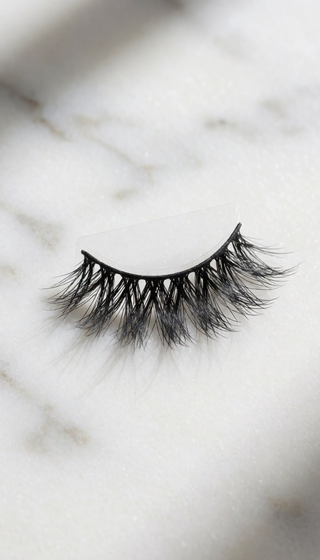
DOES LASH GLUE EXPIRE? MYTH ABOUT OLD ADHESIVES
KNOW IN UNDER A MINUTE WHETHER YOUR LASH GLUE IS STILL SAFE — OR PAST ITS PRIME
A SIMPLE, SCIENCE-BACKED WAY TO READ YOUR ADHESIVE'S TRUE CONDITION — SO EVERY APPLICATION STAYS STRONG, COMFORTABLE, AND IRRITATION-FREE
Yes — lash glue expires, and the countdown starts the moment you open the tube. That half-used bottle hiding in your makeup drawer? Its chemistry is already changing, even when it still looks perfectly normal. If you have ever asked whether an old tube is "probably fine," you are not alone — and the answer matters more than most people realize.


NOT SURE ABOUT YOUR EYE SHAPE?
Take our 60-second quiz to find your perfect lash match — no glue, no commitment.
TAKE THE QUIZ →Degraded adhesive is one of the most common — and most overlooked — causes of failed lash applications, stinging, and redness. The good news: your adhesive tells you exactly what is happening inside the tube, if you know what to look for. In the next few minutes, you will learn the science behind the breakdown, how to spot every warning sign in under a minute, and how to make your adhesive last as long as safely possible.
THE CHEMISTRY OF LASH BONDING AND DEGRADATION
Lash adhesives function through a chemical process known as polymerization. This is essentially a chain reaction where liquid monomers link together to form long polymer chains, creating the durable bond between the lash strip and your natural lashes. This reaction is triggered by moisture, even the trace amounts present in the air. When you open a tube, you expose the adhesive to this moisture, and while the cap slows the process, it cannot stop it entirely.
Over time, monomers near the opening begin polymerizing prematurely. This premature linking results in the stringy, clumpy, or watery texture often found at the bottom of an older tube. Simultaneously, the volatile solvents that keep the formula smooth begin to evaporate into the surrounding air, which changes the consistency and sharply reduces the adhesive's intended hold. An adhesive that has passed its prime has fundamentally altered chemistry, not just a temporary dip in performance.
When stored unopened in a cool, dark environment, most professional adhesives maintain stability for a significant period, often exceeding a year. However, once the seal is broken, even the highest quality formula begins a degradation process within weeks. This is why many professionals recommend marking and retiring their tubes after a set number of uses, as environmental factors like temperature fluctuations accelerate this chemical decline.
FACTORS THAT ACCELERATE ADHESIVE BREAKDOWN
The lifespan of any adhesive is heavily influenced by its environment. Heat, humidity, and airborne contaminants are the primary accelerators of this breakdown.
A tube left in a hot car or on a sunny vanity will degrade dramatically faster than one kept in a cool, dark space. Heat speeds up evaporation and pushes the polymerization reaction forward more rapidly. Furthermore, every time you apply lashes, you introduce bacteria from your skin and the air into the tube, creating an environment where contamination can thrive. Each time the cap is removed, fresh moisture interacts with the surface, curing the top layer slightly more, which contributes to texture changes.
Oxygen exposure plays a quieter but equally destructive role. Trace air inside the tube slowly oxidizes the adhesive, leading to a darkening of its color and a thinning of its grip. A tube left uncapped overnight can lose a significant amount of its remaining solvent by morning, resulting in a thick, unusable consistency even if it was only used briefly. Prompt capping after every single use is a critical habit for preserving formula integrity.
IDENTIFYING THE SIGNS OF COMPROMISED ADHESIVE
Your adhesive provides clear visual and sensory indicators as it degrades. Recognizing these cues allows you to prevent application failure or eye irritation.
- Color Shift: Fresh adhesive is typically clear or dark brown. Any noticeable yellowing or gray tint suggests oxidation is occurring within the formula.
- Consistency Change: If the glue appears stringy, clumpy, or refuses to dispense smoothly, the chemical structure is already compromised and its bonding power is diminished.
- Odor Change: An unusual sour or sharply chemical smell indicates that the solvents within the adhesive are beginning to decompose.
- Application Reaction: Any stinging, redness, or swelling during application signals chemical breakdown or bacterial contamination. Discard the tube immediately and do not apply near your eyes.
THREE QUICK CHECKS BEFORE EVERY APPLICATION
- The Bead Test: Squeeze a small drop onto a clean, non-porous surface. Fresh adhesive will form a neat, rounded bead that maintains its shape; degraded glue will spread thinly or string as you pull away.
- The Skin Test: Dab a tiny amount on the back of your hand and wait thirty seconds. Any sensation of stinging, warmth, or redness indicates the formula has broken down or become contaminated—do not apply near your eyes.
- The Sniff Test: Compare the odor to the smell when you first opened the tube. A sharper, more sour odor signals that solvents are decomposing and the chemistry has shifted away from its original state.
These three simple checks take less than a minute and can prevent an entire application from being compromised by faulty adhesive. When any warning sign appears, stop using the tube; degraded adhesive holds poorly and poses a risk of irritation to the delicate skin around your eyes.
MYTH VS. FACT: DEBUNKING ADHESIVE LASH MYTHS
-
Myth: "If the glue still dispenses, it's fine."
Fact: Bonding strength drops significantly well before the formula visibly changes. By the time you see stringiness, it is long past its peak performance. -
Myth: "Waterproof glue never expires."
Fact: Waterproofing adds polymers to resist moisture, but this does not halt solvent evaporation or bacterial contamination occurring inside the sealed tube. -
Myth: "Adding a drop of water revives thickened glue."
Fact: Water actively triggers more polymerization—the exact chemical reaction causing the thickening—thereby worsening the problem. -
Myth: "Expired glue is just less sticky, not dangerous."
Fact: Degraded adhesive and any potential bacterial growth within the tube can cause redness, swelling, and significant irritation around the eye area. -
Myth: "Refrigerating glue makes it last forever."
Fact: Cold temperatures slow but do not stop polymerization, and condensation introduces moisture—the precise trigger that hardens cyanoacrylate. Cool, dark, room-temperature storage is superior to refrigeration.
OPTIMIZING STORAGE TO MAXIMIZE ADHESIVE LIFE
To extend the usable life of any adhesive, you must actively control its chemical environment:
- Store adhesive in a cool, dark cabinet, ensuring it is completely away from direct sunlight and heat sources.
- Replace the cap immediately after every single use to minimize air and moisture exposure.
- Keep the tube upright to prevent the formula from pooling near the opening, which accelerates surface curing.
- Avoid high-humidity environments, such as bathrooms, as steam significantly accelerates chemical breakdown.
- Mark the tube with the date you first opened it to maintain a personal log of its usable lifespan.
- Never return excess glue from the applicator back into the tube, as this introduces external moisture and bacteria.
Even with the most meticulous storage practices, every opened tube has a natural chemical lifespan. This inherent limitation is precisely why many modern beauty solutions are moving away from liquid adhesives entirely.
HOW DIFFERENT BONDING MECHANISMS PERFORM
Different lash formulas rely on distinct chemical bases, and each degrades according to its unique composition:
- Cyanoacrylate-based glues: These are the most common type. They cure when exposed to moisture, meaning ambient humidity alone slowly hardens the adhesive from the top down.
- Latex-based adhesives: Used in some formulas, these carry a higher potential risk of triggering sensitivities as they age due to their protein content.
- Waterproof formulas: Extra polymers are added to resist sweat and moisture, which extends the wear time per application. However, this does not stop internal chemical degradation.
- Professional-grade adhesives: These are formulated for maximum retention but are not immune to the natural chemical breakdown timeline inherent in liquid formulas.
No formula is immune to the degradation timeline. While waterproof and professional-grade options can increase wear time per application, they do not increase the chemical stability of the product itself. To compare the primary application methods, consider this breakdown:
| Application Method | How It Works | Expiration Risk | Irritation Risk | Application Speed |
|---|---|---|---|---|
| Traditional lash glue | Liquid cyanoacrylate bonds the strip to natural lashes. | High — expires within months of opening. | Rises sharply as the glue degrades. | Slow — requires drying time. |
| Magnetic lashes | Magnets clamp the strip between natural lashes. | None, but magnets can weaken over time. | Low, but clamping pressure can strain natural lashes. | Fast — no drying time needed. |
| Glue-free micro-adhesive lashes | A micro-adhesion band grips the natural lash directly — no liquid adhesive involved. | None — no solvent to evaporate or cure inside a tube. | Very low — no cyanoacrylate or latex touches the eye area. | Fast — applies in seconds, no drying time. |
WHAT TO LOOK FOR IN A SOLUTION
If the expiration countdown frustrates you, you are not stuck with it. When evaluating any lash application method, five criteria separate a genuinely better solution from a temporary workaround:
- No liquid adhesive: A bonding method that does not depend on liquid cyanoacrylate has no solvent clock running down in your drawer.
- Gentle materials: Hypoallergenic composition, free of latex and formaldehyde-releasing preservatives, matters most for the delicate eye area.
- A waterproof hold: The bond should survive sweat, humidity, oils, and long days without lifting at the corners.
- Real reusability: A band that stays flexible and grippy for dozens of applications — not a one-and-done strip.
- Speed: Application measured in seconds per eye, not minutes of drying, adjusting, and hoping.
Check every box, and you will have found a lash routine with no expiration date on the calendar — which brings us to a product built on exactly that principle.
PHANSTA LASHES — THE GLUE-FREE LASH THAT NEVER EXPIRES IN YOUR DRAWER
Every point above points to one conclusion: the cleanest fix is to remove liquid adhesive from the equation entirely. PHANSTA LASHES are built on exactly that idea. Instead of cyanoacrylate glue, they use a glue-free micro-adhesion band that grips your natural lashes directly — no liquid, no latex, no magnets, no liner, and no fumes.
Because there is no liquid formula inside, there is nothing to evaporate, oxidize, or cure into a clump. The expiration countdown simply does not apply. The hold is hypoallergenic and waterproof, so it stays secure through sweat, humidity, and oily skin — for 30+ wears from a single pair.
- Objection 1 — Glue and irritation (the most common complaint): Traditional adhesive is the number-one source of stinging, redness, and sensitivity around the eyes. PHANSTA LASHES eliminate the problem at its source: no cyanoacrylate, no solvents, no sticky residue, nothing degrading next to your skin.
- Objection 2 — Durability: The micro-adhesion band is engineered to last 30+ wears per pair, holding its grip long after a glue tube would have thickened into uselessness.
- Objection 3 — Value: At $59 per pair and 30+ wears, each application works out to under $2 — a routine that costs less every single day than the adhesive it replaces.
The collection covers 17 styles, from barely-there everyday looks to full glam, and each pair applies in seconds per eye with no drying time. No color shifts to sniff tests, no thrown-out tubes — just the same reliable bond every time you reach for them.
FREQUENTLY ASKED QUESTIONS
HOW LONG DOES LASH GLUE LAST AFTER OPENING?
Most professional lash adhesives remain stable for roughly 3 to 6 months after the seal is broken, though heat and humidity can shorten that window dramatically. Mark the opening date on the tube and retire it at the first sign of texture, color, or odor change — even if the calendar suggests it should still be usable.
CAN EXPIRED LASH GLUE ACTUALLY HARM MY EYES?
Yes. As adhesive degrades, its chemistry shifts and bacteria can multiply inside the tube. Applying degraded glue can cause stinging, redness, swelling, and irritation around the eye area. If you experience any of these reactions, remove the lashes, discard the adhesive, and avoid applying anything new until the irritation fully clears.
DOES REFRIGERATING LASH GLUE EXTEND ITS SHELF LIFE?
Refrigeration only slows the chemical breakdown — it cannot stop it. Worse, moving a cold tube in and out of the fridge creates condensation, and moisture is precisely the trigger that hardens cyanoacrylate adhesives. A cool, dark cabinet at stable room temperature is a far better storage environment.
WHAT ARE THE EARLIEST SIGNS THAT LASH GLUE HAS EXPIRED?
The earliest warning signs are subtle: a yellowing or gray tint, a stringier or clumpier texture, a sharper or sourer odor, and glue that refuses to form a neat bead on the applicator. Bonding strength drops well before visible changes appear, so do not wait for obvious symptoms — retire the tube at the first signal.
ARE GLUE-FREE LASHES A BETTER OPTION THAN TRADITIONAL LASH GLUE?
For sensitive eyes and anyone frustrated by the expiration countdown, glue-free lashes remove the root cause: no liquid adhesive means no solvent evaporation, no polymerization clock, and no degrading chemicals near your eyes. PHANSTA LASHES use a glue-free micro-adhesion band that applies in seconds and delivers 30+ wears per pair.
STILL COMPARING OPTIONS? Explore our guides on finding your perfect lash, magnetic vs strip, and sensitive eyes.
FIND THE PERFECT LASH — Not sure which style suits you? Take the 30-second lash finder quiz →
NOT SURE ABOUT YOUR EYE SHAPE?
Find your eye shape and get personalized lash recommendations:
FIND THE PERFECT LASH FOR EVERY MOMENT
Explore our occasion-specific lash guides:
EXPERIENCE THE DIFFERENCE
Join thousands of women who have made the switch. No glue, no damage, no salon appointments — just beautiful lashes in seconds.
SHOP PHANSTA LASHES — GLUE-FREE, 30+ WEARS →