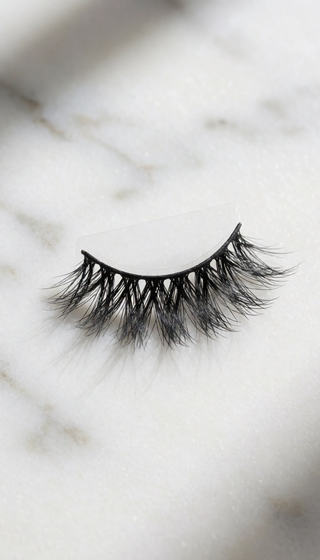
CURVED VS. STRAIGHT: FIND THE FALSE LASH SHAPE THAT FLATTERS YOUR EYES
Short answer: follow the visible contour of each eye with the band, then adjust fiber length, curl, and density so the style enhances your lash line without crowding it.
Curved vs. straight false lashes do not come with one universal eye-shape rule. A curved band looks balanced when it follows the eye’s natural arc, while a straighter or gently lifted profile can complement an eye that needs more upward definition. The most useful choice is the one that sits flush, keeps the fibers visible, and feels balanced from every angle.
A curved lash is not automatically more opening, and a straight-looking band is not automatically wrong. Evaluate the center, middle, and outer third of the band separately; a style that fits beautifully in the center can still lift at either end.
- Start with a curved-band profile when it follows an almond, upturned, or evenly balanced eye without forcing the ends above the natural lid line.
- Start with a straighter or gently lifted profile when a downturned or hooded eye would benefit from more lift at the outer third.
- For monolid, deep-set, or close-set eyes, let available lid space and tip visibility matter more than a general eye-shape label.
If both profiles look plausible, compare the fit on each eye. Mild asymmetry is normal, so forcing both sides into an identical silhouette can make an otherwise suitable style look less natural.
START WITH THE DIFFERENCE: BAND CURVE IS NOT THE SAME AS LASH CURL
“Curved” and “straight” can describe different parts of a false lash. Looking at these features separately makes it easier to identify what actually suits your eye.
- Band curvature: The horizontal curve that follows the eyelid. A well-matched band should rest along the lash line without pinching the center or lifting at the corners.
- Fiber curl: The vertical direction in which individual fibers rise. A curved band can have straight fibers, while a straighter band can still contain lifted or curled fibers.
- Length map: Where the fibers are shortest or longest. A subtle increase toward the outer third usually preserves movement, while equal lengths can create a flatter or denser outline.
- Density: How closely the fibers sit together. Higher density changes the visual weight, so it should be considered alongside length rather than treated as a separate improvement.
The useful approach is to adjust one variable at a time. First confirm that the band fits, then examine curl, length, and density. This prevents a technically curved style from being chosen when your real need is visible fiber lift.
MATCH THE LASH PROFILE TO YOUR EYE SHAPE
Use eye-shape labels as cosmetic guidance rather than fixed rules. The visible lid angle, brow position, lash-line space, and amount of hooding all affect how a lash profile appears once it is in place.
- Almond eyes: A moderate band curve with balanced lengths often works well because it echoes the eye’s natural taper without exaggerating either end.
- Round eyes: Slight elongation and a gently lifted outer third may create a more lengthened appearance. Extra density concentrated in the center can make the shape appear rounder.
- Hooded eyes: Moderate curl and clearly visible tips are useful because long or heavy fibers may disappear beneath the lid when you look forward.
- Downturned eyes: A restrained upward flick at the outer third can visually balance the corner. An extreme upward angle may look disconnected from the natural lash line.
- Upturned eyes: A soft, balanced curve usually complements the existing lift. Forcing the band higher than the eye can make the outer fibers look exaggerated.
- Monolid, deep-set, or close-set eyes: Visible tip space and available lid room deserve priority. A lighter profile or lower band curve may keep the style open and comfortable-looking.
Compare both eyes in a mirror and in natural light rather than relying only on a front-facing photo. If one lid is more hooded or one eye has less space, the two sides may need slightly different placement even when you use the same style.
CHOOSE FOR YOUR LOOKING GOAL, NOT A TREND
Once the band direction feels right, choose the visible effect you want. The most flattering profile is usually the one that suits your features and daily routine, not simply the longest or densest option available.
- For a natural result: Choose the shortest workable length, restrained density, and a subtle taper through the outer third.
- For soft definition: Look for moderate density, controlled curl, and slightly greater length toward the outer third without crowding the inner corner.
- For a clearer edge: Use a defined fiber pattern and moderate length so the lashes remain distinct instead of merging into a dense shadow.
- For a more open effect: Favor visible upward lift, especially on downturned or hooded eyes, while checking that the middle section remains visible when you blink.
Longer is not automatically more flattering. If fibers approach the brow, overlap the inner corner, or disappear beneath the lid, reduce length, density, or curl until the eye remains easy to see.
TEST THE FIT BEFORE YOU CHOOSE A STYLE
A two-sided comparison gives you more useful information than the style name alone. Use this process before applying any adhesive or choosing an attachment method.
- Start with a clean, dry lash line. Remove eye cream, powder, oil, and residue from the area where the band will sit.
- Hold the lash against your natural lashes without fastening it. Match the center first, then compare the middle and outer third rather than aligning only one point.
- Check three contact areas. The center should follow the lash line, the middle should not bow away, and the outer end should not point sharply upward or downward.
- Test movement in a mirror. Look forward, blink naturally, look down, and turn your head slightly. Check for rubbing, gaps, pinched fibers, and corners that lift during movement.
- Adjust the profile rather than forcing it. If the ends lift, consider a gentler curve or lighter band. If fibers crowd the brow or inner corner, reduce length or density. Never cut a lash while it is being worn.
After confirming the fit, follow the directions for the chosen attachment system. Persistent rubbing, redness, swelling, or discomfort is a sign to stop using the product; irritation that does not settle warrants professional advice.
WHAT TO LOOK FOR IN A LASH SOLUTION
The recurring problem is not a lack of style options; it is choosing without a reliable method. A useful solution should make the decision repeatable by combining shape logic with a comfortable physical fit.
- Shape logic: Clear band curvature, fiber direction, and length distribution that you can compare with each eye.
- Visible fiber placement: Enough tip clearance for the lashes to remain visible during natural blinking and looking.
- A stable band: A design that follows the lash line without pinching, excessive lifting, or constant adjustment.
- Specific care guidance: Clear attachment, removal, storage, and expected wear information so use remains consistent.
When those checks are present, selecting a lash becomes a process rather than a guess. Appearance should be the final confirmation, not the only information you use.
PUT YOUR EYE-SHAPE MATCH INTO PRACTICE WITH PHANSTA LASHES
Instead of treating curved and straight as universal labels, use the map you just built: compare each eye’s natural contour, available tip space, and desired fiber direction. PHANSTA LASHES offers 17 styles, giving you multiple shape options to consider after you understand what your eyes need.
THREE PRACTICAL CHECKS TO CONSIDER
- Glue or irritation concern: The lashes are hypoallergenic and use glue-free micro-adhesion rather than glue, magnets, or liner.
- Durability concern: The waterproof lashes are designed for 30+ wears when the care directions are followed.
- Price concern: At $59, the stated 30+ wears works out to under $2 per wear.
FREQUENTLY ASKED QUESTIONS
ARE CURVED LASHES ALWAYS BETTER THAN STRAIGHT ONES?
No. Curved bands can suit almond and upturned eyes, while straighter or gently lifted profiles may suit downturned or hooded eyes. The reliable test is whether the band sits flush along the center, middle, and outer third without lifting. Compare fiber lift separately, because a curved band can still have straight fibers, and vice versa.
WHAT LASH SHAPE WORKS BEST FOR HOODED EYES?
For hooded eyes, look for moderate upward lift and a visible outer taper rather than dense, uniformly long fibers. Place the band against the dry lash line and check that the tips remain visible when you look forward and blink naturally. If the middle disappears, shorten the style or reduce density before adding more length.
WHAT SHOULD I CONSIDER IF I HAVE SENSITIVE EYES?
If your eyes are sensitive, treat comfort as a fitting criterion, not an afterthought. Check every component against your known sensitivities, wash your hands, and avoid rubbing the eye area while adjusting. A hypoallergenic label can inform your choice, but no label guarantees zero reaction; stop if irritation occurs and seek professional advice when needed.
HOW MANY WEARS DO PHANSTA LASHES PROVIDE?
PHANSTA LASHES are designed for 30+ wears when used and stored according to the care directions. Wear varies with condition, application, and removal habits, so 30+ is not a guarantee for every routine. Follow the included care guidance, handle the band gently, and replace the style if the micro-adhesion area loses its hold.
CAN I USE ONE STYLE IF MY EYES ARE DIFFERENT SHAPES?
Yes, especially if the difference is mild. Many people have slight asymmetry between eyes, so evaluate each side in a mirror and in normal light. A style that follows one eye may need a gentler curve on the other. Choose an adaptable shape or separate lash options when the visible lash lines differ meaningfully in height, tilt, or available space.
SHOP PHANSTA LASHES — GLUE-FREE, 30+ WEARS →
STILL COMPARING OPTIONS? Explore our guides on finding your perfect lash, magnetic vs strip, and sensitive eyes.
FIND THE PERFECT LASH — Not sure which style suits you? Take the 30-second lash finder quiz →