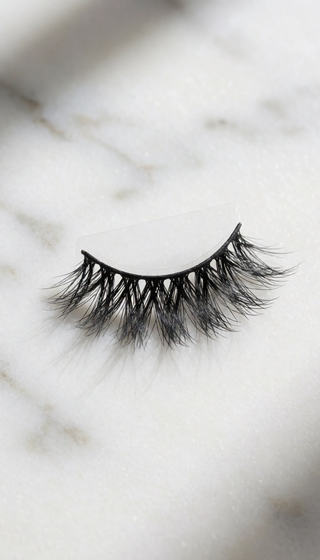
CAN FALSE LASHES BE REUSED? CLEAN, STORE, AND PROTECT EVERY WEAR
Learn which lashes are designed for repeat wear, how to remove adhesive gently, and how to clean and store each pair so its band and fibers remain ready for another look.
NOT SURE ABOUT YOUR EYE SHAPE?
Take our 60-second quiz to find your perfect lash match — no glue, no commitment.
TAKE THE QUIZ →Yes—false lashes can be reused when both the lash and its attachment method are designed for repeat wear. A reusable band may remain sound across several cycles, while a pair labeled for single use should be discarded after one wear. Reuse does not have a fixed number because the band, fibers, adhesive, and cleaning method all affect whether another wear is comfortable and intact.
- Check the maker’s reuse and care directions.
- Remove the lash without pulling on the fibers or band.
- Clean adhesive with a method approved for that lash.
- Let the band dry completely before storing it.
- Inspect the fibers, edge, and adhesive before every wear.
If you notice persistent adhesive, fraying, odor, a warped band, or irritation after removal, stop using that pair. The useful rule is simple: reuse only when the product’s directions and the lash’s physical condition both support another wear.
THE SAFEST REUSE TEST: The band should still be flexible, the fibers should lie smoothly, and no adhesive should remain after cleaning.
REUSABILITY DEPENDS ON THE LASH AND ITS ATTACHMENT
The word “reusable” is not a universal durability claim. Different lash constructions need different care, and the attachment method can matter as much as the lash itself. Always begin with the instructions supplied for the exact pair rather than a general rule for all false lashes.
- Reusable glue-on strips: These may be worn again when the band, fibers, and adhesive remain in good condition after removal and cleaning.
- Pre-bonded lashes: Follow their stated removal and storage directions. Do not add glue or another attachment unless the maker specifically instructs you to.
- Single-use lashes: Discard them after their listed wear or immediately if they lose their shape or collect residue.
Water, makeup, skin oils, sweat, and adhesive can affect a lash differently. Even a durable band may not be suitable for another wear if its fibers have become rough or its edge has begun to break down. Inspect rather than assuming every pair has the same lifespan.
REMOVE FALSE LASHES WITHOUT PULLING OUT FIBERS
Most damage happens during removal, especially when adhesive has dried or the band is pulled from the inner corner. Work slowly with clean hands and keep your fingers away from the eye whenever possible.
- Prepare the workspace. Wash and dry your hands, and place a clean tissue or towel underneath the lashes.
- Follow the adhesive directions. If a remover is approved for the glue, apply it to clean fingertips or cotton rather than flooding the eye area.
- Loosen the outer corner first. Gently press and release the band so the adhesive separates without dragging across the natural lashes.
- Support the fibers. Hold the underside of the band and peel slowly rather than pulling from a single point.
- Clear remaining residue. Follow the adhesive maker’s removal method and avoid scrubbing the natural lashes.
- Clean up. Wash your hands and remove used tissues or applicators before handling a stored pair.
If removal causes pain or the band starts to bend, stop and reassess the method. Forcing a resistant lash off can remove natural lashes or split the reusable band, ending its useful life.
CLEAN ONLY WITH GENTLE, EYE-AREA-SAFE METHODS
Cleaning should remove adhesive without changing the band’s shape or dulling the fibers. The safest formula depends on the adhesive, so use the product-specific directions before choosing a cleanser or remover.
- Water-based adhesive: Use lukewarm water and a gentle cleanser only when the lash maker permits it. Avoid hot water, which can warp the band.
- Stronger adhesives: Use an approved adhesive remover. Alcohol, acetone, nail-polish remover, and household solvents can damage fibers or the band and should not be improvised.
- Tools: Do not push cotton swabs into the fibers, twist the band, or scrub the lash against a rough towel.
- Drying: Blot excess moisture gently and let the pair air-dry on a clean surface. Avoid a hair dryer unless its instructions explicitly permit it.
- Final inspection: The band should look clean and flexible, with no hard adhesive, discoloration, or clumped fibers.
Dermatology guidance around sensitive skin emphasizes clean tools, minimal handling, and avoiding unnecessary irritants. A lash that looks clean can still be unsuitable if adhesive remains or its construction has degraded; cleaning cannot restore damaged fibers.
USE THE GENTLEST APPROVED METHOD: More product does not mean a cleaner lash. Thin residue can often be removed with repeated gentle passes rather than aggressive scrubbing.
STORE FALSE LASHES FLAT, DRY, AND PROTECTED
Correct storage protects the shape you spent time creating. A reusable lash should rest in its original case or another rigid, clean container without being folded, crushed, or compressed.
- Dry the pair completely. Do not seal damp fibers or adhesive inside a closed case.
- Support the band. Lay it flat or use a case that holds it in its natural curve.
- Keep the fibers aligned. Avoid rolling, folding, or stacking pairs that can bend the band or create creases.
- Choose a cool, dry location. Keep the case away from direct heat, sunlight, bathroom humidity, dust, and makeup spills.
- Separate styles carefully. Label the outside of the container rather than marking the lash band.
A clean lidded container can work if the original case is damaged, but it should still keep the band supported. Do not use water to loosen the fibers, and do not refrigerate the lashes; neither method improves their usable condition.
REPLACE A PAIR WHEN ITS BAND OR FIBERS CHANGE
Care instructions cannot make every damaged pair safe or comfortable. Check the lashes before applying them and replace a pair when the condition changes.
- Missing fibers, frayed edges, or a shedding band
- Cracks, deep creases, persistent curling, or lost flexibility
- Adhesive that remains soft, hardens inside the band, or cannot be removed cleanly
- Unusual odor, discoloration, or residue on the storage case
- Any lash that repeatedly shifts, twists, or presses uncomfortably against the eye
Pain, swelling, discharge, persistent redness, or vision changes should not be treated as a cosmetic inconvenience. Remove the lashes and seek appropriate medical advice. If a lash has been worn during an eye infection or discharge, do not clean and reuse that pair.
WHEN THE CONDITION IS UNCERTAIN, REPLACE IT. A smooth fit, intact fibers, and a clean band matter more than squeezing out another wear.
WHAT TO LOOK FOR WHEN CLEANING AND REUSE ARE NOT THE GOAL
Reusable strip lashes can work well when you enjoy the removal and maintenance routine. If repeatedly cleaning adhesive and protecting a band feels unnecessary, compare other formats using clear criteria rather than the word “reusable” alone.
- Attachment: Identify whether glue, a liner, or another component must be handled before and after every wear.
- Documented durability: Look for a stated wear count that matches how the lashes are intended to be used.
- Removal method: The product should explain how the attachment separates without requiring harsh chemicals.
- Comfort information: Consider material wording, flexibility, weight, and your own eye-area sensitivity.
- Style fit: Length, density, and shape still matter; low-maintenance construction does not guarantee a flattering look.
Once you decide that cleaning and storing an adhesive band adds more maintenance than you want, compare pre-bonded, glue-free lashes by their attachment mechanism, documented durability, comfort, and total use.
PHANSTA LASHES: 30+ WEARS WITHOUT THE CLEANING ROUTINE
That is where PHANSTA LASHES offers a different answer: instead of preserving one cotton band through washing cycles, it uses glue-free micro-adhesion technology for repeatable wear. There is no glue, magnet, or liner to manage.
Each pair is waterproof and hypoallergenic, with 17 styles at $59. PHANSTA LASHES deliver 30+ wears, which works out to under $2 per wear based on the stated price. They are designed for readers who prioritize quick, low-maintenance lashes over cleaning and reshaping a glue-on strip.
THE THREE BIGGEST CONSIDERATIONS
- Glue or irritation concerns: Micro-adhesion means no glue, no separate liner, and no magnets to apply or clean from the eye area.
- Durability concerns: The stated wear claim is 30+ wears rather than an open-ended reuse estimate.
- Value concerns: At $59 with 30+ wears, the cost works out to under $2 per wear.
Hypoallergenic does not mean every person will respond identically. Stop wearing any lash that causes pain, itching, swelling, or redness, and seek medical advice when symptoms persist.
FREQUENTLY ASKED QUESTIONS
CAN ANY FALSE LASHES BE REUSED?
Only when the lash is designed for repeat wear and its care instructions allow it. Follow the maker’s directions for the specific band and adhesive. A lash labeled for one use should not be saved, and a reusable-looking band may still be compromised by damaged fibers, trapped adhesive, odor, or loss of shape.
WHEN SHOULD I REPLACE A PAIR OF FALSE LASHES?
Replace a pair when the band cracks, curls, creases, or loses flexibility; fibers fray or shed; adhesive will not come away cleanly; or the color develops an unusual odor. After a wear causes pain, swelling, discharge, or persistent redness, remove the lashes and seek appropriate medical advice rather than cleaning and reusing them.
ARE PHANSTA LASHES REUSABLE?
Yes. PHANSTA LASHES are designed for 30+ wears and use glue-free micro-adhesion rather than glue, magnets, or a liner. Their waterproof, hypoallergenic construction is also positioned for convenient wear. Actual lifespan still depends on following the included care directions and replacing a pair if the band or fibers deteriorate.
HOW DO I REMOVE PHANSTA LASHES?
Start with clean, dry hands, then peel the lash away slowly from the lash line while supporting the band. Do not yank, twist, or rub the fibers against the eye. Follow the product’s removal directions, and do not introduce glue, magnets, or a liner to alter the attachment.
ARE PHANSTA LASHES SUITABLE FOR SENSITIVE EYES?
Hypoallergenic does not mean irritation-proof. PHANSTA LASHES are labeled hypoallergenic and are made without glue, magnets, or liner, which removes those particular variables. Sensitivity can still vary, so stop wearing them if you develop pain, itching, swelling, or redness and seek medical advice when symptoms persist.
STILL COMPARING OPTIONS? Explore our guides on finding your perfect lash, magnetic vs strip, and sensitive eyes.
FIND THE PERFECT LASH — Not sure which style suits you? Take the 30-second lash finder quiz →
NOT SURE ABOUT YOUR EYE SHAPE?
Find your eye shape and get personalized lash recommendations:
FIND THE PERFECT LASH FOR EVERY MOMENT
Explore our occasion-specific lash guides:
EXPERIENCE THE DIFFERENCE
Join thousands of women who have made the switch. No glue, no damage, no salon appointments — just beautiful lashes in seconds.
SHOP PHANSTA LASHES →