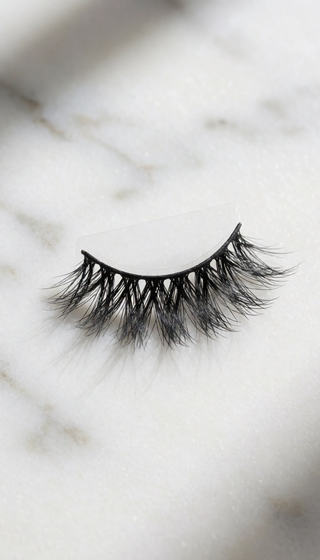
BEST LENGTHENING PHOTOSHOOT FOR ALL-DAY COMFORT
If you’ve ever been mid-smile during a shoot and felt your lash lift at the inner corner, you know the exact nightmare this guide addresses. The fix isn’t more glue — it’s understanding why lashes release in the first place. Here’s what keeps a lengthening lash camera-secure through hours of shooting, heat, angled poses, and facial movement. No brand talk — just the technique, eye-shape factors, and material science that matter most.

WHY LASHES LIFT MID-SHOOT (AND IT’S NOT YOUR FAULT)
A lengthening lash carries more surface area, which means more places for leverage to pull against your lash line. Three triggers cause a fold or lift during a shoot: heat and humidity soften the adhesive bond; camera flashes and studio lights raise skin temperature around the eye; and repeated facial movement — squinting, widening, laughing, even talking — creates micro-pull at the inner and outer corners. The inner corner is almost always the first to fail because it’s the thinnest part of the lash band and the most mobile part of your eye area.
That’s why it happens no matter how carefully you apply. The adhesive and the band design carry most of the responsibility — not your technique.
WHAT “LENGTHENING” REALLY MEANS FOR YOUR FACE
True lengthening visually extends the outer third of your lash line, opening the outer corner and creating a cat-eye silhouette that reads beautifully in photos. For that effect to survive a full day, three variables matter:
- The band must be thin enough to sit flush against your lash line — a thick band casts a visible shadow and slides easily.
- The fibers must be lightweight so they don’t pull the band down as the hours pass.
- The grip must not rely on sticky residue — residue is what eventually lets the band slide, and it’s also what causes that tugging feeling you notice at the corners.
When a lash is weighted evenly, you forget you’re wearing it. When it’s not, you feel a constant pull that shows up as a stiff, nervous expression in your photos.
EYE-SHAPE SMARTS FOR CAMERA-READY LASHES
Different eye shapes change where a lengthening lash sits — and that changes how it behaves under lights:
- Hooded eyes: The low crease can push a thick band against the lid fold. A thin, flexible band that sits close to the lash line stays out of the crease and keeps a full look without fold interference.
- Almond eyes: Naturally balanced — lengthening reads beautifully here. The main risk is a too-heavy outer corner that tips downward over time, so lightweight fibers matter most.
- Round eyes: The lash needs to open the look without adding width. A band that hugs the natural curve prevents that “floating” gap at the center.
- Monolid eyes: The lash sits on a flatter plane, so band flexibility is everything. A rigid band will pop off the inner corner; a flexible one contours without gaping.
- Deep-set eyes: The brow bone casts shadow, so you need visible length payoff without the band settling into the socket shadow.
- Close-set eyes: Lengthening frames the outer half and visually separates the eyes — but only if the lash adds no extra weight at the inner corner, which would draw them together.
Whatever your eye shape, one principle holds: the band should disappear against the lash line, and the fibers — not the adhesive — should carry the length.
THE 5-MINUTE LASH CHECK BEFORE ANY SHOOT
Run this checklist right before applying, and you’ll avoid mid-set surprises:
- Clean the lash line. Remove any lingering moisturizer or oil — it breaks down adhesion and causes corner lifts.
- Warm the band. A few seconds of gentle warmth (hands or slow breathing) makes the band more flexible so it molds to your lash line instantly.
- Press and hold. Place at the center, then work to each corner, holding for about 10 seconds per section rather than one quick press.
- Check the inner corner. This is the first place to fail on angled shots; make sure it’s flush, not lifted.
- Test under flash. Take a quick test photo with flash and mirror. A true lengthening lash should read clean at every angle with no visible band line.
Test your look at three angles: straight-on, chin down (the classic doe pose), and a three-quarter profile. If the inner corner stays put through all three, you’re camera-ready.
MATERIALS THAT DECIDE ALL-DAY COMFORT
Comfort comes down to what the lash is actually made of — not the marketing language around it. Four material factors determine whether a lash still feels weightless at hour six:
- Band flexibility — a rigid band presses and shifts; a flexible band hugs the lash line without digging in.
- Fiber weight — heavy fibers pull the band down and eventually make the corners droop.
- Water resistance — sweat and humidity break down water-soluble adhesives, so a truly shoot-proof lash needs to shed moisture.
- The adhesion method itself — traditional glue dries rigid and eventually cracks; a micro-adhesion layer grips without a wet or tacky stage, so there’s no drying window and no brittle edge to snap under tension.
Hypoallergenic materials matter, too. Irritation makes you rub your eyes — and rubbing is what finishes off a shoot-day lash faster than anything else.
Browse our complete library of lash guides →
WHAT TO LOOK FOR IN A PHOTOSHOOT LASH
By now, you know exactly what separates a lash that lasts from one that debuts at hour one. Before you decide, ask these questions about any option you’re considering:
- Does it stay secure without glue? If a lash depends on liquid adhesive, heat and movement will eventually break the bond — no matter how careful your application.
- Is it genuinely gentle on sensitive eyes? Adhesive-based formulas are a leading cause of eye-area irritation. Look for hypoallergenic materials and a glue-free grip.
- Will it survive 30+ wears? If the band can’t hold its shape across reuses, it’s not a long-term investment — it’s a single-use purchase priced like a repeat one.
- How fast can you apply it? On a shoot morning, every minute counts. The ideal lash goes on in seconds per eye — no glue waiting, no drying time.
- What’s the true cost per wear? A reusable pair that holds up for 30+ wears costs far less per use than daily disposables or monthly salon fills.
PHANSTA LASHES — BUILT FOR THE SHOOTS GLUE COULDN’T HANDLE
Everything you just read about what makes a lash survive a full shoot day is exactly what PHANSTA LASHES was engineered around. Each pair uses a micro-adhesion layer that grips your lash line without glue, magnets, or a sticky liner — so there’s no drying window, no rigid glue edge, and no bond to break under heat or movement. The flexible band sits flush against every eye shape, and the lightweight, hypoallergenic fibers keep a lengthening silhouette comfortable from the first frame to the last.
With 17 styles to choose from, one pair costs $59 — and because each pair is reusable for 30+ wears, you get under $2 per wear. Waterproof, comfortable, and ready for back-to-back looks.
- “Will it really hold without glue?” Yes — the micro-adhesion layer grips the lash line instantly and holds through heat, sweat, and expression changes. No glue means no brittle edge and no irritation, which is why it’s hypoallergenic and safe for sensitive eyes.
- “Is it durable enough to be worth it?” Each pair is reusable for 30+ wears, keeping its shape and grip across shoots and nights out — the longevity that makes it a smarter buy than salon refills.
- “What will it cost me?” One pair is $59, which works out to under $2 per wear — and with 17 styles you’re covered for every look you shoot.
Frequently Asked Questions
Are glue-free lashes safe for sensitive eyes?
Yes. PHANSTA LASHES are hypoallergenic, latex-free and fragrance-free, and they apply without liquid adhesive — the most common lash irritant. Patch-test any new product on your inner arm for 24 hours before first use.
How long do glue-free lashes last per wear?
With clean, dry lids at application, PHANSTA LASHES hold comfortably through a full day — including workouts and light rain when you use the waterproof version. Hold depends mostly on clean, dry application.
Can you really reuse PHANSTA LASHES 30+ times?
Yes, when cared for properly. Gently peel them off by lifting from the outer corner, wipe the band with a damp swab after each wear, and store pairs curved-side-up in the tray. Never soak the band in remover.
Do PHANSTA LASHES damage natural lashes?
No — unlike tugging off dried glue, PHANSTA LASHES peel away cleanly without pulling natural hairs. Remove gently by lifting from the outer corner.
How much do PHANSTA LASHES cost?
PHANSTA LASHES are $59 per pair, reusable for 30+ wears — that works out to under $2 per wear over a full month of use.
Find your eye shape and get personalized lash recommendations: Explore our occasion-specific lash guides:NOT SURE ABOUT YOUR EYE SHAPE?
FIND THE PERFECT LASH FOR EVERY MOMENT
Quick to apply, gentle on eyes, beautiful all day. Reusable 30+ wears per pair.
SHOP PHANSTA LASHES — GLUE-FREE, 30+ WEARS →STILL COMPARING OPTIONS? Explore our guides on finding your perfect lash, magnetic vs strip, and sensitive eyes.
FIND THE PERFECT LASH — Not sure which style suits you? Take the 30-second lash finder quiz →