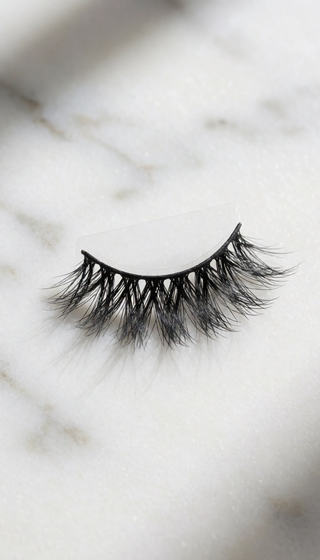
MYTH: SYNTHETIC LASHES LOOK FAKE, REAL HAIR LOOKS NATURAL

Ask five people why they avoid synthetic lashes and four will say the same thing: 'They look fake. Real hair looks natural.' But here's the uncomfortable truth: the material isn't what makes a lash look fake. Design is.
I used to fall for this myth too. I spent $60 on 'real hair' lashes once and they curled at the ends like a bad breakup text. Meanwhile, a friend was wearing a $12 synthetic pair that looked so soft and real that I asked who her lash tech was. The difference wasn't the fiber. It was the lash construction.
WHERE THE MYTH COMES FROM
Early synthetic lashes were made from thick, shiny plastic molded in perfect, identical shapes. They had no taper, no curl variation, and a stiff band. No wonder they looked like spider legs. But lash technology has quietly changed. Modern synthetic fibers are heat-treated, textured, and designed with cuticle-like layers that mimic real hair.
WHAT ACTUALLY MAKES LASHELS LOOK FAKE
- Blunt, flat tips. If every lash ends at the same width, it reads plastic.
- Uniform crisscross pattern. Real lashes cross irregularly, not like a grid.
- Shiny gloss. A lash that catches light like a vinyl sticker is the #1 fake signal.
- Too dark or too uniform. Natural lashes have subtle color variation along the shaft.
- Visible band. Lifting edges ruin the illusion faster than anything.
WHEN SYNTHETIC FIBER IS BETTER THAN REAL HAIR
Here's what most people don't know: synthetic lashes hold their curl in humidity, last longer, and cost a fraction of real-hair lashes. They're also hypoallergenic for sensitive eyes, unlike some mink lashes that can carry allergens. Real-hair lashes, especially mink, can be gorgeous — but they're high-maintenance and can lose their curl in tears, rain, or a humid ballroom.
HOW TO TEST A LASH'S 'FAKE' FACTOR
Before you commit to a pair, do this 3-second test:
- Run your finger from base to tip. It should taper, not feel like a toothbrush.
- Hold it up to the light. If it gleams like a plastic spoon, it's too shiny.
- Bend the band. It should flex gently, not snap or stay crinkled.
YOUR SYNTHETIC LASH MYTH QUESTIONS, ANSWERED
Are mink lashes always more natural-looking than synthetic?
No. Some mink lashes are thick and heavy. A well-made synthetic lash can outperform them in realism, especially if it has a matte finish and tapered tips.
Will synthetic lashes irritate my eyes?
Not usually. Look for 'hypoallergenic' on the label and always patch-test the adhesive. Many synthetic lashes are safe for contact lens wearers.
Can synthetic lashes look as soft as real hair?
Yes. High-quality synthetic fibers now mimic the natural crisscross pattern and have a soft, matte touch. The key is the manufacturing, not the material.
THE REAL-HAIR LOOK WITHOUT THE REAL-HAIR PRICE
When you're shopping, ignore 'mink' or 'synthetic' on the label. Instead, look for three words: matte, tapered, and flexible. Those are the true markers of natural-looking lashes. Whether the fiber is real hair or a lab-crafted polymer doesn't matter if the design is right.
That's why I'm confident recommending PHANSTA LASHES. Their synthetic lash collection is crafted with heat-treated fibers that mimic real hair — including the cross-hatched texture that catches light the way natural lashes do. You get the 'real hair' effect without the $80 price tag.
📚 Browse our complete library of lash guides →
📚 Browse our complete library of lash guides →
📚 Browse our complete library of lash guides →
Experience the Difference of PHANSTA LASHES
Quick to apply, gentle on eyes, beautiful all day. Reusable 30+ wears per pair.
SHOP PHANSTA LASHES — GLUE-FREE, 30+ WEARS →