DO FALSE LASHES LOOK BETTER WITH MASCARA? MYTH VS. FACT—WHEN TO USE OR SKIP IT
Usually, no—not when the false lash already has the curl, density, and separation you want. Mascara can help a thin, natural-looking set, but it should be a light tool used before application, not a rescue layer dragged through finished fibers. Applied afterward, it can catch multiple fibers, transfer near the band, and make a polished lash look heavy.
The best rule depends on your goal. For soft daytime definition, wear the false lash alone or use one light mascara coat on your natural lashes first. For a noticeable lift, mascara underneath can blend your natural lashes into the false lash. For a full or dramatic style, skip it over the fibers: extra volume usually adds weight without improving the silhouette.
Try this simple test: apply mascara only to one eye, add the same false lash to both eyes, and compare in daylight. You are looking for clean separation, comfortable weight, and a smooth transition—not simply more product. If the mascara side looks denser but less defined, omit mascara next time.

MYTH VS. FACT: WHAT MASCARA ACTUALLY CHANGES
Mascara and false lashes do not automatically improve one another. Mascara coats and defines natural lashes; a false lash supplies its own fibers, length, and designed curve. When both are used, the result depends on application sequence, dryness, and how much product reaches the false fibers.
While mascara is wet, it increases the chance that touching fibers will gather as it dries. A wand pulled through a finished lash can move fibers out of alignment, collect product at the base, or create a dark bridge between strands. That visible “spider-web” effect is usually a cohesion and placement issue, not simply a lack of product.
Traditional lash adhesive adds another variable. Dragging mascara over a set bond can disturb the bond or pick up residue, so the adhesive must be fully set before the wand comes near it. With a sufficiently full false lash, extra mascara generally adds bulk rather than useful definition.
THREE LOOKS, THREE MASCARA DECISIONS
WHEN TO SKIP, USE, OR AVOID MASCARA
Instead of a blanket yes-or-no rule, choose based on the result you want:
- The Natural Definition Goal: For a soft daytime look, skip mascara over the false fibers and let the lash band do the work. The result should enhance your natural set rather than look like another heavy layer.
- The Extreme Volume Goal: If the false lash is already super dramatic and dense, mascara is usually counterproductive. It can add weight, pull fibers inward, and form visible clumps.
- The Light Lift Goal: With a thin, lighter style, apply only a very light volumizing coat to the natural lashes underneath. Once it dries, it can improve base separation and make the transition more believable without coating the false fibers.
| Scenario | Mascara Usage | Desired Result |
|---|---|---|
| Natural/Day Look | None, or a light defining coat on natural lashes before application | Subtle enhancement and airy separation |
| Dramatic/Night Look | None over false fibers | Maximum impact with a clean, defined shape |
| Clumpy/Overdone | Avoid adding more mascara | Heavy, merged fibers and less movement |
THE RIGHT SEQUENCE PREVENTS SMUDGING AND CLUMPING
Mascara works best as preparation rather than a finishing product when it is part of the same look.
- Start clean and dry. Remove old makeup and let your natural lashes dry completely. Residual fibers or moisture can make mascara gather before it reaches the false lash.
- Apply one light coat. Hold the wand upright, wiggle it at the base, and comb through with a clean spoolie. Avoid pressing clumps together or adding a second coat before the first one has dried.
- Let the mascara set fully. It should no longer feel wet or tacky before the false lash touches your natural lashes. This reduces transfer and keeps the fibers easier to separate.
- Follow the false-lash method. With traditional glue lashes, follow the adhesive instructions and wait until the bond is fully set. With a no-glue method, begin with clean, dry lashes.
- Keep the wand away from finished fibers. If you need separation, use a clean spoolie on the natural lashes rather than pulling product through the strip. Remove the false lashes before mascara to reduce tugging.
WHY LASH STRUCTURE MATTERS MORE THAN EXTRA PRODUCT
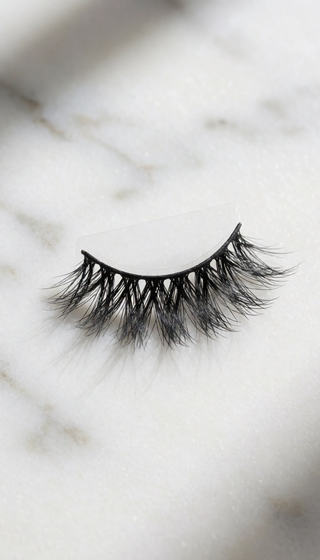
The difference between a cohesive look and a heavy one often comes down to structure rather than the amount of product. A well-shaped lash has a stable arc, a neat base, and enough spacing to stay light. When those qualities are missing, mascara cannot selectively lengthen one fiber without making several fibers heavier.
Inspect the set in daylight and ask four useful questions:
- Defined arc: Does the band follow the eye’s curve and sit neatly above the natural lashes?
- Even spacing: Can you see distinct fibers rather than one dense dark edge?
- Fine, tapered ends: Do the strands narrow gradually so the outer edge looks feathered?
- Lightweight balance: Can you blink and move naturally without the lash dragging or lifting?
The goal is not to make the lash look as large as possible. It is to preserve a clean silhouette, comfortable weight, and enough movement to look polished from every angle.
WHEN MASCARA IS NOT THE ANSWER
Mascara is not the answer to every lash gap. If the false style itself looks sparse, choose a set designed for more density; mascara usually adds bulk or closes spaces rather than creating precise fullness.
If the finished look is clumpy or overdone, do not add another coat to balance it. Remove the false lash, clean your natural lashes gently, let them dry, and restart with mascara alone or one defined false-lash style.
If mascara causes stinging, redness, swelling, or discomfort, stop using it. Follow the removal directions and seek healthcare advice if symptoms persist. Even a formula labeled hypoallergenic is not a guarantee of zero sensitivity for every person.
WHAT TO LOOK FOR IN A FALSE-LASH SOLUTION
When comparing a false-lash solution, look for evidence that the shape holds without corrective makeup:
- A defined silhouette: The style should look intentional when worn completely alone.
- Fine, lightweight fibers: A pre-curled shape and tapered texture should preserve separation without mascara.
- A stable base: The band should sit neatly and feel balanced rather than pulling the outer corner.
- Dry-lash compatibility: The application method should work with clean, dry lashes, and any traditional adhesive should be fully set before makeup touches it.
- Clear wear and care guidance: The lashes should come with consistent directions for application, removal, storage, and reuse.
Together, these criteria support one simple routine: prepare the natural lashes if needed, let them dry, then add a false lash that keeps its shape without a corrective coat of mascara.
The reusable lashes are designed for 30+ wears. At $59, the collection costs under $2 per wear, so the defining shape comes from the lash rather than repeated layers of mascara.
EYE-SHAPE GUIDES: Hooded Eyes, Almond Eyes, Round Eyes, Monolid Eyes, Close-Set Eyes, Deep-Set Eyes, and Prominent Eyes.
COMPARISON GUIDES: PHANSTA vs Glue Lashes, PHANSTA vs Extensions, and PHANSTA vs Magnetic.
WHY PHANSTA LASHES FIT A CLEAN, MASCARA-FIRST ROUTINE
PHANSTA LASHES are the natural fit for those criteria because the style supplies the finished effect without relying on mascara to build density. The collection offers 17 styles, giving you room to move from a soft enhancement to a fuller silhouette while keeping the routine straightforward.
PHANSTA LASHES use waterproof, hypoallergenic micro-adhesion technology: no glue, no magnets, and no liner. That removes the glue bond you would otherwise avoid when applying mascara over a strip lash. Apply mascara to the natural lashes first if desired, allow it to dry fully, and then add the false lashes without pulling a wand through their fibers.
OCCASION GUIDES: Wedding Lashes, Prom Lashes, Beach Lashes, and Festival Lashes.
📚 Browse our complete library of lash guides →
FREQUENTLY ASKED QUESTIONS
Do false lashes look better with mascara?
False lashes often look better without mascara when the style already has the density and curl you want. For a subtle set, a light mascara coat on natural lashes before application can improve definition without weighing down the false fibers. The best choice depends on fullness, length, and the finish you want.
Should mascara go on before or after false lashes?
Before is the more dependable sequence. Apply one controlled coat to clean, dry natural lashes, let it set, and then position the false lashes. If you use traditional glue lashes, follow the adhesive instructions and avoid mascara until the bond has fully set. This reduces dragging and transfer at the band.
Can mascara make false lashes clump?
Yes. A wet or tacky mascara wand can catch several fibers at once, add weight, and create a spider-web effect. It can also transfer to natural lashes or the band. Keep the wand drier, remove excess product, and work only on natural lashes before application if the false style is already full or dramatic.
Do I need mascara with glue-free false lashes?
No, not automatically. Glue-free lashes still look best when their fibers remain light, separated, and shaped. Mascara can be useful beforehand for natural lashes, but it is not needed to make a well-designed false lash functional. Choose based on your natural lash condition and the opacity of the style.
How can I tell whether too many lash products are being layered?
If the base looks heavy, fibers merge, mascara transfers near the band, or one lash casts an uneven shadow, simplify the routine. Remove the false lashes, clean the natural lashes gently, and restart with either a defined false-lash style alone or mascara on natural lashes followed by a lighter lash. Less product often creates a cleaner result.
STILL COMPARING OPTIONS? Explore our guides on finding your perfect lash, magnetic vs strip, and sensitive eyes.
FIND THE PERFECT LASH — Not sure which style suits you? Take the 30-second lash finder quiz →