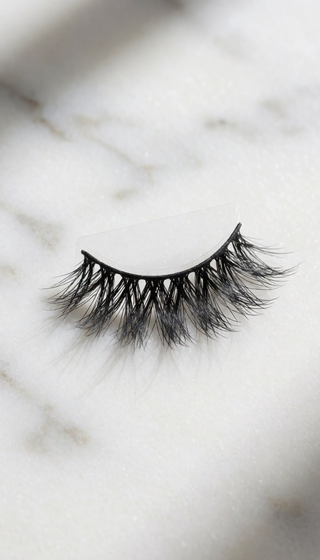
MYTH: ALL LASHES ARE THE SAME – WHY YOUR LASHES KEEP FAILING
Stop guessing why your lashes look heavy or unnatural. Understanding the four core components of lash design is the key to finding the perfect fit for your unique eye shape.

THE ANATOMY OF A PERFECT LASH: WHAT MATTERS BEYOND THE PACKAGING
When selecting lashes, you are not just choosing a style; you are selecting a combination of four distinct engineering elements. If any one of these elements is mismatched to your eye structure or desired effect, the final result will look unnatural, regardless of how well you apply them.
1. The Band: The Foundation of Comfort and Fit
The band is the strip that holds the hairs. Its construction dictates how the lash sits on your eyelid. A stiff, thick band provides structural support but often sits heavily on the waterline, creating a noticeable line that can look fake or uncomfortable. Conversely, a thin, flexible band is designed to contour to the natural curve of your eye, allowing the lash to appear weightless and seamlessly integrated into your lash line. If lashes are lifting at the corners, it is often because the band lacks the necessary flexibility to follow the natural curve of your eye.
2. Hair Material: Texture and Visual Depth
Lash materials fall broadly into synthetic and natural-mimicking fibers (like silk or faux mink). Synthetic fibers are known for their high shine and ability to hold a dramatic curl, which can be beneficial for high-glamour looks. However, up close, this shine can appear artificial. Fibers mimicking natural hair are matte, possess a softer texture, and are designed with a natural taper at the tips. This matte finish helps diffuse light, making the lashes blend more harmoniously with your own natural lashes, creating a look that appears like an enhancement rather than an addition.
3. Length Pattern: Sculpting Your Eye Shape
This is arguably the most critical element for achieving a flattering look. The length pattern dictates where the visual weight of the lash falls on your face. Some patterns feature longer hairs concentrated in the center, creating a pronounced "doll" or "cat eye" effect. Others concentrate length on the outer corners, creating a lifted, "winged" appearance. A wispy or natural pattern features short hairs near the inner corner that gradually increase in length toward the outer edge. Mismatch occurs when a center-flare lash is applied to round eyes, which can make them appear wider, or when a heavy outer-flare is used on hooded eyes, which can cause the eye to appear weighed down.
4. Density: Volume vs. Subtlety
Density refers to how tightly packed the hairs are at the base of the strip. A high-density lash packs hairs closely together, resulting in a heavy, voluminous, and dramatic look. A sparse lash, conversely, has visible gaps between the hairs. This allows your natural lash line to remain visible through the lash, providing a more subtle, airy, and natural appearance. Furthermore, dense lashes carry more weight, which can cause them to droop, particularly if your natural lashes are naturally straight.
DIAGNOSING YOUR LASH ISSUES: A QUICK CHECKLIST
If your current lashes are failing to deliver the look you want, the issue is likely a design mismatch, not an application error. Use this checklist to identify the specific component that is causing the issue:
- The "Sits On My Eye" Problem: If the lash feels like it is resting on your eyeball rather than attached to your natural lash line, the band is too thick. You require a thinner, more flexible band that sits higher on the lid.
- The "Lifts at the Corner" Problem: This indicates the band is too rigid. You need a flexible band capable of conforming to the unique curve of your eye.
- The "Overdone/Costume" Problem: If the lash looks too heavy or dense for your features, the pattern is too dramatic. Switch to a wispy style with varying lengths and a sparser base.
- The "Looks Flat/Lacks Lift" Problem: If your natural lashes are straight and pointing down, a heavy, dense lash will only weigh them down further. Opt for a lightweight, flared lash design with a thin band to encourage an upward lift.
HOW TO INTERPRET LASH DESCRIPTIONS LIKE AN EXPERT
You can decode the quality and style of a lash before you even open the packaging by analyzing the terminology used in the product description and imagery.
- Look for "Wispy" or "Flared": These terms signify a deliberate variation in hair length, which is the foundation of a natural, wearable look.
- Search for "Lightweight" or "Featherlight": This suggests the band is thin and the overall density is managed, prioritizing comfort and subtlety.
- Avoid "Volume" or "Drama" for Daily Wear: By definition, these terms imply high density and heavy application, which is not suitable for a natural, everyday enhancement.
- Analyze Side-Profile Photos: Always look for images taken from the side. These angles allow you to visually assess the thickness of the band and the overall density of the hairs without the distortion of a straight-on view.
THE SOLUTION: DESIGN ENGINEERED FOR YOUR NATURAL LASH LINE
The frustration of mismatched lashes ends when you choose a product engineered around these precise principles. PHANSTA LASHES focuses on the intersection of comfort and aesthetic perfection. Every style is crafted using ultra-thin, flexible bands that sit perfectly against the lid, ensuring a weightless feel. We utilize soft, matte fibers that mimic the look of natural hair, avoiding the artificial shine. Crucially, our 17 available styles are not random; they are curated based on the four design elements—pattern, density, band flexibility, and material—to provide a specific, flattering outcome for various eye shapes and desired looks.
FREQUENTLY ASKED QUESTIONS
Are expensive lashes worth it?
Answer: Not necessarily. The value lies in the engineering—specifically the band's flexibility and the fiber's taper. A mid-range lash with a superior, thin band and soft fibers will provide a better experience than a costly lash with a stiff, thick band.
What is the best style for a first-time user?
Answer: We recommend a style that is shorter near the inner corner and gradually flares outward. This design is the most forgiving across different eye shapes and helps mask minor application inconsistencies while still providing a beautiful lift.
Can I make a heavy lash look natural?
Answer: It is extremely difficult. While trimming can adjust length, it cannot alter the inherent density of the fibers. For a truly natural look, the initial selection must be a sparse, wispy style.
How long do PHANSTA LASHES last?
Answer: Because our lashes are designed for comfort and durability, they are built to last 30+ wears per pair. They are also waterproof and hypoallergenic, ensuring they maintain their integrity through various wear conditions.
What makes PHANSTA LASHES different from traditional magnetic lashes?
Answer: PHANSTA LASHES utilizes advanced glue-free micro-adhesion technology. Unlike magnetic systems, our lashes are designed for superior comfort and adherence without relying on magnets, offering a more secure and lightweight experience.
📚 Browse our complete library of lash guides →
Experience the Difference of PHANSTA LASHES
Quick to apply, gentle on eyes, beautiful all day. Reusable 30+ wears per pair.
SHOP PHANSTA LASHES — GLUE-FREE, 30+ WEARS →