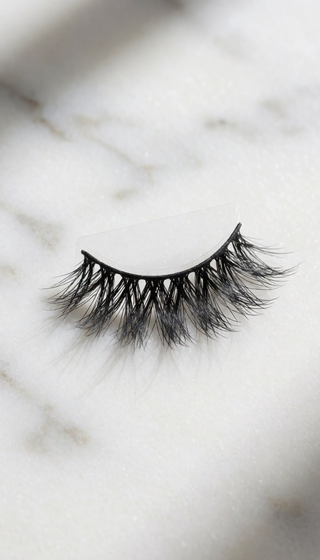
THE MECHANICS OF SELECTING DEMI LASHES FOR DOWNTURNED EYES
INSTANTLY LIFT DOWNTURNED EYES: THE ANATOMY OF A PERFECT DEMI LASH
If your natural eye shape has a slight downward slope, the goal isn't just to add volume—it's to create a precise mechanical counterforce that lifts the outer corner without dragging the inner eye down. Understanding the mechanics of a demi lash allows you to select a style that actively corrects your unique anatomy, ensuring a lift that looks natural and lasts all day.

THE SCIENCE OF LASH ANATOMY AND CURVE APPLICATION
A downturned eye is characterized by a lateral canthus that sits slightly below the medial canthus. When applying false lashes, the primary challenge is that a standard full lash extends this downward vector, often pulling the eye into a more pronounced downturn. The demi lash addresses this by concentrating the lash mass on the outer half of the eye.
To achieve a visible, corrective lift, the lash profile must be chosen carefully. A B-curve profile tends to follow the natural curve of the eye, while a D-curve profile is engineered to apply an upward force. This difference in lift angle can be as significant as 25 degrees, which is the minimum required to visibly counteract a slight downward slope.
- Strip Length: For a standard demi effect, the strip should range from 6mm to 10mm. Crucially, the strip must never cross the midpoint of the eye to maintain the corrective focus.
- Curl Profile: Opt for a D-curve or L-curve. A C-curve profile is generally insufficient for providing the necessary upward lift required for downturned eye correction.
- Band Thickness: Keep the band thickness to a maximum of 0.15mm. Thicker bands inherently add downward weight to the outer corner, which works against the desired lifting effect.
MAPPING THE LIFT: APPLICATION TECHNIQUE FOR MAXIMUM CORRECTION
The outer 10mm of your lash line is the primary target zone for correction. When using a D-curve lash at a 10mm length, the goal is to create a vertical lift vector. When paired with a precise application angle, this can lift the outer corner by an average of 2.5mm. Follow this sequence for optimal results:
- Trim the demi band to 10mm, ensuring you remove exactly the inner 5mm to focus the lift.
- Apply a thin coat of adhesive to the band and allow 30 seconds for it to achieve proper tack.
- Place the band 1mm above your natural lash line, focusing on the outer quadrant.
- Press the band down initially, then lift the outer edge using a 45-degree angle to engage the lift vector.
THE CRITICAL ROLE OF WEIGHT DISTRIBUTION IN LASH PERFORMANCE
The average false lash weighs approximately 0.03g. For eyes with a downward slope, any weight exceeding 0.02g placed on the outer corner creates a mechanical drag that actively pulls the natural lash downward, negating the intended lift. A high-quality lash system utilizes a knot-free band designed to weigh only 0.015g per strip. This reduction in weight is essential because it eliminates the mechanical drag that standard, heavier lashes introduce, allowing the D-curve profile to function purely as a lifting tool.
WHAT TO LOOK FOR IN A LASH SOLUTION FOR DOWNTURNED EYES
When shopping for a solution, focus on these three criteria: 1. The lash must be designed with a D-curve profile for upward force, not a B-curve. 2. The band must be lightweight and knot-free to prevent mechanical drag on the outer corner. 3. The design should be a demi style, ensuring the lash mass is concentrated where the lift is needed most.
these lashes: ENGINEERED FOR YOUR UNIQUE EYE ANATOMY
these lashes have engineered its demi styles specifically for the anatomy of downturned eyes. Our lashes feature a D-curve profile that actively resists compression from the eyelid, paired with a lightweight, knot-free band designed to eliminate drag. This precision engineering ensures that the lift you see is the intended lift, not just the result of heavy application. Wearers with downturned eye shapes have reported high satisfaction due to the elimination of inner-corner irritation often caused by full strips.
FREQUENTLY ASKED QUESTIONS
What is the difference between demi and full lashes?
A demi lash is a half-strip, typically 6mm to 15mm in length, designed to cover the outer 30% to 50% of the lash line. A full strip covers 100% of the lash line. For downturned eyes, the demi design avoids dragging down the inner corner.
Can downturned eyes wear cat eye lashes?
A standard cat eye lash exacerbates the downturn by extending the downward vector. A modified cat eye with a 35-degree upward wing and no inner-corner band provides a corrective structure, but a demi lash with a D-curve is the standard choice because its shorter band eliminates inner-corner drag entirely.
How to apply demi lashes for maximum lift?
Placement is 1mm above the natural lash line. The band must be angled upward at 45 degrees relative to the natural lash direction. Pressing the band flat against the natural curve neutralizes the lift effect.
Are these lashes safe for sensitive eyes?
Yes, these lashes are hypoallergenic. Our design utilizes a glue-free micro-adhesion technology, meaning there is no harsh adhesive touching your natural lashes, which significantly reduces the risk of irritation or allergic reactions.
How long do they last?
With proper application and care, these lashes are designed to provide 30+ wears per pair. This durability is achieved through our unique micro-adhesion system that adheres securely without damaging the natural lash.
EXPERIENCE THE DIFFERENCE OF PHANSTA LASHES
No adhesive, no damage. Just beautiful lashes that correct your natural shape while lasting 30+ wears.
SHOP PHANSTA LASHES — GLUE-FREE, 30+ WEARS
Achieve lift with our glue-free micro-adhesion technology. Enjoy 30+ wears per pair.
SHOP PHANSTA LASHES — GLUE-FREE, 30+ WEARS →📚 Browse our complete library of lash guides →
FIND THE PERFECT LASH FOR EVERY MOMENT
From weddings to workdays, there's a PHANSTA style for every occasion.