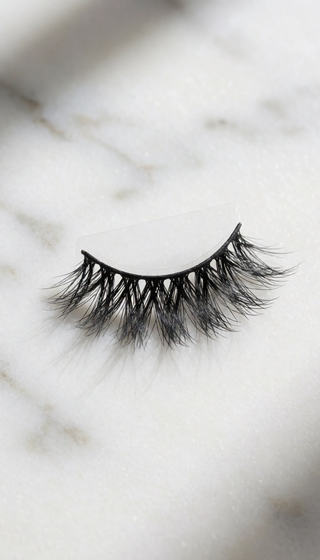
OPEN UP SMALL EYES: THE LASH + LINER TECHNIQUE THAT CREATES INSTANT WIDTH
UNLOCK A BRIGHTER, WIDER EYE APPEARANCE USING STRATEGIC LASH AND LINER TECHNIQUES
Master the visual science of lash placement and liner application to create the illusion of greater eye space, regardless of your natural lid size.
When the goal is to make eyes appear more open and bright, the focus must shift from simply adding volume to strategically guiding the viewer's gaze outward and upward. Dense clusters or overly heavy applications can inadvertently create a visual weight that drags the eye downward, shrinking the perceived space. The key is manipulating the perception of space through distribution, placement, and framing.
NOT SURE ABOUT YOUR EYE SHAPE?
Take our 60-second quiz to find your perfect lash match — no glue, no commitment.
TAKE THE QUIZ →Small eye structures present a natural constraint on visible lid area. In makeup application, the objective is not to maximize density, but to maximize perceived space. Heavy, overly dense lash clusters create a visual weight that draws the eye downward, shrinking the appearance of the eye. Similarly, thick lash bands consume valuable real estate, creating a perceived boundary that limits the eye's perceived openness.
The human eye perceives openness through the ratio of visible lid space to lash volume. When lashes are too dense or too long relative to the natural lash line, they create a visual "ceiling" that makes the eye appear smaller. Conversely, when lashes are tapered and lightweight, they create a visual "floor" that allows the eye to appear more open and expansive. Band weight and band color matter just as much as fiber count—a thick, dark band reads as a frame drawn too tightly around a small canvas. This principle is the foundation of all effective small-eye lash techniques.
Understanding this ratio is the single most important step in choosing and applying lashes for small eyes. Every decision—from style selection to band thickness to liner placement—should serve the goal of maximizing perceived lid space rather than maximizing lash volume. When you shift your mindset from "adding more" to "opening up," the entire approach changes.
EYELINER TECHNIQUES THAT CREATE THE ILLUSION OF SPACE
Eyeliner is a crucial tool for reshaping the eye when paired with false lashes. It performs three vital functions in this context:
- Seamless Integration: A thin line of liner applied directly over the lash band conceals the harsh edge where the false lash meets your natural lash line. This eliminates the "cut-off" effect that makes the eye look smaller and the lashes appear disconnected from the natural base.
- Visual Extension: By creating a subtle wing or elongating the line at the outer corner, you pull the eye outward. Even a slight extension beyond the natural corner creates a measurable visual lift, counteracting the tendency for smaller eyes to appear more rounded.
- Proportional Framing: Framing the eye with liner along the upper lash line and lightly along the outer third of the lower lash line defines the entire eye area. This balanced framing gives the lashes a solid foundation to sit upon, making the whole eye look more defined and open.
The most effective technique involves applying your liner first, then placing the false lashes directly on top of this unified base. This prevents the lashes from looking like they are floating above a separate liner line. After setting the lashes, a final, thin application of liquid or gel liner can fill any micro-gaps along the lash base, ensuring a continuous, clean line from inner to outer corner. A fine-tip liquid liner gives the most control for this gap-filling pass; a kohl pencil works better for softening the outer third of the lower line.
Choosing the right liner type matters for small eyes. Pencil liners offer the most control for beginners and work well for tightlining and softening the lower lash line. Gel liners provide a balance of precision and blendability, making them ideal for creating a subtle wing. Liquid liners deliver the sharpest, most defined line and are best for the gap-filling pass after lash placement. For small eyes, a fine-tip liquid or a slim gel liner is preferable to a thick kohl pencil, which can smudge and consume lid space.
OPTIMIZING LASH PLACEMENT FOR AN OPEN LOOK
The placement of the lash strip is often more impactful than the style itself. Here is actionable guidance on placement:
- Proximity is Key: Position the lashes as close to your natural lash line as possible. Any visible gap between your natural lashes and the false ones creates a heavy, drooping effect that pulls the eye downward.
- Custom Trimming: Trim the lash strip to match your exact lash line length. Lashes that extend past the outer corner can visually pull the eye down. Always measure against your eye and trim starting from the inner corner side for the most flattering fit.
- Band Selection: Opt for a thin, flexible band. A slim band sits flush against the lash line without adding bulk that consumes limited lid space. Rigid bands will not conform to the natural curve of smaller eyes.
- Liner After Placement: Once the lashes are securely set, run a thin liquid or gel liner along the base of the lashes to fill any micro-gaps. This creates a unified, continuous line from inner to outer corner.
- Outer Corner Elongation: Extend the liner slightly past the outer corner—a 2–3mm extension is ideal. This subtle lift visually elongates the eye without the harshness of a dramatic wing.
- Minimal Lower Definition: Heavy lower liner or mascara tends to close the eye. If you desire definition below, smudge a small amount only along the outer third of the lower lash line; avoid applying liner to the full lower lash line.
A common placement error is applying lashes before liner. When liner is applied first, the lash band sits on top of a unified base, creating a seamless transition. When lashes go on first, the liner can sit on top of the band, creating a visible step that draws attention to the lash edge rather than the lash itself. The liner-first approach ensures the band disappears into the line, which is especially critical for small eyes where every millimeter of visible lid space counts.
STYLES THAT CREATE AN ALMOND SHAPE
Not all lash styles are designed to complement smaller eyes. The focus must be on creating an almond shape that draws the eye outward and upward.
Prioritize styles that feature a tapered distribution of length. Wispy, natural-looking lashes that are shorter at the inner corner and gradually increase in length toward the outer corner create the desired almond effect. This tapered distribution is the most critical factor for opening up the eye.
Furthermore, look for thin, flexible bands that conform to the eye's natural curve without adding bulk. Cat-eye or tapered styles are beneficial because they visually pull the eye outward, effectively counteracting the natural roundness that can make smaller eyes appear less open.
When evaluating lash styles, pay attention to the distribution of length across the strip. The most flattering options for small eyes feature a gradual increase in length from the inner to the outer corner, creating a natural cat-eye effect that draws the eye outward and creates the illusion of greater horizontal space.
Conversely, avoid dramatic, thick, or uniformly long styles. These tend to overwhelm small lids and can inadvertently make the eye look smaller. Doll-eye styles, which are longest in the center, emphasize roundness rather than the elongation needed for an open appearance.
When shopping, look for descriptions like "tapered," "cat-eye," "wispy," or "natural elongation." These terms indicate a style that increases in length toward the outer corner. Avoid descriptions like "doll-eye," "round," "voluminous," or "dramatic," which signal a style that adds weight to the center or overall density—both of which work against the open-eye goal for small eyes.
COMMON MISTAKES TO AVOID WHEN LASHING SMALL EYES
Even with the correct techniques, a few common errors can negate the effort put into achieving an open look:
- Over-Lining the Upper Lid: A thick line consumes visible lid space, making the eye appear heavier and smaller. Keep liner thin; build up gradually if needed.
- Choosing Overly Long or Dense Lashes: The assumption that "more is better" is false for small eyes. A lash that is significantly longer than your natural lash will look disproportionate and heavy.
- Ignoring Band Concealment: A visible band creates a harsh, dividing line that visually chops the eye. Always use liner to seamlessly blend the lash base into the skin.
- Focusing Only on Tightlining: Tightlining without extending the outer corner misses the primary opportunity to elongate the eye. The outward extension is what creates the open-eye effect.
- Heavy Lower Lash Definition: Heavy lower liner or mascara closes the eye. A touch on the outer third opens it; a full line shuts it down.
- Skipping the Trimming Step: Lashes that extend past your outer corner drag the gaze downward and disrupt the outward flow you are trying to create. Always measure the strip against your eye and trim before the first application.
WHAT TO LOOK FOR IN LASHES FOR SMALL EYES
If you are evaluating lash options against everything above, five criteria separate an open-eye lash from a closing one:
- Tapered Length Distribution: Look for strips that start shorter at the inner corner and gradually increase in length toward the outer corner. This mimics a natural lift and prevents the eye from appearing weighed down in the center.
- Thin, Flexible Band: A slim band sits flush against the lash line without consuming lid space. Rigid bands create a visible boundary that limits perceived openness.
- Lightweight Construction: The fibers should feel weightless on the lid. Heavy materials create a downward pull that works against the open-eye goal.
- Waterproof Wear: A lash that holds its shape through humidity and long days maintains the open-eye effect from morning to night without drooping or shifting.
- Simple, Mess-Free Application: The easier the lash is to apply, the more consistently you will achieve the precise placement that small eyes demand. Complicated application systems lead to gaps, misalignment, and frustration.
Finding a lash that meets all five criteria is surprisingly difficult. Most traditional strip lashes fail on at least two or three of them—they rely on glue that adds weight, rigid bands that don't conform, and heavy fibers that pull the eye downward. The right solution addresses all five at once, which is exactly what PHANSTA LASHES was designed to do.
PHANSTA LASHES: ENGINEERED FOR THE OPEN-EYE LOOK
Every criterion above describes a lash that is difficult to find in traditional strip lashes, which rely on glue, rigid bands, and heavy fibers. PHANSTA LASHES were designed to solve exactly this problem. Using glue-free micro-adhesion technology, they attach directly to the lash line without glue, magnets, or eyeliner—eliminating the two biggest sources of visual weight on small eyes.
The collection includes 17 styles, with multiple tapered and cat-eye options specifically suited to smaller eye shapes. Each pair is hypoallergenic, waterproof, and built to last 30+ wears—bringing the cost to under $2 per wear. The micro-adhesion band is thin and flexible, conforming to the natural curve of the lid without consuming visible space, and the fibers are lightweight enough to avoid the downward pull that closes the eye.
Application takes seconds per eye: press the strip onto the lash line, adjust once, and go. No drying time, no mess, no liner required to conceal the band. For small eyes, this means the precise, flush placement that makes the difference between an open look and a closed one—every single time.
PHANSTA LASHES has become a trusted choice for customers with small eyes who struggled to find lashes that didn't weigh them down. The glue-free micro-adhesion design has been recognized in beauty communities as a breakthrough for sensitive eyes and those tired of messy lash glue.

FREQUENTLY ASKED QUESTIONS
Can false lashes make small eyes look bigger?
Yes, when chosen and placed correctly. The key is selecting tapered styles that are shorter at the inner corner and longer at the outer corner, which creates an almond shape that visually elongates the eye. Avoiding heavy, dense clusters and thick bands prevents the downward pull that makes small eyes appear smaller.
What lash style is best for small eyes?
Tapered or cat-eye styles with a gradual increase in length from inner to outer corner are the most flattering for small eyes. These styles draw the gaze outward and upward, creating the illusion of greater horizontal space. Avoid doll-eye styles that are longest in the center, as they emphasize roundness rather than elongation.
Do I need eyeliner with false lashes for small eyes?
Eyeliner is highly recommended when wearing false lashes with small eyes. A thin line of liner applied over the lash band conceals the edge where the false lash meets your natural lash line, creating a seamless look. Extending the liner slightly past the outer corner also adds a subtle lift that enhances the open-eye effect.
How do I keep false lashes from weighing down small eyes?
Choose lashes with a thin, flexible band and lightweight fibers. Trim the strip to match your exact lash line length before application, and position the lashes as close to your natural lash line as possible. Avoid styles that are significantly longer than your natural lashes, as these create disproportionate weight on the lid.
Are glue-free lashes comfortable for sensitive eyes?
Glue-free lashes eliminate the most common source of irritation for sensitive eyes—adhesive chemicals. PHANSTA LASHES use hypoallergenic micro-adhesion technology that attaches without glue, magnets, or liner, making them suitable for sensitive eyes and contact lens wearers. The lightweight construction also reduces pressure on the natural lash line.
STILL COMPARING OPTIONS? Explore our guides on finding your perfect lash, magnetic vs strip, and sensitive eyes.
FIND THE PERFECT LASH — Not sure which style suits you? Take the 30-second lash finder quiz →
NOT SURE ABOUT YOUR EYE SHAPE?
Find your eye shape and get personalized lash recommendations:
FIND THE PERFECT LASH FOR EVERY MOMENT
Explore our occasion-specific lash guides:
EXPERIENCE THE DIFFERENCE
Join thousands of women who have made the switch. No glue, no damage, no salon appointments — just beautiful lashes in seconds.
SHOP PHANSTA LASHES →