FALSE LASH MAPPING STYLES: GET THE EXACT EYE LOOK YOU WANT
If you've ever applied false lashes and felt something was "off" — the shape looked wrong, the proportions felt strange, or the effect didn't match what you pictured — the problem usually isn't the lashes themselves. It's the mapping. Mapping refers to how fiber length is distributed along the lash band, and it single-handedly determines whether your lashes lift, open, or subtly enhance your eyes. Get the mapping right and even inexpensive lashes look intentional and polished. Get it wrong and even premium lashes can look droopy, clownish, or oddly placed.
Three mapping styles dominate the false lash landscape — cat-eye, doll-eye, and wispy — and each produces a distinctly different effect. Understanding how they work lets you choose with confidence instead of guessing, and it explains why two pairs of lashes with identical fiber length can look completely different once applied. Most lash wearers focus entirely on fiber length, curl, and material, overlooking the one factor that determines how the final look sits on your face: the distribution pattern along the band.
CAT-EYE MAPPING: THE LIFTED, ELONGATED LOOK
Cat-eye mapping places the longest fibers at the outer third of the lash band, creating a gradual taper toward the inner corner. This mimics the effect of a winged eyeliner — pulling the eye upward and outward for a lifted, elongated appearance. It is the most universally flattering mapping style and works especially well on almond, monolid, downturned, and hooded eye shapes.
The key to nailing this look is the transition. The length should build gradually from short at the inner corner to longest at the outer corner — never a sudden jump. A smooth gradient keeps the effect looking natural rather than clownish. If the longest fibers are too short, the effect is lost; if they're too long, the lashes can droop and work against gravity throughout the day.
Who it suits best: Almond eyes, monolid eyes, downturned eyes, hooded eyes, and anyone wanting a lifted, feline finish. If your eyes are naturally round or wide-set, cat-eye mapping adds balance and prevents a "surprised" look.
Application tip: When applying cat-eye lashes, allow the band to conform to your lid curvature before pressing the outer corner into place. A stiff band can spring the outer fibers away from the natural lash line, breaking the gradient that makes the mapping work.
DOLL-EYE MAPPING: THE OPEN, ROUNDED LOOK
Doll-eye mapping places the longest fibers at the center of the band, with shorter fibers tapering toward both the inner and outer corners. This opens up the center of the eye, making the iris appear larger and rounder — the classic "doll-eyed" or "doe-eyed" effect. It is the go-to for anyone wanting a youthful, wide-awake look.
The critical factor here is proportion. The center fibers should be noticeably longer than the corner fibers, but not dramatically so — a difference of roughly 2-3mm is the sweet spot. Too much contrast and the effect becomes theatrical; too little and the mapping is invisible. The result should be an eye that looks open and bright, not overwhelmed by lashes.
Who it suits best: Deep-set eyes, almond eyes with a flatter profile, and anyone wanting a brighter, more open appearance. If your eyes are already round, proceed with caution — doll-eye mapping can exaggerate roundness. If they are deep-set, it can make them appear more open and less recessed.
Application tip: Center the lash band carefully before pressing it into place. Even a few millimeters off-center shifts the longest fibers away from the pupil, which can make the mapping read as asymmetric rather than intentionally rounded.
WISPY MAPPING: THE TEXTURED, NATURAL LOOK
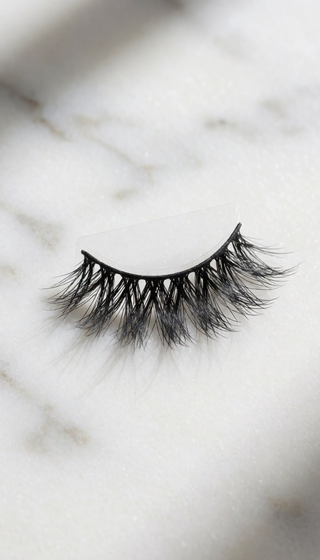
Wispy mapping distributes longer fibers at scattered intervals along the band rather than concentrating them at a single point. The result is a feathered, textured finish that mimics the natural variation of real lashes — some strands longer, some shorter, creating depth without an obvious pattern. It sits between the dramatic structure of cat-eye and the uniform roundness of doll-eye.
The trick to a convincing wispy map is irregularity. If the longer fibers are placed too evenly, the lash looks striped rather than wispy. Manufacturers that achieve a convincing wispy effect vary both the length and the spacing of the longer clusters, so the eye catches dimension rather than pattern.
Who it suits best: Anyone seeking a natural, "your lashes but better" enhancement. It is particularly flattering on oval and heart-shaped faces where neither extreme elongation nor extreme roundness is needed. It also works well for beginners because the irregular pattern is forgiving — minor placement errors are far less visible than with a structured cat-eye or doll-eye map.
Application tip: Wispy lashes are the most forgiving mapping to apply. Starting with a wispy style lets you practice band placement and adhesion without the pressure of achieving a precise gradient or perfectly centered focal point.
MATCHING YOUR MAPPING TO YOUR EYE SHAPE
Choosing a mapping style is less about trends and more about geometry. If you are unsure of your eye shape, look straight into a mirror and note whether you can see a crease above your lash line, whether your outer corner sits higher or lower than your inner corner, and whether your iris appears large or small relative to the visible white of your eye. Those three observations are enough to point you toward the right mapping.
Here is how the three primary maps interact with common eye shapes:
- Almond eyes — Cat-eye mapping amplifies the natural upward tilt; doll-eye mapping opens the center for a brighter finish. Both work well; the choice depends on whether you want elongation or openness.
- Round eyes — Cat-eye mapping is the safest choice. It adds horizontal length and counteracts the circular shape. Doll-eye mapping will exaggerate roundness.
- Hooded eyes — Cat-eye mapping with a steep length gradient lifts the visible lid area. Keep the longest fibers at the very outer edge so they clear the hood when the eye is open.
- Monolid eyes — Cat-eye mapping creates a visible wing effect where lid space is minimal. Doll-eye mapping can add a center focal point that makes the iris appear larger.
- Deep-set eyes — Doll-eye mapping draws attention to the center of the eye and reduces the visual distance between the brow bone and the lash line.
- Downturned eyes — Cat-eye mapping with extra-long outer fibers counters the natural downward pull. Avoid mapping styles that add weight to the outer corner without also adding lift.
MAPPING STYLES AT A GLANCE
| Mapping Style | Longest Fibers | Effect | Best For |
|---|---|---|---|
| Cat-Eye | Outer third | Lifted, elongated | Almond, hooded, downturned, monolid |
| Doll-Eye | Center | Open, rounded | Deep-set, flatter almond profiles |
| Wispy | Scattered intervals | Textured, natural | Oval, heart-shaped faces, beginners |
WHAT TO LOOK FOR IN A FALSE LASH MAPPING
Not all lashes labeled "cat-eye" or "doll-eye" deliver the effect they promise. Here are the criteria that separate a well-executed mapping from a marketing label:
- Gradual taper: The length transition from short to long should be smooth across at least three distinct zones. A two-zone jump reads as a hard stripe, not a map.
- Band flexibility: A stiff band cannot conform to the curvature of your lid, causing the outer fibers to lift away from the natural lash line and breaking the mapping's effect.
- Fiber density balance: The longest fibers should not be the densest cluster. Overloading the longest zone with too much volume creates a heavy, droopy look that fights the intended lift.
- Application system: The method that holds the lash to your lid — whether adhesive, micro-adhesion strips, or another mechanism — should not add visible weight or bulk along the band, which distorts the mapping.
- Reusability: A mapping you can only wear once defeats the purpose of choosing a style. Look for lashes that maintain their shape and adhesion through multiple applications.
- Material compatibility: If you have sensitive eyes or wear contact lenses, the fiber material and the adhesion method should be hypoallergenic and free of irritating chemical residues.
Once you know the mapping you want and the criteria that matter, the next question is whether a specific lash delivers on all of them. That is where the details of construction — adhesion type, fiber quality, and band design — become the deciding factors. A lash can carry the perfect cat-eye gradient and still fail if the band is too stiff, the adhesive too heavy, or the materials irritating, so evaluating construction is the final step before committing to a style.
The glue-free micro-adhesion system applies in seconds and holds for 30+ wears per pair. Each of the 17 styles is mapped intentionally — whether you want the lifted feline finish of a cat-eye, the wide-open brightness of a doll-eye, or the textured naturalism of a wispy look, there is a style designed for that specific outcome.
PHANSTA LASHES: PRECISION MAPPING WITHOUT THE GLUE
PHANSTA LASHES are built around the mapping criteria above. Every style is hypoallergenic, waterproof, and constructed on a flexible band that conforms to your lid curvature — so the mapping stays exactly where it was designed to sit, from the first application to the thirtieth. Because the micro-adhesion system uses no glue, there is no drying time, no sticky residue, and no irritation along the lash line, making these lashes a practical fit for sensitive eyes and contact-lens wearers. The strips apply cleanly, remove without pulling, and reapply without losing hold.
The three biggest concerns, addressed:
- Glue and irritation: Traditional lash glue is the leading cause of lash-line irritation and allergic reactions. PHANSTA LASHES use a glue-free micro-adhesion system — no chemicals, no drying time, no residue — and the hypoallergenic strips are safe for sensitive eyes and contact-lens wearers.
- Durability: Most strip lashes warp or lose adhesion after a couple of wears, which makes any careful mapping choice feel wasteful. PHANSTA LASHES are engineered for 30+ wears per pair, with strips that reapply cleanly so the fibers hold their shape and the mapping stays true across dozens of applications.
- Price: A $59 pair that delivers 30+ wears works out to under $2 per application — significantly less than replacing single-use lashes every few days.

FREQUENTLY ASKED QUESTIONS
WHAT IS THE DIFFERENCE BETWEEN CAT-EYE AND DOLL-EYE LASH MAPPING?
Cat-eye mapping places the longest fibers at the outer third of the band for a lifted, elongated effect, while doll-eye mapping centers the longest fibers to open the middle of the eye. Cat-eye adds horizontal length; doll-eye adds central brightness. Choosing between them comes down to whether you want elongation or openness.
CAN I WEAR STRIP LASHES WITH SENSITIVE EYES OR CONTACT LENSES?
Yes, provided the adhesion method and fiber material are hypoallergenic. Glue-based systems are the usual culprit for irritation — the chemicals and residues sit directly on the lash line. A glue-free micro-adhesion system with hypoallergenic fibers, like PHANSTA LASHES, removes that exposure and is generally comfortable for contact-lens wearers.
HOW MANY TIMES CAN YOU REUSE A PAIR OF FALSE LASHES?
Traditional glue-applied lashes are often single-use because adhesive residue degrades the band. PHANSTA LASHES are designed for 30+ wears per pair — the micro-adhesive strips reapply cleanly without residue, so the band, fibers, and mapping hold their shape across dozens of applications.
HOW DO I FIGURE OUT WHICH MAPPING SUITS MY EYE SHAPE?
Look in a mirror and note three things: whether a crease is visible above the lash line, whether the outer corner sits higher or lower than the inner corner, and how much iris is visible. Those observations point to the right map — cat-eye for hooded or downturned eyes, doll-eye for deep-set eyes, and wispy for natural texture.
WHAT MAKES A WISPY LASH LOOK NATURAL INSTEAD OF STRIPED?
Irregularity. If longer fibers sit at evenly spaced intervals, the eye reads a repeating stripe. A convincing wispy map varies both length and spacing, so light catches dimension rather than pattern. This irregularity also makes wispy styles the most forgiving for beginners — small placement errors stay invisible.
SHOP PHANSTA LASHES — GLUE-FREE, 30+ WEARS →
STILL COMPARING OPTIONS? Explore our guides on finding your perfect lash, magnetic vs strip, and sensitive eyes.
FIND THE PERFECT LASH — Not sure which style suits you? Take the 30-second lash finder quiz →
NOT SURE ABOUT YOUR EYE SHAPE?
Find your eye shape and get personalized lash recommendations:
FIND THE PERFECT LASH FOR EVERY MOMENT
Explore our occasion-specific lash guides:
EXPERIENCE THE DIFFERENCE
Join thousands of women who have made the switch. No glue, no damage, no salon appointments — just beautiful lashes in seconds.
SHOP PHANSTA LASHES →