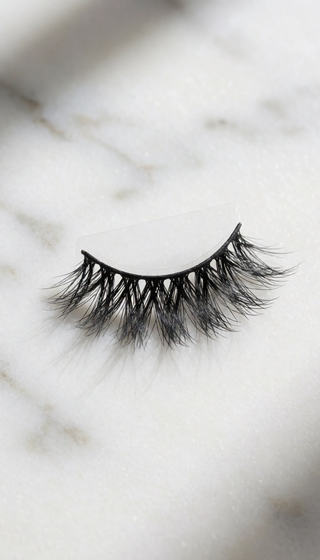
WHY PHOTOSHOOT LASHES NEED EXTRA VOLUME
NOT SURE ABOUT YOUR EYE SHAPE?
Take our 60-second quiz to find your perfect lash match — no glue, no commitment.
TAKE THE QUIZ →
You've probably been there: full face of makeup on, ready for the photo, your everyday lashes applied. And in the picture? Nada. Your lashes look like they never showed up. It's not your makeup — it's the camera. And once you understand how it works, you'll stop blaming yourself and start choosing lashes that photograph the way you actually look.
THE CAMERA LIES — AND HERE'S THE MATHEMATICAL PROOF
Camera lenses compress depth. That's not a feeling — it's physics. When you stand in front of a lens, the three-dimensional space between your lashes and your eye gets flattened into two dimensions. The result: lashes that look fluttery in real life become a barely-there shadow on screen.
- Your phone's front camera uses a wide-angle lens, which flattens facial features even more than a standard lens.
- Flash lighting eliminates the natural shadows that make your lashes visible in the first place.
- The gap between your lash tips and your lid — about 2–3 millimeters — becomes invisible when compressed into a flat image.
WHAT EXTRA VOLUME DOES IN PHOTOS
Extra volume isn't about looking fake in person — it's about looking alive in photos. Here's what a denser lash does that a sparse lash simply can't:
- Rebuilds dimension: A dense lash line casts a tiny shadow over the eye, which the camera captures as depth. That's the difference between a flat "nice photo" and one where your eyes genuinely pop.
- Creates definition: Your eyes need a visible frame in photos — a clean, dark line that separates the eye from the surrounding skin. Volume lashes provide exactly that.
- Works with flash: Flash bounces off light or thin lashes, making them look almost invisible. Darker, denser lashes absorb the flash and photograph as a smooth, rich lash line.
HOW MUCH VOLUME IS ENOUGH — AND WHEN IS IT TOO MUCH?
Here's the specific number: lashes with 3–4 layers of density give you the "photogenic" sweet spot. That's enough to hold the camera's attention without looking costume-y in person.
One thing I learned from a professional makeup artist who shoots campaigns: press the lash band flat against any surface before applying. If it springs back into a curve, it has structure. If it folds or stays flat, it doesn't — and it won't hold its shape through a long shoot.
THE 4-POINT PHOTOSHOOT LASH CHECKLIST
Before you trust any lash with your next photo moment, check these four things:
- Dense at the base, not just the tips. Fanned-out tips with a sparse base don't photograph as volume.
- Structured band. The band should feel firm, not flimsy.
- Matte finish. Shiny lash fibers reflect flash and wash out badly in photos.
- Moderate-to-long length. For most faces, 10–14 mm is the photographic safe zone.
FAQ
Q: Will volume lashes look too much in person?
A: It depends on the style. Volume lashes with a natural curve and matte finish look like a strong mascara moment in person — not "costume." The key is choosing density without excessive length.
Q: Can I use volume lashes for a casual photoshoot?
A: Absolutely. Casual shots with natural light are actually where volume lashes shine. They give you definition without needing heavy post-editing.
Q: How do I make volume lashes last through a full day?
A: They need to stay seamlessly adhered at the inner and outer corners — the two spots that lift first. Checking your lash line after applying and pressing the corners gently will make them last all day.
📚 Browse our complete library of lash guides →
📚 Browse our complete library of lash guides →
Find your eye shape and get personalized lash recommendations: See how PHANSTA compares to traditional lashes: Explore our occasion-specific lash guides:NOT SURE ABOUT YOUR EYE SHAPE?
STILL COMPARING OPTIONS?
FIND THE PERFECT LASH FOR EVERY MOMENT
Quick to apply, gentle on eyes, beautiful all day. Reusable 30+ wears per pair.
SHOP PHANSTA LASHES — GLUE-FREE, 30+ WEARS →