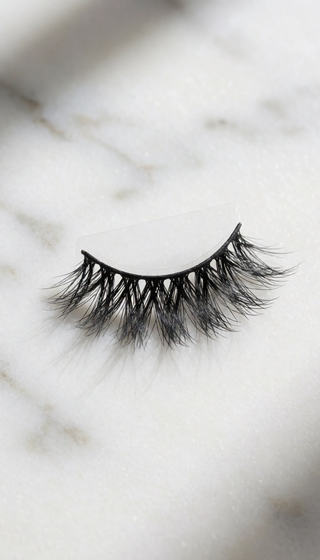
If you've been following the beauty trends, you've likely seen the rise of individual lash clusters. They promise that perfect, natural-looking definition without the heavy, block appearance of traditional strips. But sometimes, the search for that perfect 'natural' look leads to overwhelming choices—some clusters look too chunky, others don't give enough impact, and you end up feeling like you're just wearing a collection of random, uneven hairs.
I remember feeling the exact same way—want that fluffy, defined look, but terrified of looking 'fake' or having an uneven patch. The difference between a genuinely beautiful, enhancing lash and one that looks artificial comes down to the quality of the cluster and how it’s designed to mimic natural density.
DECODING THE 'NATURAL' CLUSTER
A truly natural-looking cluster isn't just one long lash placed next to another. It's about the *pattern* of the cluster. Think of it like a single, perfect clump of hair that grows naturally. The best clusters feature:
- Varying Curvature: Instead of every lash being perfectly straight, natural clusters have subtle, staggered curves that align with your natural lash arc.
- Density Gradient: The cluster should transition from denser at the base to more separated at the tips, mimicking how real hair sheds and fans out.
- Consistent Thickness: The individual fibers within the cluster must be of similar gauge so they blend seamlessly when applied to your existing lashes.
THE 'EVERYDAY' APPLICATION STRATEGY
To achieve that perfect 'just had a good night' effect every morning, you need a strategic application approach. This is where many people go wrong—they apply clusters too thick in one spot or too sparse in another. Here is the technique I always recommend for an undetectable finish:
- The Mapping Technique: Don't place a cluster in a straight line. Map the cluster to follow the natural curve of your eyelid, placing the densest part where your natural lashes are thinnest.
- The Sparseness Rule: For an everyday look, do not cover 100% of your natural lash line. Leave small gaps between clusters. This allows the natural lashes to peek through, providing the necessary contrast that makes the clusters look like they belong there.
- The Feathering Finish: When applying, gently fan the cluster outwards from the center point. This light 'fanning' ensures the cluster looks like a natural outgrowth rather than a glued patch.
THE OUTCOME: FEELING AUTHENTIC
The result of using the right cluster and the right application is more than just beautiful lashes; it's about how you feel looking in the mirror. It's the feeling of waking up and knowing your eyes look instantly more awake, more open, and perfectly framed—all without the heavy, clunky feeling associated with traditional lash extensions. It’s confidence that comes from authenticity.
WHAT TO PRIORITIZE IN YOUR LASH CHOICE
When you are shopping for clusters, shift your focus away from just the length and toward the *design*. Look for clusters marketed with terms like 'Feathery,' 'Fluffy,' or 'Natural Blend.' These terms imply that the manufacturer has focused on the distribution of fibers, not just the sheer length of the longest lash.
You should be looking for a solution that promises comfort, durability, and a design that enhances your bone structure rather than overwhelming it.
COMPARISON: CLUSTER TYPES
| Type | Natural Clusters | Dramatic Volume Clusters |
|---|---|---|
| Fiber Distribution | Varying lengths, feathered | Uniform length, dense |
| Best For | Daily wear, subtle definition | Evening impact, strong statement |
| Application Feel | Light, airy | Full, weighty |
Ready to achieve that perfectly enhanced, effortlessly beautiful gaze?
FREQUENTLY ASKED QUESTIONS
Can I mix different clusters together?
Yes, many beauty editors suggest mixing a wispy cluster with a slightly longer, more defined one in the outer corner for a customized, natural effect.
How do I prevent clusters from looking uneven after one day?
The key is re-evaluation. After 6-8 hours, look closely in good light and gently remove or re-apply any clusters that have shifted out of alignment.