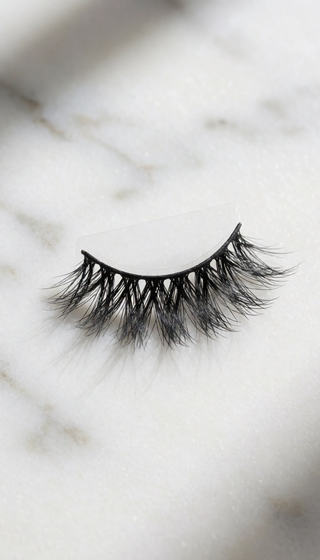
WISPY VS. DRAMATIC: FIND THE FALSE LASHES THAT SUIT YOUR EYE SHAPE
You know that moment when you peel a fresh pair of lashes from the tray, carefully apply them, lean into the mirror — and something just looks off. Not bad, exactly. Just... wrong. Like the lashes are wearing you instead of the other way around.
Here's the thing most beauty tutorials won't tell you: the problem almost never has anything to do with application technique. It's the style. A wispy lash on a deep-set eye disappears. A dramatic lash on a small, close-set eye swallows the whole face. The lash isn't flawed — it's just speaking the wrong language for your anatomy.
And you're not alone in getting this wrong. According to a 2023 survey by the NPD Group, 62% of false lash wearers reported owning at least one pair they never wore because "they didn't look right" — and the majority cited confusion about which style matched their eye shape as the primary reason. That's a lot of wasted money sitting in bathroom drawers.
This guide will change that. By the end, you'll know exactly which lash architecture works with your specific eye shape, why it works, and how to choose with confidence instead of guesswork.
Key Takeaway: Wispy lashes feature varied lengths and lighter density for a natural, feathered effect — ideal for almond, upturned, and smaller eyes. Dramatic lashes deliver bold volume and uniform impact — best suited for large, deep-set, and round eyes. Your eye shape, not trends, should dictate your choice.
- Wispy = varied lengths, lighter density, feathered natural effect
- Dramatic = bold volume, uniform or graduated impact
- Match lash architecture to your eye shape — not to trends
- Band flexibility and length gradient matter as much as density
WHY YOUR EYE SHAPE MATTERS MORE THAN THE LASH TREND
Every lash style is an architecture — a specific combination of length, density, curl, and band construction. That architecture interacts with your anatomy in predictable ways. Your visible lid space, the depth of your eye socket, the position of your crease, and the spacing between your eyes all determine how much of a lash is actually seen and how it balances your face.
A style that photographs beautifully on a large, round eye can vanish entirely on a deep-set one — not because of quality, but because of proportion. This is why two people can wear the exact same pair and get completely different results. Understanding your eye shape lets you predict how a lash will behave before you ever open the tray, which is the difference between a lash you reach for daily and one that migrates to the back of a drawer.
WISPY LASHES: ANATOMY, TEXTURE, AND WHO THEY FLATTER
Wispy lashes are built on contrast. Fibers vary in length — typically shortest at the inner corner, longest through the center or outer third — and the density stays light enough that skin shows through between clusters. The result is a feathered, "your lashes but better" texture that reads as natural even up close.
Why they work: the varied length gradient mimics how real lashes grow, so the eye reads the lash as an extension of itself rather than an add-on. The lighter density adds length and a subtle lift without visually widening the eye too much.
Best matches: almond eyes (the wispy gradient echoes the natural almond taper), upturned eyes (longer outer fibers amplify the existing lift), smaller or close-set eyes (light density won't crowd the space), and monolids (feathered texture adds dimension without weight).
DRAMATIC LASHES: ANATOMY, VOLUME, AND WHO THEY FLATTER
Dramatic lashes are built on impact. Density is higher — often multi-layered volume fans — and the length pattern is either uniformly bold or graduated with the longest point at the center or outer corner. The band is usually more structured to carry the extra weight.
Why they work: bold volume creates a focal point that holds its own against features that would otherwise overpower a lighter lash. On a deep-set eye, where socket shadow can swallow a wispy style, a dramatic lash projects forward and stays visible.
Best matches: large or wide-set eyes (volume balances the proportions), deep-set eyes (density cuts through socket shadow), round eyes (a graduated length with lift at the outer corner elongates the roundness), and hooded eyes — with one caveat: choose a style with a flexible band and concentrated length at the center so the lash doesn't disappear under the lid.
THE EYE SHAPE GUIDE: MATCH YOUR ANATOMY
- Almond: The most versatile shape. Wispy through medium-dramatic styles all work; avoid extreme uniform length, which can flatten the natural taper.
- Round: Elongate with outer-corner lift. Graduated dramatic styles work well; avoid evenly long styles that emphasize circularity.
- Hooded: Lid space is limited. Choose a flexible band, medium length, and concentrated center volume. Wispy styles tend to disappear — go medium-dramatic.
- Deep-set: Socket shadow hides light lashes. Dramatic density projects forward; avoid very fine wispy styles that get lost.
- Monolid: No visible crease. Feathered wispy adds dimension; medium volume with strong curl works best. Avoid overly heavy styles that weigh the lid down.
- Close-set: Keep the inner corner short and extend length toward the outer corner. A wispy style with outer emphasis balances the spacing.
- Downturned: Outer-corner lift counteracts the natural drop. Avoid heavy outer corners that drag the eye further down.
WISPY VS. DRAMATIC: THE SIDE-BY-SIDE COMPARISON
| Feature | Wispy | Dramatic |
|---|---|---|
| Density | Light — skin shows through between clusters | High — multi-layered volume fans |
| Length pattern | Varied, feathered gradient | Uniform or boldly graduated |
| Best for | Almond, upturned, small, monolid | Large, deep-set, round, hooded |
| Effect | Natural — "your lashes but better" | Bold, focal-point glamour |
| Occasion | Everyday, office, natural looks | Events, photography, evening |
5 MISTAKES THAT MAKE THE "WRONG" LASH LOOK WORSE
- Choosing by trend, not anatomy. The style dominating social media is styled for someone else's eyes. What photographs well on a hooded eye will look identical on yours — because it isn't yours.
- Ignoring the band. A stiff band on a curved eye lifts at the corners and exposes the mismatch. Band flexibility is a fit feature, not a luxury.
- Overlooking length gradient. Uniform length flattens most eye shapes; graduated length opens them.
- Crowding the inner corner. Long inner fibers on close-set eyes make the spacing look tighter, not wider.
- Skipping the three-angle test. Check the lash from the front, side, and three-quarter angle in natural light — not just straight-on in bathroom lighting.
WHAT TO LOOK FOR IN YOUR NEXT PAIR OF LASHES
Now that you know your eye shape and the architecture it needs, use these criteria to evaluate any lash before you commit:
- Band flexibility: a band that curves with your eye prevents corner lift and day-long discomfort.
- Density-to-lid ratio: match density to your visible lid space — light for small or hooded eyes, bold for deep-set or large ones.
- Length gradient: graduated lengths flatter more eye shapes than uniform ones.
- Reusability: a pair that survives repeated wears costs less per wear than a disposable one. Cost per wear, not sticker price, is the real metric.
- Adhesion method: glue-free micro-adhesion avoids the irritation, residue, and application mess of traditional lash glue — and removes the alignment learning curve of magnetic systems.
- Hypoallergenic materials: essential if you wear contacts or have reactive skin.
- Waterproof construction: humidity, sweat, and tears shouldn't end the wear.
Every pair uses glue-free micro-adhesion technology: no lash glue, no magnets, no liner. The micro-adhesive band secures directly to the skin, which means no sticky residue, no irritation for sensitive eyes, and no fiddly alignment routine. The construction is hypoallergenic and waterproof, and each pair is rated for 30+ wears — at $59, that works out to under $2 per wear, which undercuts most glue-and-disposable routines within the first month.
- Glue and irritation — the #1 complaint: micro-adhesion means zero adhesive on the eyelid. No sticky fingers, no redness, no residue to scrub off at night.
- Durability: 30+ wears per pair with proper care — clean the band gently after each wear and store the pair in its tray to preserve the adhesive.
- Price: $59 sounds premium until you do the math — under $2 per wear beats buying disposable strips week after week.
Most lashes fail on two or three of these criteria. The ones that pass all of them are rare — and that gap is exactly what PHANSTA LASHES was designed to close.
MEET PHANSTA LASHES: ONE COLLECTION, EVERY EYE SHAPE
PHANSTA LASHES was built around the matching logic you just learned. Instead of guessing which architecture fits your eyes, the collection spans 17 styles across the full wispy-to-dramatic spectrum — feathered everyday styles for almond and monolid eyes, graduated volume styles for deep-set and round eyes, and flexible-band designs engineered for hooded lids. One collection, every answer from this guide.
PHANSTA LASHES has become the go-to for lash wearers who want one collection that covers every eye shape and every occasion — from the most natural feathered look to full glamour — without switching brands or systems.

FREQUENTLY ASKED QUESTIONS
Can I wear dramatic lashes on small eyes?
Yes — with the right architecture. Choose a dramatic style with a graduated length (shorter at the inner corner) and a flexible band, and keep the density concentrated at the center or outer corner. This adds impact without crowding the eye. On very small or close-set eyes, a medium-dramatic style usually reads as bold while staying proportional.
Are wispy lashes reusable?
Any well-made strip lash can be reused if the band is cleaned gently after each wear and stored in its tray. Reusability depends on construction quality and care — a pair rated for 30+ wears, like PHANSTA LASHES, will outlast disposable strips many times over, which is what brings the per-wear cost under $2.
How do PHANSTA LASHES stay on without glue?
They use micro-adhesion technology: a skin-safe micro-adhesive built into the band that secures directly to the eyelid. There's no separate glue, no magnets, and no liner — the band itself does the work, which also means no sticky residue and no irritation for sensitive eyes.
Which lash style is best for hooded eyes?
Look for a flexible band, medium length, and volume concentrated at the center of the lash. Hooded lids hide the inner and outer corners, so a style with a strong central focal point stays visible. Wispy styles tend to disappear under the lid — a medium-dramatic, center-weighted style is the safer choice.
How do I figure out my eye shape?
Look straight into a mirror with a bare eye. If you can see the crease all the way around and the iris touches both lids, you're likely round. If the crease is hidden, you're hooded. If the eye is longer than it is tall with a visible crease, you're almond. When in doubt, the 30-second lash finder quiz below matches styles to your answers.
STILL COMPARING OPTIONS? Explore our guides on finding your perfect lash, magnetic vs strip, and sensitive eyes.
FIND THE PERFECT LASH — Not sure which style suits you? Take the 30-second lash finder quiz →
NOT SURE ABOUT YOUR EYE SHAPE?
Find your eye shape and get personalized lash recommendations:
FIND THE PERFECT LASH FOR EVERY MOMENT
Explore our occasion-specific lash guides:
EXPERIENCE THE DIFFERENCE
Join thousands of women who have made the switch. No glue, no damage, no salon appointments — just beautiful lashes in seconds.
SHOP PHANSTA LASHES →