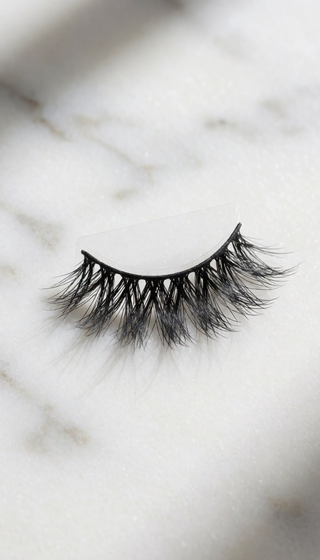
GET THE HONEST TRUTH ABOUT VEGAN LASH QUALITY—AND CHOOSE WITH CONFIDENCE
Vegan lash quality is not guaranteed by the word “vegan.” The label describes material origin, not fiber shape, band comfort, attachment method, or repeat wear. A vegan lash can still look heavy, feel stiff, or have uneven tips, so the label is only the first checkpoint.
Use a fast three-part assessment: inspect the tips in bright light, gently flex the band, and read how one wear is defined. Then check whether fiber spacing and direction appear even. These details reveal more about everyday performance than a luxury-sounding material name.
- Inspect the profile: Fine, consistent tips should narrow toward the ends instead of stopping in flat, visibly chopped shapes.
- Flex the band: A comfortable band should follow the lash line without kinking, fighting the fibers, or feeling rigid.
- Check distribution: Uneven length, clumping, or fibers pointing in different directions can make a lash look heavy or artificial.
- Trace the claims: Confirm whether “vegan” refers to the fibers, band, adhesive, packaging, or every component used.
A useful label separates material origin from performance and safety. Vegan does not automatically mean biodegradable, hypoallergenic, waterproof, or compostable; each of those attributes needs its own evidence.
FIVE QUALITY CHECKS TO USE BEFORE CHOOSING
A lash may look refined in a photograph but behave differently in real life. Evaluate these five areas before judging the overall result.
- Read the material disclosure carefully. Vegan should mean that no animal-derived materials are intentionally used. Clarify whether the statement covers every component. A broad term such as “vegan-friendly” provides less information than a specific material and sourcing statement.
- Examine the fiber tips and taper. A fiber that narrows gradually creates a softer-looking edge than one with an abrupt, blunt end. A thickness measurement can describe an individual design, but there is no universal taper ratio that automatically proves quality.
- Determine how the band is constructed. Hand-knotted fibers can create a flexible edge, while some machine-crimped bands feel stiffer. Neither construction is automatically better: the finished band should remain controllable without pulling against the natural lashes.
- Assess density and fiber direction. Quality is not the same as maximum volume. Even spacing, balanced length, and controlled density help the lash blend with natural lashes instead of creating a heavy edge.
- Look for clear application and wear evidence. The attachment method, removal process, care requirements, and definition of one wear should all be explained. “Up to” a number of wears is less useful than a documented 30+ wear claim with realistic care guidance.
Certification can strengthen a material claim, but vague wording such as “medical-grade” does not prove that a product will cause zero irritation. Clear ingredients, instructions, and precautions are more useful than broad safety slogans.
WHAT VEGAN MATERIALS STILL NEED QUALITY ENGINEERING
Material science matters after vegan status has been established. PBT—polybutylene terephthalate—is a common synthetic lash fiber because it can be formed into fine, consistent strands. Nylon and other synthetic fibers may also be used. Those material names do not guarantee taper, comfort, spacing, or durability, so the finished construction still requires inspection.
PUNCHED FIBERS VS. TAPERED FIBERS
A punched fiber is cut from a thin sheet and may finish with a flatter end. A tapered or extruded fiber narrows toward its tip, which can create a softer silhouette and silk-like appearance. Manufacturers do not always use these terms consistently, which makes examining the actual lash more reliable than relying on a technical label alone.
BAND FLEXIBILITY AND HAND-KNOTTING
Hand-knotting can secure each fiber to the band while preserving flexibility along the edge. A band that is too rigid may pull or create an obvious line; one that is excessively floppy can be difficult to position. The best balance is controlled flexibility.
DENSITY, LENGTH, AND DIMENSION
A dimensional look usually comes from gradual taper, balanced density, and mixed lengths—not simply adding more fibers. Excessively long or dense fibers can overwhelm the natural lashes, while controlled variation helps the style blend while still looking defined.
CALCULATE VALUE BY COST PER WEAR—NOT THE LABEL
A low total cost can still produce a high cost per wear when durability is weak. Compare the documented lifespan, care requirements, and expected uses rather than relying on words such as “premium” or “luxury.”
COST PER WEAR = TOTAL COST ÷ DOCUMENTED WEARS
At $59, dividing by 30 wears gives approximately $1.97 per wear. A documented 30+ wear claim can keep the actual cost below $2, but the calculation is only meaningful when “one wear” and the required care are clearly defined.
DEFINE ONE WEAR HONESTLY
A complete wear might mean a set number of hours, one full day, or one event. Instructions should state the difference between a brief application and continuous wear. An undefined “up to” figure is less useful than a documented 30+ wear range with specific care conditions.
CARE CHANGES REAL-LIFE RESULTS
Remove lashes before sleeping, clean them as directed, let them dry fully, and store them supported in their case. A waterproof surface does not make overnight wear comfortable or prevent the band from warping under pressure.
VEGAN DOES NOT AUTOMATICALLY MEAN BIODEGRADABLE
Vegan status addresses the absence of animal-derived materials. It does not establish how a product behaves after disposal. Synthetic fibers such as PBT and nylon are not automatically broken down in ordinary landfill or compost conditions, even though they contain no animal products.
Claims about bio-resin polymers or faster decomposition need supporting material documentation and specific disposal conditions. “Vegan” alone is not proof that a lash is compostable. Extending the usable life of a durable style and following local disposal guidance can reduce avoidable waste more reliably than a vague sustainability label.
READ SAFETY CLAIMS WITH A HEALTHY SKEPTIC
Safety wording is easy to misread. Vegan addresses material source, hypoallergenic indicates an intention to reduce reactions, and waterproof describes resistance to water. None of those terms guarantees that every person will have the same experience.
- Check the complete application system. If a style uses traditional adhesive, inspect the full ingredient disclosure. “Latex-free” does not automatically mean vegan, and certification for one component may not cover the entire application process.
- Interpret certification carefully. A named certification and clear sourcing information provide more context than broad terms such as “medical-grade,” which are not universal proof that a product is irritation-proof.
- Use the lash as directed. Follow placement, removal, and storage instructions. Stop using it if burning, redness, swelling, pain, or discharge occurs, and never apply a cosmetic product to an already irritated eye.
WHAT TO LOOK FOR IN A COMPLETE LASH SOLUTION
Use a final scorecard instead of relying on one impressive word. A complete solution should make the following points easy to verify:
- A specific material-origin and sourcing statement.
- Tapered fibers, even spacing, and controlled density.
- A lightweight, flexible band that remains easy to position.
- A clearly explained attachment, removal, and care process.
- Documented wear, realistic use conditions, and transparent cost per wear.
When material transparency, construction, comfort, care, and wear all support each other, the choice becomes much clearer.
GET DEFINED VOLUME WITH GLUE-FREE, 30+ WEAR CONVENIENCE
THE THREE BIGGEST CONCERNS, ANSWERED
- GLUE AND IRRITATION Micro-adhesion works without separate glue, magnets, or liner. The build is hypoallergenic, although no eye-area cosmetic can promise that every person will have zero reaction.
- DURABILITY The documented target is 30+ wears. Remove, clean, and store according to the care directions so the fibers and band retain their shape between uses.
- VALUE AND CHOICE Seventeen styles are available at $59. Using the stated 30+ wear range keeps the cost under $2 per wear.
PHANSTA LASHES combines a waterproof, hypoallergenic build with glue-free micro-adhesion—no separate glue, magnets, or liner required.
The natural answer is not a louder label but a system that makes attachment, care, and wear expectations clear. PHANSTA LASHES provides that practical combination for readers who want a defined, repeatable lash routine without a separate glue step.
FREQUENTLY ASKED QUESTIONS
DO VEGAN LASHES MELT IN HIGH HEAT?
Vegan describes materials, not heat resistance. Many lashes use synthetic fibers such as PBT, which tolerate normal storage and travel, but a lash can still warp near a hot car, radiator, curling appliance, or direct flame. Keep the band away from heat and follow the maker’s storage directions, especially if the system includes adhesive.
ARE VEGAN LASHES HARDER TO APPLY?
Vegan status does not determine ease of application. A flexible band, even fiber spacing, a clear attachment method, and practiced placement matter more. Lay the lash against the natural lash line, press the band into place as directed, and avoid pulling the fibers. If the lash sits above the lashes, reposition it rather than adding more pressure.
CAN I SLEEP IN VEGAN LASHES?
Removing lashes before sleeping is the safer routine. Pressure from a pillow can twist the band, crush fibers, or leave adhesive residue, while trapped warmth and moisture may increase irritation or bacterial buildup. For a reusable style, remove it gently, clean and dry it as instructed, then store it supported in its case rather than loose.
HOW DO I IDENTIFY A GENUINELY HYPOALLERGENIC LASH?
“Hypoallergenic” describes a formulation intended to reduce allergic reactions; it does not guarantee that no person will react. Check the complete material and adhesive disclosure, follow application and removal directions, and stop using the product if burning, redness, swelling, or discharge occurs. Persistent symptoms need medical attention, and a lash should never be applied to an irritated eye.
WHAT IS THE DIFFERENCE BETWEEN MICRO-ADHESION AND TRADITIONAL GLUE?
Traditional lash glue creates a bond between an adhesive and the natural lash. Micro-adhesion describes a different attachment approach intended to secure the strip without a separate glue step. Ask the manufacturer what the technology contains, how the lash is positioned, and how it is removed. “No adhesive” does not mean irritation-proof, so normal eye-area caution still applies.
EXPLORE OCCASION-SPECIFIC LASH GUIDES: Wedding Lashes, Prom Lashes, Beach Lashes, and Festival Lashes.
EXPLORE EYE-SHAPE LASH GUIDES: Hooded Eyes, Almond Eyes, Round Eyes, Monolid Eyes, Close-Set Eyes, Deep-Set Eyes, and Prominent Eyes.
STILL COMPARING OPTIONS? Explore our guides on finding your perfect lash, magnetic vs strip, and sensitive eyes.
FIND THE PERFECT LASH — Not sure which style suits you? Take the 30-second lash finder finder →