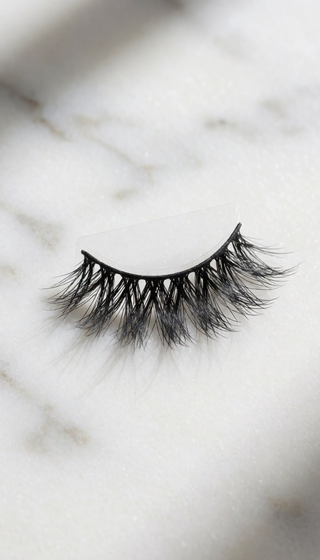
TOP FLARED LASHES FOR WIDE-SET EYES | these lashes
Visually Narrow Your Eye Spacing by Engineering a Central Lash Focus
Learn the optical principles of lash architecture that draw the viewer's eye inward, creating the illusion of perfectly balanced, closer-set eyes.
THE OPTICAL PRINCIPLES OF LASH ARCHITECTURE
The perception of eye spacing is heavily influenced by the visual weight and distribution of the lashes. When eyes are set wider than average, the goal of lash styling is not to add overall volume, but to create a focal point that draws the viewer’s eye inward toward the center of the face. This is achieved through specific architectural design rather than sheer density.
Understanding facial proportions is key. The standard guideline suggests that the distance between the inner corners of the eyes should roughly equal the width of one eye. For those with a wider set, the lash application needs to compensate by creating a visual anchor in the center. A standard cat-eye flare naturally pushes the gaze outward, which is the opposite of the corrective effect needed.
ENGINEERING A CENTER-FOCUSED LASH LOOK
The most effective technique involves utilizing a specific density gradient within the lash strip. Instead of uniform volume across the entire lash line, the longest and densest strands must be strategically placed directly above the pupil. This central peak acts as a visual magnet, pulling the viewer’s focus inward and creating the illusion of a narrower bridge.
- Peak length must be located centrally on the lash strip, not concentrated on the outer third.
- The inner and outer edges require a sharp, controlled taper. This frames the eye without extending the perceived width of the eye itself.
- High-density volume is required specifically in the center to anchor the visual focus and create the necessary optical pull.
MASTER APPLICATION: SYMMETRY AND PLACEMENT
Precision in placement is non-negotiable when attempting to correct perceived spacing. The application point must be biased toward the inner corner to ensure the visual correction is effective. Standard practice dictates positioning the lash band approximately 1 to 2 millimeters from the tear duct.
The process requires methodical placement to ensure both eyes are treated identically. The strip should be aligned so that its inner edge meets the first visible natural lash follicle. Crucially, the outer edge must not extend beyond the natural boundary of the eye socket to prevent visual widening. The application sequence should prioritize anchoring the center of the band first, thereby setting the peak length directly over the pupil before finalizing the outer edges.
- Align the inner edge of the lash strip precisely with the first visible natural lash follicle.
- Verify the outer edge does not extend past the natural contour of the eye socket.
- Anchor the center of the band first to secure the peak length directly over the pupil.
WHY ARCHITECTURE TRUMPS MERE VOLUME
It is a common misconception that simply applying a high volume of lashes will correct facial proportions. Volume alone distributes mass evenly across the lash line, which results in a fuller look but does not inherently alter the perceived width of the eye. The specific, engineered spike design of a properly constructed lash strip creates a clear apex—a defined point of focus—that actively draws the eye toward the middle of the face.
This architectural layering mimics the effect of a professionally mapped set of extensions, but it is achieved through the inherent design of the strip itself. This method provides a structural solution to visual balance without the need for complex, time-consuming application techniques.
THE ROLE OF ADHESION TECHNOLOGY IN PRECISION PLACEMENT
Traditional adhesive systems demand near-instant placement, which leaves virtually no margin for error when trying to achieve perfect optical symmetry. The use of advanced, non-permanent film technology allows the lash strip to adhere to the lash line without immediate, irreversible bonding. This crucial characteristic permits the user to adjust and test the symmetry across both eyes until the desired centered peak is achieved.
This flexibility significantly reduces the likelihood of application errors, ensuring that the flared peak remains equidistant on both eyes, which is the foundation of a balanced look. The ability to reposition the strip multiple times across different wears is a key advantage in achieving flawless alignment.
WHAT TO LOOK FOR IN A CORRECTIVE LASH SOLUTION
When seeking a solution for wide-set eyes, the primary criteria must be the lash's internal geometry, not just its length. Look for a strip that features a pronounced central peak and a tapering effect on the outer edges. Furthermore, the application system must allow for precise, multi-point adjustment before final wear. The technology should be designed to be gentle on the natural lash line, allowing for repositioning without compromising the integrity of the adhesive bond.
these lashes: THE ENGINEERED SOLUTION FOR CENTER-FOCUSED BEAUTY
these lashes were developed specifically for users who require precise, architectural lash results without the commitment of liquid adhesives. Our system utilizes advanced, glue-free micro-adhesion technology to allow for perfect symmetry and adjustment during application. We offer 17 distinct styles, each engineered with specific density gradients—including those designed for a center-flare effect—to help you achieve the visual balance you desire.
Our commitment is to provide a high-quality, durable experience. these lashes are hypoallergenic, waterproof, and designed to last for 30+ wears, offering a professional, polished look that is effortlessly maintained.
FREQUENTLY ASKED QUESTIONS
Can I cut flared lashes in half for wide-set eyes?
Halving a lash strip destroys the architectural gradient that creates the centering effect. Instead, select a strip engineered for center-flare geometry. these lashes offer specific styles where the length peak is fixed at the center point of the band.
How do I make my wide-set eyes look closer together with lashes?
Concentrate lash length on the inner and middle sections of the strip. Avoid heavy winged liners or lashes that stack volume on the outer corner. A dark lash line at the inner corner also helps to bridge the gap optically.
Are glue-free lashes easy to center on the eye?
Centering is simplified with glue-free strips because the user can test the placement by resting the band on the lash line before committing to the press. these lashes can be lifted and repositioned multiple times across different wears.
How long do these lashes last?
these lashes are designed for longevity. With their micro-adhesion technology, they are built to provide a beautiful, lasting look for 30+ wears per strip, ensuring consistent results with minimal upkeep.
What makes PHANSTA LASHES different from traditional glue?
PHANSTA LASHES use a unique micro-adhesion polymer film instead of harsh liquid glue. This allows for repositioning and removal without damaging your natural lashes, offering a gentler and more flexible application experience.
FIND THE PERFECT LASH FOR EVERY MOMENT
Explore our occasion-specific lash guides:
EXPERIENCE THE DIFFERENCE
FIND THE PERFECT LASH FOR EVERY MOMENT
Explore our occasion-specific lash guides:
Join thousands of women who have made the switch. No adhesive, no damage, no salon appointments — just beautiful lashes in seconds.
SHOP PHANSTA LASHES — GLUE-FREE, 30+ WEARS →