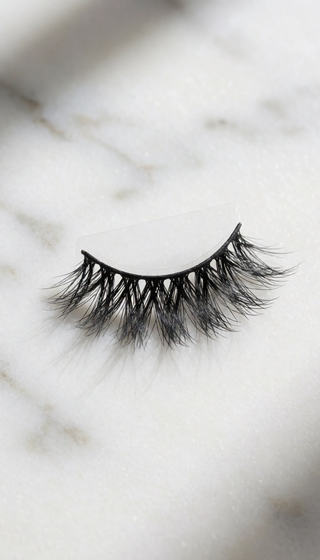
HOW TO FIX FALSE EYELASH CORNERS THAT KEEP LIFTING
FIX LIFTING LASH CORNERS IN MINUTES — AND KEEP THEM DOWN ALL DAY
There is nothing more frustrating than watching the outer corner of a false lash peel away hours before the day is over. If you have ever caught your reflection mid-event with one side lifting while the other holds, you are not alone — corner lift is the single most common way strip lashes fail, and it almost never means you applied them wrong.
The outer corner is the most mobile part of the eye. Every blink, smile, and expression stresses that edge, and it is also where skin oils accumulate fastest. The good news: most lifts can be corrected in under a minute with the right technique, and the right materials can prevent them entirely. Here is exactly why corners lift, how to fix them on the spot, and what to look for in a lash that stays put.

WHY THE OUTER CORNER ALWAYS LIFTS FIRST
Corner lift is rarely random. It is usually the result of one — or a combination — of four fixable factors. Identifying which one is at play for you determines whether you need a better technique, better prep, or a better lash.
- Oil interference: The skin at the outer corner produces more oil as the day goes on, and oil is the enemy of any adhesive. Even a perfectly applied lash will slide once the bond is compromised by a thin film of sebum.
- Movement stress: The outer corner moves more than any other point on the lash line with every expression, so it absorbs the most mechanical stress and is always the first edge to fatigue.
- Excess weight: Heavier lashes and dense styles pull constantly at the corner, gradually breaking the bond from the edge inward until the whole strip loosens.
- Rushed curing: Adhesive needs time to reach full strength. If the lash is released before the bond sets, the corner — the last point of contact — lets go first.
The band itself plays a role too. Thick cotton bands absorb moisture and loosen within hours, while thin, flexible bands conform to the eye's natural curve and hold their shape. A band that does not match your eye's anatomy will spring upward at the corner no matter how much adhesive you use.
Environment matters as well. Humidity, sweat, and even the natural oils from hair products that drift near the face all accelerate bond breakdown at the edges. And if your eyes water after application — a common reaction to any new product near the eye — that moisture can seep under the band and lift the corner before the bond has fully formed.
THE 60-SECOND CORNER RESCUE: RE-ANCHOR A LIFTED LASH
When a corner lifts mid-day, resist the urge to peel the whole strip off and start over. A targeted re-anchor takes less than a minute and preserves the rest of the application:
- Isolate the problem: Use a clean, fine-tipped tool (like a specialized lash tweezer) to isolate the lifted corner lash. Do not pull on the lash itself.
- The debris sweep: Gently sweep away any visible flakes or dust around the lash base. Use a lint-free cloth dipped in makeup remover to ensure the skin is completely free of oils.
- The micro-dot application: Apply the smallest, most controlled amount of adhesive possible directly onto the clean, exposed lash line at the corner. This small amount of product, when applied precisely, is more effective than a large blob spread too thin.
- The cure hold: Press the lash down firmly with your finger or a small piece of tape for at least a full minute. This ensures the glue has time to reach maximum strength before you move or blink.
If you are wearing a glue-free lash with a micro-adhesion band, the same logic applies — clean the band, reseat it firmly, and hold — but there is no adhesive to reapply, which makes the fix faster, cleaner, and far less irritating to the delicate skin around the eye.
PREVENTION: PREP, CURE, AND PROTECT THE BOND
Most corner lifts are preventable before the lash ever touches your eye. Build these steps into your routine and the majority of mid-day failures disappear:
- Start with a clean, oil-free lash line. Remove all makeup and residue with an oil-free cleanser, then dry thoroughly. Even a thin film of moisturizer or primer can break a bond by midday.
- Let the adhesive get tacky. After applying, wait 10–15 seconds before placing the lash so the bond can grip on contact instead of sliding.
- Hold for a full 60 seconds. Count it out. The corner needs the longest cure because it moves the most — give it the full minute.
- Keep oils away. Avoid oil-based eye creams and waterproof mascara on the lash line; both migrate toward the corners over hours and dissolve the bond.
- Blot, don't rub. If your eyes water after application, blot gently with a tissue. Rubbing shifts the band before the bond sets.
- Check the band before applying. A stiff or bent band that does not follow your natural curve will spring upward at the corner. Warm the band between your fingers for a few seconds to soften it.
LIFT PREVENTION STRATEGIES AT A GLANCE
| Problem | Immediate Fix | Long-Term Fix |
|---|---|---|
| Corner Lift | Re-apply micro-dot after cleaning | Use lighter, flexible lashes |
| Adhesion Weakness | Ensure 60+ sec cure time | Use high-quality, tested glue |
| Oil Interference | Spot clean with alcohol | Prep skin meticulously |
WHAT TO LOOK FOR IN A LASH THAT STAYS PUT
If corner lift keeps happening no matter how carefully you apply, the lash itself is usually the problem. Evaluate any set against these five criteria before you commit:
- Weight profile: Heavy styles pull at the corner all day. Look for ultra-light, wispy constructions that distribute weight evenly along the band instead of concentrating it at the edges.
- Band flexibility: A band that bends naturally with your eye will not spring upward. Stiff bands exert constant tension on the bond near the eye and are the hidden cause of most recurring lifts.
- Bond technology: Traditional glue works, but it is messy, irritating for many wearers, and fails fastest at the corners. Glue-free micro-adhesion bands bond directly to the skin without adhesive, eliminating the most common failure point entirely.
- Reusability: A pair you can wear 30 or more times spreads the cost thin — under $2 per wear — and a band that molds to your eye over repeated wears fits more securely each time.
- Skin compatibility: If you have sensitive eyes or wear contact lenses, hypoallergenic, glue-free construction removes the irritants that cause watering — and watering is a leading cause of corner lift.
Get these five things right and corner lift stops being a daily battle. It becomes a rare, fixable exception — and the lash you reach for should be engineered around exactly these principles.
THE GLUE-FREE LASH ENGINEERED TO STAY PUT
PHANSTA LASHES were designed around one goal: a lash that goes on in seconds and stays put for the entire day — without a drop of glue. Instead of adhesive, each pair uses glue-free micro-adhesion technology: a band that bonds directly to the skin, with no glue, no magnets, and no liner required.
- Glue and irritation: No adhesive touches your skin, so there is no sticky residue, no fumes, and no allergic reaction. The pair is hypoallergenic and comfortable enough for sensitive eyes and contact-lens wearers.
- Durability: The micro-adhesion band is waterproof and holds through sweat, humidity, and long days. Each pair delivers 30+ wears — far beyond what glue lashes can survive.
- Cost: At $59 for a pair that lasts 30+ wears, you spend under $2 per wear — less than a single salon touch-up.
With 17 styles ranging from natural to dramatic, there is a pair for every eye shape and every occasion — and every one of them applies in seconds per eye.
FREQUENTLY ASKED QUESTIONS
How long should I hold the lash after application?
Press and hold the lash — especially the outer corner — for at least a full minute after placement. This gives the bond time to reach maximum strength before you blink, smile, or move your eyes. Releasing the corner early is the most common reason lashes lift within the first hour.
What is the safest way to clean the lash line?
Use a lint-free cotton swab lightly dampened with an oil-free makeup remover. Gently sweep along the lash line to remove oils, flakes, and residue without tugging at the skin or the lash band. Let the area dry completely before reapplying.
Can glue-free lashes really hold all day?
Yes. Glue-free micro-adhesion bands bond directly to the skin without adhesive, so there is no glue to break down from oils or movement. The band is waterproof and holds through sweat, humidity, and long wear — and each pair is rated for 30+ wears.
Are PHANSTA LASHES suitable for sensitive eyes?
Yes. The glue-free design means no adhesive, no latex-based glue, and no irritating fumes ever touch the skin, and the materials are hypoallergenic. They are a strong option for contact-lens wearers and anyone who reacts to traditional lash glue.
How many times can I reuse one pair?
With proper care — gentle removal, a quick wipe of the band, and storage back in the tray — each pair delivers 30+ wears. That works out to under $2 per wear, which is why one pair outlasts dozens of disposable glue lashes.
NOT SURE ABOUT YOUR EYE SHAPE?
Find your eye shape and get personalized lash recommendations:
FIND THE PERFECT LASH FOR EVERY MOMENT
Explore our occasion-specific lash guides:
EXPERIENCE THE DIFFERENCE
Join thousands of women who have made the switch. No glue, no damage, no salon appointments — just beautiful lashes in seconds.
SHOP PHANSTA LASHES — GLUE-FREE, 30+ WEARS →