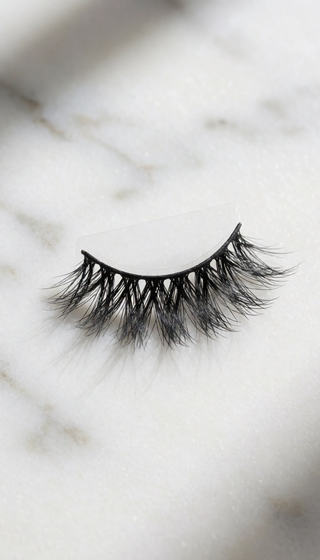
FALSE LASHES KEEP LIFTING? THE EASY FIXES THAT LOCK LASHES IN ALL DAY
Achieve flawless lash wear: the science of why lashes lift — and exactly how to lock them in.
If your false lashes are lifting at the corners or peeling away mid-day, the issue is rarely the lashes themselves. It is almost always the interaction between your natural eye environment and your application method. Eyelid oil, a rushed preparation step, or adhesive applied before it reaches its tacky state are the usual suspects — and every one of them has a reliable fix.
The single most common failure point happens before the lashes ever touch the eye. Most quality lash adhesives need 30 to 60 seconds to cure and form a secure bond; applying them while still wet almost guarantees premature lifting, usually within the first hour. While you wait, measure the band against your lash line and trim the outer corner so no excess material catches and flips up.
Below, you will learn the four root causes of lifting, the preparation routine that prevents it, the application technique for a secure bond, and how to choose a system that stays put in any climate or on any skin type.
THE FOUR ROOT CAUSES OF LASH LIFTING
Lash lifting is not a random occurrence. It is a predictable result of specific environmental or application factors, and pinpointing which cause is at play is the first step toward consistent all-day wear.
- Oily Eyelids: Natural sebum breaks down lash adhesives faster than any other factor. If your T-zone turns shiny by midday, your eyelids likely produce enough oil to weaken the bond within a few hours.
- Skipped or Rushed Preparation: Makeup, moisturizer, or sunscreen left on the lash line creates a physical barrier between adhesive and skin. Even a microscopically thin film drastically cuts your expected wear time.
- Incompatible Adhesive Selection: Lash adhesives are formulated for specific climates. Using a dry-climate formula in a humid setting — or the reverse — inevitably leads to premature bond failure.
- Improper Application Timing: Placing the band too close to the waterline, skipping the tacky wait, or not applying enough pressure on first placement all compromise the bond from the very start.
PREPARATION STEPS TO PREVENT LIFTING
Preparation is the single most impactful step you can take — and it requires less than 60 seconds to execute correctly.
- Cleanse the Lash Line Thoroughly: Use an oil-free micellar water or a gentle, dedicated cleanser to remove every trace of makeup, moisturizer, and sunscreen from the entire lash line area. Allow the skin to dry completely before proceeding.
- Eliminate Eyeliner Residue: Eyeliner pencils and liquid liners leave behind an oily film that prevents adhesive from gripping. Carefully check the waterline with a clean cotton swab to ensure complete removal.
- Blot, Do Not Rub: If you notice natural oil on your lids, gently press blotting paper or a clean tissue along the lash line to absorb excess sebum without stripping the skin barrier.
- Timing Eye Creams: Eye creams are typically oil-based products. To ensure maximum adhesion, apply these treatments at night, never immediately before applying lash adhesive.
- Utilize a Lash Primer (Optional): For an extra layer of security, a thin layer of lash primer or a light dusting of translucent powder along the lash line creates a more grippy surface for the adhesive to anchor to.
APPLICATION TECHNIQUE TO MAXIMIZE DURABILITY
Even when preparation is perfect, application technique dictates the final bond strength. Follow these steps to avoid the common pitfalls that undo meticulous prep work.
- Measure and Trim First: Before applying adhesive, hold the lash band against your eyelid and trim the outer corner if it extends beyond your natural lash line. An overly long band is the primary cause of lifting at the outer edge.
- Apply Adhesive Evenly: Do not simply dab glue on the corners. Run a thin, consistent line along the entire length of the band to ensure full coverage.
- The Tacky Wait: Allow the adhesive to cure and become tacky for a minimum of 30 to 60 seconds before touching your natural lashes — the most skipped step and the primary reason bonds fail early.
- Placement Strategy: Press the band down starting at the center of your lash line, then carefully secure the inner and outer corners for even distribution.
- Press and Hold Firmly: Once placed, hold the band in position for 10 to 15 seconds per eye so the adhesive sets fully and creates a robust bond.
- Merge the Bands: Use your fingertips or a lash curler to gently press your natural lashes and the false lashes together, merging the two sets into one seamless unit and eliminating visible gaps.
COMMON APPLICATION ERRORS THAT CAUSE LIFTING
Certain habits, even if unintentional, can sabotage even the most careful routine. Be mindful of these mistakes:
- Mascara Interference: Never apply lashes over a layer of mascara. It creates a film that prevents the adhesive from making a direct, strong bond with the natural lash base.
- Over-Application of Adhesive: Using too much glue creates a thick, heavy bond that dries slowly and is prone to sliding or failing prematurely.
- Post-Application Touching: Resist the urge to touch, adjust, or fiddle with lashes once securely placed. Any movement after the initial set breaks the delicate seal.
- Sleeping in Lashes: Pillow pressure and facial contours bend the band and compromise the bond overnight, leading to lifting upon waking.
THE SCIENCE BEHIND LASH ADHESION MECHANISMS
To truly understand longevity, you have to understand the chemistry of the bond. Traditional lash glue creates a chemical bond between adhesive and skin. Strong at first, it is vulnerable to degradation from skin oils, moisture, and body heat — which is why lifting often starts at the corners, the bond's thinnest point, and spreads inward.
Heat and humidity significantly accelerate this chemical breakdown, so wear time drops during warmer months. Oily skin actively works against the adhesive, making oilier eyelids far more prone to premature failure than drier ones.
Micro-adhesion operates on a fundamentally different principle. Rather than a chemical bond that can degrade, it establishes a physical grip between the band and the skin. With no adhesive layer to chemically fail, oils and humidity cannot weaken it — the grip remains consistent and reliable from the moment of application until the lashes are physically removed.
TECHNOLOGY COMPARISON: ADHESIVE VS. MICRO-GRIP
Not all lash systems achieve the same level of wear. Understanding the mechanics of the three primary categories helps you predict how long your chosen look will last.
| Technology | How It Works | Lifting Risk | Best For |
|---|---|---|---|
| Traditional Glue | Liquid or strip adhesive applied to the band | Moderate to high — sensitive to oil and humidity | Occasional wear, short events |
| Magnetic Lashes | Two bands sandwich natural lashes with magnets | Low lifting, but can feel heavy and pinch | Those who want no adhesive |
| Micro-Adhesion | Glue-free band that bonds to skin via micro-grip | Very low — no glue to break down | All-day wear, sensitive eyes |
Micro-adhesion represents the leading advancement in this field because it directly targets the core weakness of traditional methods — the adhesive itself. By eliminating the chemical bond, the grip stays consistent from the moment of application until removal, and minor repositioning does not ruin it the way it ruins a cured glue bond.
HOW YOUR EYE SHAPE IMPACTS LASH STABILITY
The unique anatomy of your eye dictates where pressure is applied to the lash band, which in turn dictates where lifting will start. Round eyes expose more lid surface, so the band sits flatter and adheres evenly across its full length. Hooded or monolid eyes have less visible lid, which means the band sits closer to the crease where it folds — pressing the outer corner upward throughout the day.
Deep-set eyes create shadow and trap extra oil along the lid, while downturned eyes put constant gentle pressure on the outer corner, the classic first point of failure. Whatever your shape, the principle is identical: trim the band to your exact lash line, press the center down first, anchor both corners firmly, and merge the band with your natural lashes so they move as one unit.
WHAT TO LOOK FOR IN A LASH SYSTEM THAT STAYS PUT
After understanding all the factors that cause lifting, the question becomes: what kind of lash system actually solves these problems rather than working around them? A system that delivers consistent wear needs to address three things at once — it must grip without relying on chemical adhesive, it must tolerate oil and humidity, and it must be comfortable enough that you forget you are wearing it.
This is where the distinction between a true solution and a workaround becomes critical. Most lash systems try to fix lifting by asking you to change your routine — more prep, more waiting, more maintenance. A genuinely better system eliminates the root cause entirely, so the bond never degrades in the first place.
THE LASH SYSTEM THAT ELIMINATES LIFTING AT ITS SOURCE

FREQUENTLY ASKED QUESTIONS
Do I need to use lash glue with micro-adhesion lashes?
No. Micro-adhesion lashes grip the skin directly through a proprietary band design — no glue, no magnets, and no liner needed. Simply press the band along your lash line, hold for a few seconds, and the physical grip locks into place. This eliminates the chemical bond that typically degrades with oil and humidity, so corner lifting becomes a thing of the past.
PHANSTA LASHES were designed from the ground up to solve every root cause of lifting covered above. Instead of relying on traditional glue that degrades with oil and humidity, they use a proprietary glue-free micro-adhesion band that grips the skin directly — no adhesive layer to break down, no chemical bond to fail.
Here is how PHANSTA LASHES address the three biggest objections people have about false lashes:
- Glue and irritation — solved. Traditional lash glue is the number one cause of both lifting and sensitive-eye reactions. PHANSTA LASHES eliminate the adhesive entirely. The micro-adhesion band is hypoallergenic, waterproof, and safe for the most reactive eyelids — no irritation, no redness, no lifting.
- Durability — solved. Without glue to degrade, the bond holds from morning to night and beyond. Each pair delivers 30+ wears — that is under $2 per wear at $59 — and the waterproof formula stands up to humidity, sweat, and tears without loosening.
- Value — solved. At $59 for a pair that lasts 30+ wears, the cost per wear drops below $2. No more buying disposable lashes every few days or replacing dried-out glue tubes every month.
With 17 styles to choose from, PHANSTA LASHES deliver the look you want — natural, dramatic, or somewhere in between — with a wear that matches your lifestyle, not the other way around. Application takes seconds per eye: press the band along your lash line, hold, and go. No tacky wait, no drying time, no lifting by lunchtime.
Thousands of customers with oily lids, sensitive eyes, and busy schedules have made the switch. PHANSTA LASHES consistently earn top marks for comfort, longevity, and ease of application — the three things that matter most when you are tired of your lashes failing before the day is over.
SHOP PHANSTA LASHES — GLUE-FREE, 30+ WEARS →
How long does one pair of PHANSTA LASHES last?
Each pair is designed for 30+ wears when cared for properly. At $59 per pair, that works out to under $2 per wear — far less than disposable lash alternatives. The glue-free micro-adhesion band maintains its grip strength over time without drying out or losing tack, so you get consistent performance wear after wear.
Are PHANSTA LASHES safe for sensitive eyes?
Yes. The hypoallergenic micro-adhesion band contains no glue, latex, or harsh chemicals — the most common irritants in traditional lash systems. The physical-grip mechanism means nothing is absorbed into the skin or lash line. Customers with reactive eyes, contact lens wearers, and those with eczema-prone skin report zero irritation across all 17 styles.
Can I wear these lashes in humid weather or while exercising?
Absolutely. Unlike glue-based lashes that break down when exposed to moisture, PHANSTA LASHES are waterproof and humidity-resistant. The micro-adhesion grip is physical, not chemical, so sweat, rain, and humidity cannot dissolve or weaken it. Many customers wear them through workouts, beach days, and tropical climates without any lifting.
How do I choose the right style for my eye shape?
The lash finder quiz helps match your eye shape to the most flattering style from 17 options. As a general rule, round eyes suit evenly distributed styles, hooded eyes look best with longer center strands, and downturned eyes benefit from lifted outer corners. Trimming the band to your exact lash line ensures a secure fit regardless of style.
STILL COMPARING OPTIONS? Explore our guides on finding your perfect lash, magnetic vs strip, and sensitive eyes.
FIND THE PERFECT LASH — Not sure which style suits you? Take the 30-second lash finder quiz →
NOT SURE ABOUT YOUR EYE SHAPE?
Find your eye shape and get personalized lash recommendations:
FIND THE PERFECT LASH FOR EVERY MOMENT
Explore our occasion-specific lash guides:
EXPERIENCE THE DIFFERENCE
Join thousands of women who have made the switch. No glue, no damage, no salon appointments — just beautiful lashes in seconds.
SHOP PHANSTA LASHES →