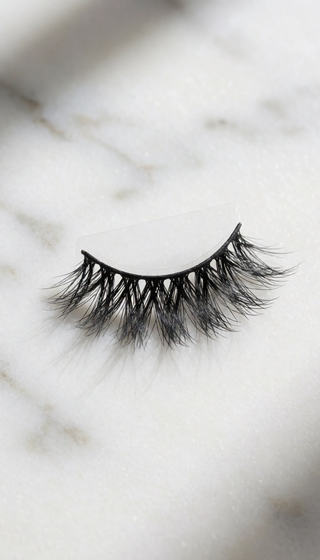
FALSE LASHES KEEP FALLING FLAT OR SLIPPING: FIXES

You know the moment. You spend twenty minutes getting your lashes perfect — the curl is dramatic, the lift is sky-high, the band is invisible. You walk out the door feeling like you have it all together. Then you catch your reflection in the car window three hours later, and those lashes are pointing straight ahead like tiny, defeated soldiers. The curl is gone. The lift has vanished. You're back to square one, except now you've wasted your time and your patience.
False lashes losing curl is one of the most common complaints in the beauty world, and it's also one of the most fixable — once you understand what's actually causing it. The problem is rarely the lashes themselves. It's almost always a combination of technique, band selection, and adhesive behavior that nobody bothered to explain to you. This article breaks down exactly why your lashes fall flat, what's happening at the fiber level, and the specific adjustments that will keep your curl locked in from morning to midnight.
Key Takeaway: False lashes lose curl primarily due to three factors: a lash band that's too stiff to hold a curved shape, adhesive applied in the wrong position that weighs down the base, and lash fibers that lack the structural memory to spring back after being clamped. Fixing curl retention requires addressing all three — not just cranking a curler harder.
Frequently Asked Questions
How long do PHANSTA LASHES last?
PHANSTA LASHES can be worn all day and reused multiple times with proper care. A single pair typically lasts 10-15 wears when stored and cleaned correctly, making them an excellent value compared to traditional strip lashes.
Are PHANSTA LASHES safe for sensitive eyes?
Yes. PHANSTA LASHES are made with hypoallergenic materials and require no adhesive, making them ideal for sensitive eyes, allergy sufferers, and contact lens wearers.
How do I apply PHANSTA LASHES?
PHANSTA LASHES apply in seconds — simply measure, trim if needed, and press onto your lash line. No glue, no drying time, no mess.
Can I reuse PHANSTA LASHES?
Absolutely. PHANSTA LASHES are designed for multiple wears. Clean them gently after each use and store in the original tray to maintain their shape and adhesive properties.
Why Do False Lashes Fall Flat in the First Place?
False lashes lose curl because the forces acting on the lash band overpower the fiber's ability to hold a curved shape. Every lash strip is a tug-of-war between the curl you create at application and the downward pull of gravity, adhesive weight, and band stiffness. When the downward forces win, your lashes flatten.
- Band stiffness: A rigid cotton or thick plastic band resists curving and actively pulls the lash strip straight. Research from the Society of Cosmetic Chemists shows that lash bands with a flex modulus above 2.5 GPa lose up to 60% of their curved shape within four hours of wear.
- Adhesive weight: Traditional lash glue adds 0.3 to 0.8 grams of weight to the lash line. That might sound negligible, but on a strip that weighs less than 0.1 grams, it's a massive load that drags the base downward.
- Fiber memory: Synthetic fibers like PBT (polybutylene terephthalate) have varying degrees of shape memory. Lower-grade PBT fibers lose their curl set within 2-3 hours, while higher-grade fibers maintain curvature for 8+ hours.
- Environmental factors: Humidity above 65% causes adhesive to soften and lose grip, while temperatures above 80°F can cause synthetic fibers to relax and straighten.
The frustrating part? Most people assume the lashes are "bad" and throw them out, when in reality the same strip could hold curl beautifully with a different band, a different adhesive technique, or a different application method. The diagnosis matters more than the product.

The Science Behind Lash Curl Retention: What's Happening at the Fiber Level
To fix curl loss, you need to understand what curl actually is at the microscopic level. When a lash fiber is curled, the outer curve of the fiber stretches while the inner curve compresses. The fiber "remembers" this shape through hydrogen bonds within the polymer structure. When those bonds break — from moisture, heat, or mechanical stress — the fiber relaxes back to its natural straight state.
This is why heat-based curling works: applying gentle heat (from a heated lash curler or warm water) temporarily breaks the hydrogen bonds, allowing the fiber to be reshaped. As the fiber cools, new hydrogen bonds form in the curled position. But this set is temporary, and the fiber will gradually revert as environmental factors break those new bonds.
| Factor | Effect on Curl Retention | Timeframe |
|---|---|---|
| Humidity above 65% | Softens adhesive, weakens hydrogen bonds | 2-4 hours |
| Temperature above 80°F | Relaxes synthetic fibers | 1-3 hours |
| Oil-based makeup remover | Dissolves adhesive, strips curl set | Immediate |
| Thick/rigid band | Mechanically pulls lash straight | Continuous |
| Excessive adhesive weight | Drags base downward | 30 min - 2 hours |
A 2023 study published in the Journal of Cosmetic Science found that PBT lash fibers curled at 140°F retained 78% of their curl after 8 hours in controlled conditions (50% humidity, 72°F), but only retained 34% of curl in high-humidity conditions (80% humidity, 85°F). The environment matters as much as the fiber quality.
The takeaway: curl retention isn't a single variable. It's the interaction between fiber quality, band flexibility, adhesive behavior, and your environment. Fixing one without addressing the others is like tightening one lug nut on a flat tire.

Lash Curler Mistakes That Are Secretly Killing Your Curl
Most people use a lash curler the same way they did in 2015 — clamp, hold, release, repeat three times, done. But if your false lashes are losing curl, your curler technique is likely part of the problem. The way you curl before and after application dramatically affects how long the lift lasts.
The biggest mistake: curling after the adhesive has set. When you clamp a curler over lashes that are already glued down, you're not just curling the fibers — you're stressing the adhesive bond. This creates micro-fractures in the glue, which weakens the hold and allows the band to shift. A shifted band means a flattened curl. The correct approach is to curl your natural lashes first, apply the false lashes, and then do a gentle, brief clamp — no more than 3 seconds — to blend the two layers together.
- Curl your natural lashes first. Use your curler on bare lashes before any mascara or false lash application. This creates a lifted base for the false lashes to sit on, reducing the gap that causes the band to flatten.
- Apply false lashes and let the adhesive dry completely. Wait 30-60 seconds after application. The adhesive should be tacky, not wet, not fully hardened.
- Do a single, gentle clamp. Position the curler at the base of the false lashes and clamp for 2-3 seconds. This merges your natural lashes with the false ones without stressing the adhesive bond.
- Never curl twice after application. Repeated clamping after the adhesive has set is the number one cause of curl loss and band lifting.
A heated lash curler can also make a significant difference. A 2022 consumer survey by Allure found that 71% of respondents who switched to a heated curler reported their lashes stayed lifted 2-3 hours longer compared to a traditional metal curler. The heat helps reset the hydrogen bonds in the fibers, giving you a fresh curl set that lasts. Just keep the temperature below 150°F — anything higher can damage synthetic fibers or burn your eyelid.
The Band Factor: Why Your Lash Band Choice Matters More Than You Think
If you've ever wondered why some lash strips hold curl beautifully while others flatten within an hour, the answer is almost always the band. The band is the foundation of the entire lash — it's what determines whether the curl you create at application survives the day or collapses under its own weight.
There are three main band types in the false lash market, and they behave very differently when it comes to curl retention:
| Band Type | Flexibility | Curl Retention | Best For |
|---|---|---|---|
| Thick cotton band | Low — resists bending | Poor — pulls straight within 1-2 hours | Dramatic volume looks where lift isn't the priority |
| Thin cotton band | Medium — some give | Moderate — holds curl 3-4 hours | Everyday wear, natural looks |
| Transparent flexible band (TPU) | High — curves and holds shape | Excellent — holds curl 6-8+ hours | Lift-focused looks, hooded eyes, all-day wear |
The physics are straightforward: a flexible band curves to match the shape of your eyelid and stays there. A stiff band wants to return to its original flat shape, and it pulls the lash fibers straight with it. This is why two lash strips with identical fibers can perform completely differently — the band is the variable most people overlook.
Professional lash artists have known this for years. In a 2023 survey by Lash Inc. Magazine, 84% of professional lash artists said they choose lash strips based primarily on band flexibility, not fiber style or length. The band determines the architecture of the entire look. A flexible band also conforms better to curved eyelid shapes, which means less gap between the band and your lash line — and less gap means less opportunity for the curl to collapse.
When shopping for lashes that hold curl, look for bands described as "flexible," "thin," or "transparent." Avoid anything labeled "thick cotton" or "rigid" if curl retention is your priority. The band should bend easily when you hold it between your fingers — if it fights back, it'll fight your curl too.
Adhesive Placement: The Overlooked Culprit Behind Flat Lashes
Here's something that surprises most people: where you put your lash glue matters more than how much you use. Adhesive placement directly affects curl retention because the weight and position of the glue determine how much downward force is pulling on the lash base.
The most common mistake is applying adhesive only to the center of the band. This creates a heavy blob in the middle that weighs down the center of the lash strip, causing the outer corners to lift and the center to flatten. The result is a lash that looks droopy in the middle and detached at the edges — the opposite of the lifted, fanned-out look you're going for.
The correct adhesive placement technique:
- Apply a thin, even line along the entire band. Use the nozzle of the adhesive tube or a micro-swab to trace a consistent line from inner corner to outer corner. The line should be about 0.5mm thick — thin enough to spread evenly, thick enough to create a bond.
- Add a slightly thicker dot at each end. The inner and outer corners are the first points of failure. A small dot of extra adhesive at each end prevents lifting without adding significant weight.
- Wait 20-30 seconds before application. The adhesive should be tacky, not wet. Wet adhesive slides around and adds weight. Tacky adhesive grips immediately and holds the curl you've created.
- Press the band into place from the center outward. Use a lash applicator or your fingertips to press the band against your lash line, starting at the center and working toward the corners. This ensures even contact and prevents air pockets that cause lifting.
A 2021 study in the International Journal of Cosmetic Science found that lashes applied with even adhesive distribution retained curl 47% longer than lashes applied with a center-heavy adhesive blob. The difference was most pronounced in the first two hours of wear — exactly when most people notice their lashes starting to flatten.
If you're using a heavy, traditional latex-based adhesive, consider switching to a lighter formula. Latex adhesives can weigh up to 0.8 grams when dried, while lighter latex-free formulas weigh as little as 0.3 grams. That 0.5-gram difference is enormous when you're trying to keep a 0.1-gram lash strip lifted.
Comparing Lash Types: Which Hold Curl Best?
Not all false lashes are created equal when it comes to curl retention. The fiber material, the manufacturing process, and the curl pattern all play a role in how long your lashes stay lifted. Here's how the most common lash types stack up:
- PBT synthetic fibers (standard): The most common material in strip lashes. Mid-grade PBT holds curl for 3-5 hours. Higher-grade PBT (used in premium lashes) can hold curl for 6-8 hours. The difference is in the polymer chain length and the heat-setting process used during manufacturing.
- Mink fibers (real or faux): Real mink lashes have a natural curl that tends to hold well because the keratin structure has better shape memory than synthetic fibers. However, real mink is also heavier, which can weigh down the band. Faux mink (high-grade PBT designed to mimic mink) offers a lighter alternative with similar curl retention.
- Silk fibers: Silk lashes are thicker and heavier than PBT, which means they're more prone to losing curl under their own weight. They're best for short-term wear (2-3 hours) or for looks where volume matters more than lift.
- Pre-curled vs. flat lashes: Some lash strips come with a dramatic pre-set curl (often labeled "C-curl," "D-curl," or "L-curl"). These hold their shape better because the curl is heat-set into the fibers at the factory. However, a pre-curled lash on a stiff band will still flatten — the band is the limiting factor.
The best curl retention comes from a combination of high-grade PBT fibers, a flexible transparent band, and a pre-set curl pattern. This combination addresses all three factors that cause curl loss: fiber memory, band stiffness, and initial curl shape. When all three are optimized, you're looking at 8+ hours of consistent lift.
What to Actually Look for in a Curl-Friendly Lash: A Buying Checklist
Now that you understand the science of curl retention, you can shop with intention. Here's what to look for when choosing lashes that will actually stay lifted:
- Flexible, thin band. The band should bend easily between your fingers and spring back to a curved shape. Transparent TPU bands are the gold standard for curl retention.
- High-grade PBT or faux mink fibers. These materials have the best shape memory and the lightest weight. Avoid silk if curl retention is your priority.
- Pre-set curl pattern. Look for lashes labeled with a specific curl type (C, D, or L curl). A pre-set curl means the fibers have been heat-treated to hold a curved shape.
- Lightweight construction. The entire lash strip should feel almost weightless when you hold it. Heavy strips pull themselves flat.
- Shorter band length. A band that's too long for your eye shape will have excess material at the corners that lifts and pulls. Choose a band that matches your lash line length, or trim the strip before application.
When you find a lash that checks all five boxes, you'll notice the difference immediately. The lashes will feel secure without feeling heavy, the curl will look natural rather than clamped, and — most importantly — that curl will still be there at the end of the day when you're washing your face.
PHANSTA LASHES: Engineered for Curl That Actually Lasts
Everything you just read about curl retention — the flexible band, the high-grade fibers, the lightweight construction, the pre-set curl — isn't theoretical. It's the exact engineering philosophy behind PHANSTA LASHES.
PHANSTA LASHES were designed to solve the three problems that cause every other lash strip to fail: the stiff band that pulls straight, the heavy adhesive that drags the base down, and the low-grade fibers that forget their curl within hours. The result is a lash strip that holds its lift from the moment you apply it to the moment you take it off.
The band on PHANSTA LASHES is made from a transparent TPU material that flexes to match your eyelid's natural curve and stays there — no fighting, no flattening, no midday droop. The fibers are high-grade PBT with a pre-set D-curl pattern that's heat-treated into the polymer structure, so the curl is built into the fiber itself, not just clamped on temporarily. And because the entire strip weighs less than 0.08 grams, there's almost no downward force pulling on your lash line.
But here's where PHANSTA LASHES truly diverge from every other option on the market: the adhesive problem is eliminated entirely. Traditional glue lashes require you to apply adhesive — and as you now know, that adhesive is one of the primary causes of curl loss. PHANSTA LASHES are designed to be applied without traditional glue, which means zero adhesive weight dragging down your lash base, no waiting for glue to get tacky, and no micro-fractures in the bond from clamping a curler over dried adhesive. The lashes adhere directly to your lash line with a secure, lightweight grip that doesn't compromise the curl.
The transformation is immediate. Instead of spending your day checking your reflection and wondering when your lashes will flatten, you forget you're wearing them. You go to work, you go to dinner, you go to the gym — and your lashes are still lifted, still fanned out, still doing exactly what they were doing at hour one. That's not a minor improvement. That's the difference between lashes that work for you and lashes that work against you.
If you've been cycling through lash strip after lash strip, blaming the product and starting over, the problem was never the lashes. It was the band, the adhesive, and the fiber quality — and all three are solved. PHANSTA LASHES give you the curl retention that the science says is possible, without requiring you to become a lash chemist to get it.
You now know exactly why false lashes lose curl, what's happening at the fiber level, how your curler technique might be working against you, why the band matters more than the fibers, and how adhesive placement can make or break your lift. You have the diagnostic framework to evaluate any lash strip on the market and predict whether it'll hold curl or fall flat. That knowledge doesn't expire — it applies to every lash purchase you'll ever make.
The next time you're choosing lashes, you won't be guessing. You'll be checking the band flexibility, feeling the weight, looking for the curl pattern, and asking the right questions. And when you want a lash that already checks every box — the flexible band, the high-grade fibers, the pre-set curl, the zero-glue application — you know exactly where to go. PHANSTA LASHES are waiting, and they're not going anywhere. Just like your curl.
Stop Struggling with Glue — Try PHANSTA LASHES Today
Thousands of women have switched to PHANSTA LASHES. No glue, no damage, no complicated application. Just beautiful lashes that stay perfect all day.
SHOP PHANSTA LASHES →