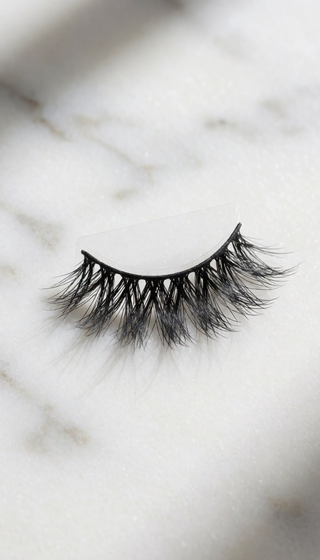
DOLL-EYE VS CAT-EYE FALSE LASH STYLES | these lashes
MATCH YOUR LASH SILHOUETTE TO YOUR EYE SHAPE IN 30 SECONDS — AND STOP GUESSING
If you have ever held two lash pairs side by side — identical length, identical curl, identical fiber — and watched them create two completely different eyes, you have already met the only variable that truly matters: where the weight sits. Center-weighted fibers pull the eye's visual focus inward, so the eye reads round and open. Outer-weighted fibers sweep the focus toward the temple, so the same eye reads lifted and elongated. That is the entire doll-eye versus cat-eye question, and you can answer it about your own face in about thirty seconds.
Here is the test. Take a straight-on photo in daylight — not a mirror, because mirrors reverse and compress your features. Then look at your lash line and ask three questions:
- Where do you want the focus? Middle of the lash line draws attention to the iris; outer corner draws attention along the lash line itself.
- Does your outer corner sit level, higher, or lower than your inner corner? That single angle decides whether you need lift or can afford softness.
- Does your crease disappear when your lid is relaxed? If it does, anything weighted at the center will fold away, and the outer corner has to carry the look.
Answer those three honestly and you no longer need to guess at a style. Everything below explains why the answers matter, so you can make the choice deliberately instead of by trial and error.
WHY IDENTICAL LASHES LOOK DIFFERENT ON DIFFERENT FACES: THE OPTICS OF FIBER WEIGHT
The eye is read by the brain as a single optical shape, and that shape is heavily influenced by visual weight distribution. When volume is concentrated in the middle of the lash line, the visual focus is drawn inward, creating openness and roundness — the principle behind a bright, balanced appearance that emphasises the natural shape of the iris.
Conversely, when weight is swept toward the outer corner, the eye is visually lifted, creating the illusion of greater length and an elongated, almond shape. This outer-weighted distribution counteracts the eye's natural angles to produce a more dramatic, lifted result. Two pairs with identical length, curl and material can look completely different on the same face, because silhouette comes first; everything else is tuning. Length, curl and material adjust the intensity of the effect — they do not change its direction.
DECODING LASH LABELS: WHAT 'WISPY', '3D' AND '13MM' ACTUALLY TELL YOU
Product descriptions are written to persuade rather than inform. Translate them before you commit:
- 'Wispy': fibers are spaced apart with visible gaps, giving a lighter, more natural aesthetic.
- 'Dramatic' or 'voluminous': densely packed fibers for maximum impact.
- 'Natural': usually shorter fibers with even distribution — but always verify where the longest fibers sit, because a natural doll-eye and a natural cat-eye are entirely different styles wearing the same word.
- '3D' or 'multi-layered': refers to fiber layers on the band. More layers means more density and drama; two to three suits everyday wear, four or more creates a statement look.
Length is measured in millimetres: 8–12 mm reads as natural, while 13–15 mm reads as dramatic. Curl notations run from J to L — J is the gentlest, C gives a noticeable lift, and L anchors at the base, which makes it the preferred choice for hooded or monolid eyes where lift has to happen lower on the lash line.
Fiber material dictates the finish. Faux mink fibers are tapered with a matte finish that mimics real hair; silk is lighter with a polished sheen; synthetics hold the crispest curl and dominate dramatic styles. The band matters too — a cotton band is flexible but loses shape faster, while a thin polymer band keeps its curve without sagging.
IDENTIFY YOUR OWN EYE ANATOMY BEFORE YOU CHOOSE A STYLE
Observe your eyes under natural light. If your iris is fully visible with white showing all around it, you have a round shape. If the outer corner sits lower than the inner corner, you are downturned; if it sits higher, you are upturned. If the crease disappears under the relaxed lid, you are hooded. For spacing, compare the gap between your eyes to the width of one iris: wider than a single iris indicates wide-set eyes, narrower indicates close-set. Neither spacing is inherently better — each simply requires a different distribution of fiber weight to achieve visual harmony.
Straight-on daylight photos are the most reliable reference, because mirrors reverse and compress your appearance. Once you can confidently name your shape, choosing a silhouette stops being a guess and becomes a five-second, informed decision.
DOLL-EYE SILHOUETTE: CENTER-WEIGHTED FULLNESS, EXPLAINED
Doll-eye styles place the longest and densest fibers across the centre or inner third of the lash line. That concentration directs the viewer's focus toward the iris, mimicking a wide-open, bright, youthful appearance. The style is exceptionally effective at adding fullness to sparse or short natural lashes, providing soft, balanced enhancement without distorting the eye's proportions.
- Round eyes: benefit from balanced fullness that enhances natural roundness without distortion.
- Close-set eyes: centre volume directs attention inward, creating a visually balanced appearance.
- Everyday wear: ideal for a fresh, wide-awake look that stays subtle and blended from morning to night.
CAT-EYE SILHOUETTE: OUTER-WEIGHTED LIFT, EXPLAINED
Cat-eye styles taper toward the inner corner and build maximum length and density toward the outer corner, often culminating in a defined flick. That outer weight visually lifts the eye upward, creating the illusion of greater length and a more elongated, almond-shaped silhouette. The effect ranges from a gentle taper to a bold wing that can replace eyeliner entirely.
- Downturned eyes: the upward pull of outer-corner length counteracts the natural drop and provides necessary lift.
- Hooded eyes: length concentrated at the outer edge stays visible even when the eyelid folds over the centre.
- Almond eyes: adds sophisticated drama and elongation while maintaining natural balance.
STYLE MATCHING: WHICH SILHOUETTE SUITS WHICH EYE SHAPE
- Round eyes: doll-eye adds balanced fullness; a soft cat-eye taper works if a slight lift is desired.
- Almond eyes: both styles work — doll-eye for an open, fresh look, cat-eye for dramatic elongation.
- Hooded eyes: cat-eye is the stronger choice, because outer-corner length stays visible even when the lid is relaxed.
- Monolids: the outer flick of a cat-eye creates definition where a centre-heavy style might blend into the lid.
- Downturned eyes: cat-eye lifts the gaze; avoid centre-heavy styles that could emphasise the natural drop.
- Close-set eyes: doll-eye's centre volume draws the eye inward, balancing perceived spacing.
APPLICATION STEPS THAT KEEP YOUR SILHOUETTE INTACT ALL DAY
Even a perfectly matched silhouette fails without careful application. These four steps keep the shape secure, regardless of the adhesion method you use.
- Precision trimming: measure the band against your lid first, trimming only from the outer edge in small increments until it sits flush without tugging the corners. An overly long band lifts at the inner corner within the first hour.
- Activating the bond: with traditional adhesive, wait 30–60 seconds until it turns tacky before placement. With a pressure-activated micro-adhesion edge, press along the lash line and hold for 5–10 seconds — no tacky stage required.
- Placement angle: apply at a slight upward angle following the natural curve of your eye, rather than laying it perfectly flat. That angle is what lets the fibers lift and elongate exactly where the silhouette intends.
- Removal and storage: peel from the outer corner inward, never straight down, and return the pair to its original tray. Careful handling is what allows a quality band to keep its shape through repeated wears.
THE FIVE-POINT CHECKLIST FOR CHOOSING ANY LASH STYLE
Before you commit to a style, run it through these five filters. They separate a pair that works from a pair that merely photographs well.
- Weight distribution: find where the longest fibers sit before you look at anything else. If the description does not tell you, the product photo will — follow the density, not the length claim.
- Band construction: a thin, flexible band follows the curve of the lid; a stiff one fights it and lifts at the corners. Bend the band gently in your fingers before the first wear to test it.
- Curl and length against your lid: match the curl to how much visible lid space you have, not to how dramatic you want to look. A strong curl on a hooded eye disappears; an L curl on the same eye stays visible.
- Attachment method: adhesive, pressure-activated micro-adhesion, or magnetic closures each behave differently on oily lids, sensitive skin and hooded eyes. Choose the method that suits your eye, not the one that is trending.
- Reusability and care: ask how many wears the pair is designed for and whether the band survives cleaning. A style you can only wear twice is a different value proposition than one built for a month of wear.
Once you know your silhouette and you know what to check on the band, the only thing left is finding a pair that already matches both — which is exactly where the next section picks up.
GET THE SILHOUETTE YOU JUST CHOSE — WITHOUT GLUE, LINER OR GUESSWORK
You have identified your eye shape, chosen between centre-weighted and outer-weighted, and run the five-point checklist. PHANSTA LASHES exists to close that last gap: 17 styles built across the doll-eye and cat-eye spectrum, so the silhouette you just reasoned your way to already exists as a finished pair — no trimming experiments, no adhesive learning curve, no liner required.
Here are the three things people ask before they try a pair, in the order they ask them:
- "Will the glue irritate my eyes or ruin my makeup?" PHANSTA LASHES use glue-free micro-adhesion — no glue, no magnets, no liner. The bond is pressure-activated along a hypoallergenic edge, so there is no tacky wait, no residue on the lid, and nothing to redo if you need to reposition.
- "Will they survive more than one or two wears?" Each pair is rated for 30+ wears and is waterproof, so rain, humidity and a full day outdoors do not cost you the shape. Return them to the tray between wears and the band keeps its curve.
- "Is $59 reasonable for lashes?" At 30+ wears, that works out to under $2 per wear — less than a coffee, and considerably less than a salon set you would need to rebook every few weeks.
Choose your silhouette, press it on in seconds per eye, and the shape you mapped out above is the shape you wear.

FREQUENTLY ASKED QUESTIONS
Which is better for hooded eyes — doll-eye or cat-eye?
Cat-eye is usually the stronger choice. When the lid folds over the centre of the lash line, centre-weighted fibers disappear into the crease, while outer-corner length stays visible. If you love the doll-eye look, choose a version with a shorter centre and a slightly stronger outer taper so some of the effect survives the fold.
Can I wear a cat-eye lash if my eyes are downturned?
Yes — it is arguably the most flattering option. The upward sweep of outer-corner weight counteracts the natural downward angle of the outer corner and lifts the gaze. Keep the flick moderate rather than extreme, and apply at a slight upward angle so the lift reads as your own lash line rather than an obvious add-on.
How do I tell whether my eyes are round or almond?
Look at a straight-on daylight photo. Round eyes show white above or below the iris and have a taller, more circular opening. Almond eyes have a pointed inner and outer corner with the iris touching or nearly touching the lids. Round eyes suit centre-weighted fullness; almond eyes carry either silhouette comfortably.
Do doll-eye lashes make close-set eyes look closer together?
No — the opposite. Centre-weighted volume draws the viewer's focus toward the middle of the face, which visually balances a narrower gap between the eyes. If you want to widen the appearance of spacing instead, shift toward a cat-eye taper and keep the inner corner short and light.
Can I switch between doll-eye and cat-eye styles day to day?
Absolutely, and it is the fastest way to learn what suits you. Keep one of each in a natural length for daytime and a dramatic length for evenings. Because the silhouette — not the length — drives the effect, swapping between the two changes your eye shape far more than swapping curl or fiber.
STILL COMPARING OPTIONS? Explore our guides on finding your perfect lash, magnetic vs strip, and sensitive eyes.
FIND THE PERFECT LASH — Not sure which style suits you? Take the 30-second lash finder quiz →
NOT SURE ABOUT YOUR EYE SHAPE?
Find your eye shape and get personalized lash recommendations:
FIND THE PERFECT LASH FOR EVERY MOMENT
Explore our occasion-specific lash guides:
EXPERIENCE THE DIFFERENCE
Join thousands of women who have made the switch. No glue, no damage, no salon appointments — just beautiful lashes in seconds.
SHOP PHANSTA LASHES — GLUE-FREE, 30+ WEARS →