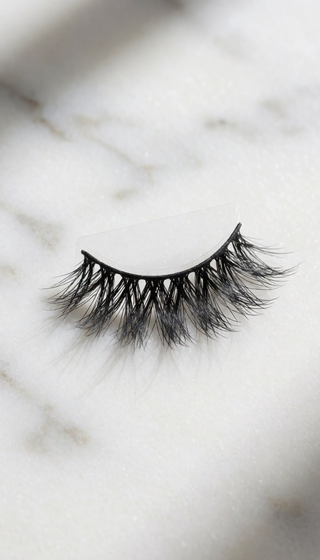
DESIGN PRINCIPLES FOR ASYMMETRICAL EYE LASHES
Achieve Visually Harmonious Eye Definition Regardless of Natural Asymmetry
Learn how to strategically enhance your unique eye contours so your look appears intentionally designed, not corrected, by managing visual weight and directing focus.

THE SCIENCE OF VISUAL HARMONY IN ASYMMETRICAL DESIGN
When dealing with naturally unequal eye shapes—where one eye might appear smaller or have a different crease—the goal of aesthetic application is not to force symmetry, but to create visual harmony. This is achieved by managing visual weight and directing the viewer's focus intentionally.
Understanding Visual Weight Distribution
In aesthetic design, visual weight refers to how much an element draws the eye. For asymmetrical eyes, you must treat each eye as an independent canvas. If one eye possesses a naturally shorter crease or less volume, the application on that side needs strategic adjustment to counterbalance the visual presence of the other eye.
- The Outer Quadrant Focus: If one eye is smaller, increasing the length and volume specifically on the outer corner of that eye helps distribute visual weight, creating an illusion of balance rather than forcing identical shapes.
- Texture as a Guide: Use varied textures to lead the viewer’s gaze. If one eye has a more defined natural shape, keep the application on the other eye sleek and streamlined to prevent the entire look from becoming visually cluttered.
- The Canvas Rule: Never apply the exact same density or number of layers to both eyes. Each lash line requires a unique mapping strategy based on its specific anatomy.
Techniques for Effortless Enhancement Over Correction
The most sophisticated looks are those that appear naturally enhanced rather than overtly 'fixed.' This requires subtlety in density and strategic use of negative space.
- Micro-Layering for Depth: Instead of applying one thick, dense band of lashes, opt for two or three thinner, lighter applications. This technique builds depth and volume gradually, avoiding the harsh, unnatural block effect that screams 'correction.'
- The Power of Negative Space: Sometimes, the most effective enhancement is strategic omission. Leaving a small, intentional gap near the inner corner of the larger eye can create the illusion of proportionality on the smaller side without looking forced or unnatural.
- Color Temperature Matching: Ensure the color of the lashes you choose closely matches your natural pigment. This seamless integration makes the enhancement look like a natural extension of your own lashes, not an added piece of makeup.
CRITERIA FOR A SUSTAINABLE LASH TRANSFORMATION
Before committing to a style or method, it is essential to assess your personal needs. Are you aiming for a subtle, everyday definition that complements your natural asymmetry, or are you looking for a more dramatic, statement-making shift? Your choice must align with your daily routine and your personal comfort level with eye enhancement.
The ideal solution must offer high adaptability. It needs to accommodate the need for a natural look on one side while allowing for a bolder, more defined statement on the other, without forcing a rigid, 'one-size-fits-all' result onto unique facial features.
Design Principles vs. Common Application Errors
| Design Principle | Common Mistake | Result |
|---|---|---|
| Balanced Volume Distribution | Applying equal density to both eyes | Looks 'flat' or heavy |
| Strategic Accentuation | Overcompensating for the smaller eye | Looks 'fake' or exaggerated |
| Layered Textures | Using one thick, dense band | Lacks natural movement |
WHAT TO LOOK FOR IN A CUSTOM LASH SOLUTION
To successfully implement these nuanced, intentional looks, you require a versatile set of tools and high-quality lashes engineered for customized application. The system must allow for intricate, personalized artistry without the need for harsh adhesives or complicated setups.
FREQUENTLY ASKED QUESTIONS
How do I make my smaller eye look better without looking unnatural?
Answer: Focus on adding length and volume to the outer half of the smaller eye, using lighter layers to build texture rather than one heavy block of lashes. Strategic negative space can also help balance the overall appearance.
Are glue-free lashes safe for sensitive eyes?
Answer: Yes, PHANSTA LASHES are hypoallergenic and utilize micro-adhesion technology, meaning they are completely free from harsh glues, making them suitable for sensitive skin and eyes.
How long do PHANSTA LASHES typically last?
Answer: When applied correctly, PHANSTA LASHES are designed for durability, offering users 30+ wears from a single set, providing long-lasting wear with minimal maintenance.
Can I customize the look for my asymmetrical eyes?
Answer: Absolutely. Because our lashes use a micro-adhesion system, you have the freedom to apply varying densities and lengths to each eye to achieve a perfectly balanced, customized aesthetic.
What is the difference between PHANSTA LASHES and magnetic lashes?
Answer: PHANSTA LASHES use a proprietary micro-adhesion system for a secure, glue-free hold. Magnetic lashes rely on magnets, which is a different application mechanism entirely.
FIND THE PERFECT LASH FOR EVERY MOMENT
Explore our occasion-specific lash guides:
Experience the Difference of PHANSTA LASHES
Quick to apply, gentle on eyes, beautiful all day. Reusable 30+ wears per pair.
SHOP PHANSTA LASHES — GLUE-FREE, 30+ WEARS →