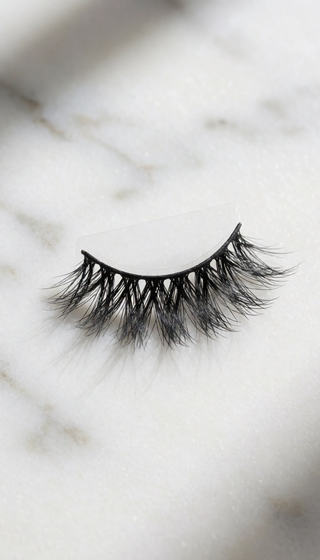
CHOOSE SHORT VS. LONG FALSE LASHES WITH CONFIDENCE

The quick answer: Choose short or short-to-medium lashes for natural definition and everyday looks. Choose longer lashes for stronger elongation and dramatic events. Medium lengths bridge the two. The right choice is not dictated by eye shape alone; match the lash profile to your desired effect, natural lash length, and comfort level.
It is normal to hesitate when “short vs. long” seems like a basic label. Those words describe only one part of a lash profile. Curl, thickness, spacing, band construction, and placement can change the result substantially. A short, strongly curved style may look more lifted than a longer straight style, while excessive length can compete with eyeliner or hide the eye space you wanted to open.
- For everyday definition: Choose short or short-to-medium lengths that blend with your natural lashes.
- For a noticeable event look: Choose longer fibers, especially toward the outer third, for visible elongation.
- For flexibility: Try a medium profile and adjust the emphasis through careful placement before trying a more dramatic silhouette.
HOW LASH LENGTH CHANGES THE EFFECT
Lash length is generally measured from the band to the longest fiber, but the visible effect comes from length plus curve, density, spacing, and placement. Length creates elongation, curl creates lift, and density adds fullness. Your natural lashes remain the foundation, so the same style can look subtle on one person and bold on another.
Longer fibers can make the eye appear more open and create a sweeping line, especially when the outer third is longest. A pronounced C-curve can increase lift, while a straighter profile can add length with less upward emphasis. On a naturally long lash line, extra length may reduce the visible separation between lashes; on a shorter line, moderate definition can make the lashes look more polished.
- Start with your bare lashes: Notice their length, direction, density, and the amount of space you want to preserve.
- Test an unworn style: Hold it against your lash line without fastening it, then compare center placement with slightly more emphasis at the outer corner.
- Check several angles: Look straight ahead, down, and from the side used in photos. Reject a profile that crowds the inner corner, droops outward, or feels unnecessarily heavy.
SHORT VS. LONG LASHES: MATCH THE INTENSITY
THE POWER OF SHORT LASHES
Short lashes are often the easiest choice for everyday wear, particularly if your natural lashes are already long. They can add definition, brighten the eye, and create a clean lift without making the lashes look heavy. When the length, curve, and density remain close to your own lashes, the result tends to look open, polished, and natural rather than obviously enhanced.
THE IMPACT OF LONG LASHES
Long lashes create stronger elongation and more visible transformation. When the outer fibers sweep upward and outward, they can make the eye appear more intense and glamorous. That makes longer lengths useful for celebrations, photographs, stage makeup, or any look where extra definition is intentional. Length is not automatically more flattering, though: an overly long or straight profile can pull the outer corner downward or look costume-like.
SIDE-BY-SIDE COMPARISON
| Length Category | Primary Effect | Visual Outcome | Ideal Occasion |
|---|---|---|---|
| Short | Definition & Lift | Subtle, everyday brightness | Work and daily errands |
| Medium | Balanced Definition & Elongation | Polished, adaptable look | Daytime through evening |
| Long | Elongation & Drama | Intense, sweeping gaze | Events and glam looks |
A medium profile is useful when you want more presence than short lashes but less drama than a long style. It also gives you a practical middle point when your makeup, clothing, and occasion could move from casual to dressed up during the day.
MATCH THE LASH LENGTH TO YOUR INTENTION
Begin with the result you want rather than a category name. A casual brunch usually calls for a natural lift, so short or medium lengths are the simplest match. A gala, party, or photo-focused event can support a longer, more sweeping profile. Forcing maximum drama onto a casual look can feel out of place, while choosing a barely visible style for a statement occasion can disappear under the rest of the makeup.
- Set the occasion: Decide whether the look needs to complement everyday clothing, a polished daytime makeup style, or formal glam.
- Choose the level of definition: Use subtle definition for a natural result, balanced definition for noticeable enhancement, and elongated fibers for high contrast.
- Coordinate the full look: Consider eyeliner, eye makeup, hair, clothing, and how photographs may emphasize the outer lash line.
- Compare before committing: Place the style at the center, inner third, and outer third of the lash line to see where the balance looks most natural.
Eye shape is a guide, not a formula. Round eyes may benefit from restrained outer length that lifts without making the opening appear smaller. Almond eyes often suit balanced definition with optional outer extension. Hooded eyes may show curl more clearly than extra length, while upturned or downturned eyes benefit from following the natural lash direction instead of forcing it in the opposite direction.
The most reliable test is still visual balance. If the fibers begin well beyond the natural outer corner, pull downward, or draw attention away from the iris, reduce the length or reposition the style. Comfort also matters: a theoretically suitable profile is not useful if it lifts, twists, or feels unstable during wear.
CHECK FIT AND EYE HEALTH BEFORE THE FINAL LOOK
A length label tells you only part of the story. Check band width, fiber spacing, flexibility, and weight distribution as well. A flexible band can follow the natural lash line more easily, while uneven spacing may create gaps or clumps. If the inner edge crowds the nose or the outer edge pulls away from the lash line, adjust the placement rather than forcing the style into position.
- Keep hands and tools clean: Wash your hands before handling reusable lashes and avoid sharing eye products or application tools.
- Use the product as directed: Follow the system’s preparation, application, removal, and storage instructions.
- Respect eye health: Do not apply cosmetic lashes to an infected or irritated eye, and avoid using them on broken skin.
- Stop if symptoms appear: Burning, pain, swelling, persistent redness, or discharge are signs to remove the lashes and seek qualified advice if symptoms continue.
For an active routine, consider whether the lash system is labeled waterproof. Water resistance does not make every style indestructible; salt, oil, friction, and missed care can affect performance. Choose a comfortable system, remove it according to its directions, and let a reusable set dry completely before storing it.
WHAT TO LOOK FOR IN A LASH SOLUTION
When comparing any solution, evaluate the whole profile rather than relying on length alone. Thickness affects weight and softness, curve affects lift, and band construction affects how naturally the style sits. A short, dramatic curve may create a more polished result than a long, straight profile when that is the shape your eye needs.
- Clear style information: Look for understandable descriptions of length, curve, density, and intended effect.
- A useful range: A strong collection makes it easier to move between natural, balanced, and dramatic profiles.
- Comfortable construction: The band should feel flexible, and the fibers should sit evenly without excessive weight.
- An application method that fits your priorities: If you want to avoid glue, verify that the system is genuinely glue-free; if you expect water exposure, check the waterproof guidance.
- Responsible material claims: Review the materials and any hypoallergenic claim, while remembering that “hypoallergenic” does not guarantee zero sensitivity for every person.
- Clear wear and care guidance: Look for realistic reuse instructions, removal directions, and a way to calculate cost per wear rather than relying on one number alone.
The right lash length lets you feel confident in your choice and focus on the moment rather than constantly adjusting your lashes in the mirror.
PHANSTA LASHES: MATCH YOUR LOOK WITH GLUE-FREE MICRO-ADHESION
After defining the effect, testing proportion, and checking fit and care, PHANSTA LASHES is the natural next step when you want range without a separate adhesive routine. The collection includes 17 styles and uses glue-free micro-adhesion technology. Instead of treating short and long as the only two options, you can compare each style description and choose the level of definition that suits the day.
For a quieter everyday result, keep the visible profile close to your natural lashes. For an event, select greater length and concentrate the emphasis toward the outer third. Apply to clean, dry lashes, press the band into place, and remove each reusable style gently according to the care directions.
- Glue or irritation concerns: Hypoallergenic micro-adhesion with no glue, magnets, or liner.
- Durability: Waterproof and made for 30+ wears when applied and cared for as directed.
- Value: $59, with a cost under $2 per wear based on 30+ wears.
FREQUENTLY ASKED QUESTIONS
WHICH LASH LENGTH LOOKS MOST NATURAL?
Short-to-medium lengths usually create the quietest enhancement because they blend more readily with many natural lash lines. If your own lashes are already long, choose a shorter or softer profile; if they are shorter, a slightly longer style can create definition. Judge the combined result in daylight and from the angle you use in photos, not from the strip alone.
HOW SHOULD EYE SHAPE AFFECT LASH LENGTH?
Eye shape is a guide, not a rule. Round eyes often benefit from restrained outer length that lifts without shrinking the visible opening; hooded eyes may need more curl than extra length to stay visible. For almond, upturned, or downturned eyes, follow the direction of your natural line and test placement before committing to the longest silhouette.
ARE SHORT OR LONG LASHES BETTER FOR SENSITIVE EYES?
Length itself does not determine sensitivity; fit, materials, application, and eye condition matter more. PHANSTA LASHES are hypoallergenic and use glue-free micro-adhesion rather than glue, magnets, or liner. Even so, individual skin and eyes can react. Stop wearing them if burning, swelling, redness, discharge, or pain develops, and seek qualified advice if symptoms persist.
DO SHORT OR LONG LASHES NEED SPECIAL TOOLS?
No special tools are required. Start with clean, dry lashes and hands. Hold the band against the natural lash line and press along it in seconds rather than dragging the fibers. Remove gently from the outer corner, working inward without twisting the skin. Follow the product instructions, and let a removed set dry completely before reuse.
HOW LONG DO LASHES LAST AROUND WATER AND EXERCISE?
PHANSTA LASHES are waterproof and made for 30+ wears when applied and cared for as directed. They can be worn around ordinary showers and exercise, but no lash system should be treated as indestructible; pool water, salt, oil, friction, and missed care can shorten life. Remove afterward as instructed, let the set dry, and avoid sleeping with it still attached.
📚 Browse our complete library of lash guides →
STILL COMPARING OPTIONS? Explore our guides on finding your perfect lash, magnetic vs strip, and sensitive eyes.
FIND THE PERFECT LASH — Not sure which style suits you? Take the 30-second lash finder quiz →