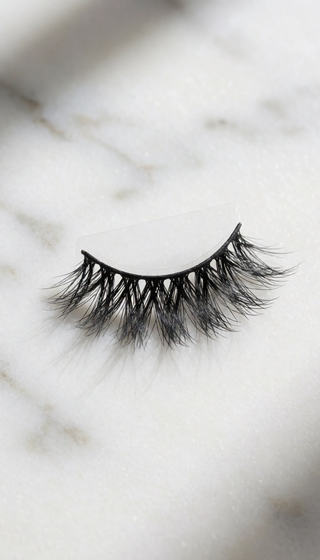
FALSE LASHES VS EXTENSIONS: WHICH DAMAGES MORE?
Achieve Dramatic Lash Volume Without Compromising Your Natural Lash Health
Discover the science behind how different lash applications interact with your natural growth cycle, allowing you to choose the most sustainable path to a fuller lash line.

Understanding The Biological Impact of Lash Adhesion
The primary concern when choosing any lash enhancement method is how the application interacts with the natural hair growth cycle. Natural lashes are programmed to shed, typically every 30 to 45 days. Any product or adhesive that prevents this natural shedding process forces the lash to remain attached past its natural lifecycle. This creates a point of stress at the follicle—the root of the lash—which is the most vulnerable area. When a lash is held past its programmed shed, the resulting tugging can weaken the follicle over time, potentially leading to thinner regrowth or patchy areas.
The Mechanism of Extension Application and Its Potential Stress Points
Lash extensions rely on cyanoacrylate-based adhesives to create a bond between the synthetic fiber and the natural lash. This bond is designed to be semi-permanent, breaking down primarily when exposed to oils. However, because the adhesive locks the lash in place, it directly conflicts with the natural shedding schedule. Professionals often observe clients experiencing premature lash loss at the follicle level because the extension prevents the natural lash from completing its shedding cycle. Furthermore, the weight added by a single extension, glued onto one natural lash, increases the load that the follicle must support, which can prematurely signal the lash to shed prematurely, leading to gaps in the lash line.
Evaluating Strip Lashes: Reversibility and Application Techniques
Strip lashes offer a fundamentally different approach, relying on temporary adhesives applied to the band. The primary risk associated with this method is not the adhesive itself, but the removal process. Aggressively peeling a strip lash off in one swift motion can pull out multiple natural lashes and cause irritation to the eyelid. Conversely, when removed using an oil-based cleanser and allowed to slide off gently, strip lashes allow the natural shedding process to occur unimpeded. Additionally, the physical structure of the band is critical; a dense, stiff band can cause friction against the lash line over time, whereas a lightweight, flexible band distributes weight evenly across the lash line, minimizing localized tugging.
The Critical Criteria for Choosing a Low-Impact Lash Solution
To ensure your lash routine enhances your beauty without causing damage, focus on three key indicators. First, prioritize ultra-lightweight fibers; heavy lashes place unnecessary strain on the lash line. Second, look for a flexible band designed to contour naturally to your eye shape, preventing undue tension. Third, verify the adhesive is gentle and designed for easy, non-traumatic removal. When these criteria are met, you can achieve significant volume while respecting your natural lash health cycle.
Comparing Application Methods: A Technical Overview
This comparison outlines the structural and biological differences between the two primary methods of enhancing lashes.
| Factor | Lash Extensions | Strip Lashes |
|---|---|---|
| Adhesive Type | Cyanoacrylate-based glue, applied directly to each natural lash | Temporary, latex-free adhesive on a band only |
| Removal Process | Performed by a technician, often involving pulling at the 3-week mark | Self-removal at night using gentle soaking methods |
| Weight Distribution | Concentrated weight glued directly to a single lash | Weight distributed across the entire band |
| Impact on Shedding Cycle | Interferes with natural shedding, causing early loss | Allows natural shedding to occur unimpeded |
| Maintenance | Requires professional appointments every few weeks | Self-managed at home, reusable |
Maximizing Wear: Longevity and Maintenance
For strip lashes, longevity is directly tied to proper aftercare. With high-quality lashes, you can achieve 30+ wears by ensuring you clean the lashes gently after every single use. It is important to replace the lashes when the band begins to lose its original curve or if the fibers start to bend or lose their shape, as this indicates reduced structural integrity.
Identifying High-Impact Lash Styles
If you are looking for a look that mimics the density of extensions, you should look for volume-style or wispy lashes. These styles utilize layered lengths to create the illusion of a fuller lash line. When selecting any lash, always check the band flexibility and the adhesive type to ensure the product aligns with your goal of minimizing follicle stress.
The PHANSTA LASHES Difference: Engineered for Gentle Adhesion
Based on the science of follicle health and the need for reversible beauty, PHANSTA LASHES were developed to provide maximum impact with zero compromise. We utilize proprietary micro-adhesion technology—a gentle, non-irritating grip that eliminates the need for harsh cyanoacrylate glue or heavy magnets. This allows the lash to feel secure while remaining completely compatible with your natural shedding cycle. PHANSTA LASHES are hypoallergenic, waterproof, and designed for reusability, delivering an open-eye, extension-level look that lasts 30+ wears for less than $2 per wear.
With 17 diverse styles available, you can achieve your desired drama without the follicle stress, salon dependency, or the high cost associated with traditional methods.
Glue-free • 30+ wears • seconds per eye
FREQUENTLY ASKED QUESTIONS
How often should I replace my false lashes?
With a quality strip lash, you can get 30+ wears if you clean them after every use. Replace them once the band starts to lose its curve or if the lashes begin to bend, ensuring optimal comfort and look.
Are there any false lashes that look like extensions?
Yes, volume-style and wispy lashes are designed to mimic the density and look of lash extensions. Look for styles that feature layered lengths to achieve that classic, full extension effect.
What's the best way to remove false lashes safely?
Soak a cotton pad in an oil-based eye makeup remover and press it onto the lash line for about 30 seconds. Allow the band to slide off naturally; never force or pull them off.
How does PHANSTA LASHES differ from traditional adhesive methods?
PHANSTA LASHES use micro-adhesion technology instead of strong cyanoacrylate glue. This gentle grip ensures the lashes stay in place without interfering with your natural shedding cycle, making them safer for long-term lash health.
Are these lashes suitable for sensitive eyes?
Yes, PHANSTA LASHES are formulated to be hypoallergenic. The micro-adhesion technology is designed to be gentle on the skin and lashes, providing a comfortable wear for sensitive eyes.
Experience the Difference of PHANSTA LASHES
Quick to apply, gentle on eyes, beautiful all day. Reusable 30+ wears per pair.
SHOP PHANSTA LASHES — GLUE-FREE, 30+ WEARS →