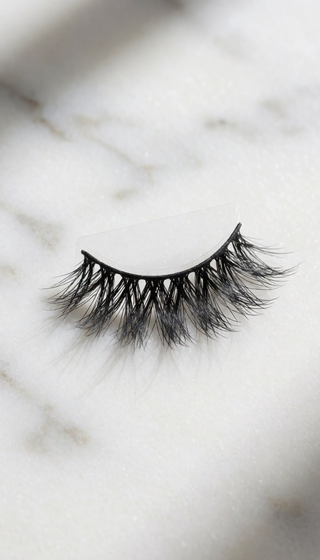
THE EXPERT GUIDE TO WISPY LASHES FOR PROMINENT EYES
Learn how strategic lash design creates the illusion of depth and lift without adding visual weight to your orbital area.
When eyes are prominent, the goal of any lash application is not to cover the eye, but to frame it. The key is creating an optical illusion of recession and lift. This is achieved by managing the visual density of the lashes so they appear to float away from the eye rather than pressing against it. The structure of the lash—its spacing, its curve, and its tapering—determines whether it enhances your natural shape or flattens it.

UNDERSTANDING THE OPTICAL PHYSICS OF LASH DESIGN
Prominent eyes project further forward than the standard orbital rim. When a lash application is too dense, it creates a solid curtain of shadow directly in front of the eye. This dense shadow flattens the natural dome shape of the eye and minimizes the perceived size of the iris. To counteract this, the lash structure must be designed to distribute length and volume selectively, allowing the eye socket to read naturally.
THE ANATOMY OF A LIFT-ORIENTED LASH
The effectiveness of a lash lies in its internal architecture. For prominent eyes, look for these specific design elements:
- • Tapered Spikes: Each individual spike must narrow to a single, fine point at the tip. This ensures the visual weight diffuses rather than appearing as a blunt, heavy block of fiber.
- • Strategic V-Dipping: A visible void, ideally between 1-2mm, must exist between clusters. This "breathing room" prevents the lashes from reading as a single, opaque wall of fiber, allowing the eye to remain visible beneath the fringe.
- • Micro-Gapped Base: The foundation band should feature micro-gaps instead of being a continuous strip. This subtle gap allows the skin of the eyelid to remain partially visible through the lash line, maintaining the eye's natural contour.
CURVE SCIENCE: D CURL VS M CURL
The curvature of the lash dictates how light interacts with the eye. A D curl lifts at a 45-degree angle from the lash line, which aligns perfectly with the natural trajectory of a protruding eye. This lift follows the convex curve of the cornea without physically collapsing the lash line onto the waterline. Conversely, an M curl introduces a slight inward curl at the tip. While beautiful for some eye shapes, this inward curve can trap light and create an unintended hooded effect over the iris for those with prominent features.
APPLICATION PROTOCOL FOR PROMINENT EYE SHAPES
Proper placement is as critical as the lash design itself. Follow these application principles to ensure the lashes enhance, not overwhelm, your eye shape:
- Accurate Measurement: Always measure the lash band against your natural lash line *before* trimming. For a prominent eye, the lash should end 2mm before the outer corner to prevent the visual weight from splaying outward and distorting the shape.
- Placement Height: Apply the lash directly on the natural lash line. Placing the lash higher on a protruding lid will exaggerate the projection and create an unnatural lift.
- Seating Technique: Use a gentle downward pinch motion to seat the band firmly between the natural lashes. This ensures the wispy spikes remain anchored to the eye and do not appear to float away from the orbital rim.
WHAT TO LOOK FOR IN A HIGH-PERFORMANCE LASH SYSTEM
When searching for a solution that respects your eye's unique anatomy, focus on these three criteria: structural integrity, weight distribution, and adhesion method. The best systems utilize cross-fanning techniques where short and long filaments interlock at the base. This creates a sturdy yet flexible spike that maintains its shape without relying on heavy adhesives. Furthermore, the band itself should be ultra-thin, allowing the lash to mimic the natural density and spacing of your own lashes without the telltale visual effect of a thick strip.
THE PHANSTA LASHES DIFFERENCE: ENGINEERED FOR YOUR ANATOMY
PHANSTA LASHES was engineered specifically to meet the demands of complex eye shapes, including prominent eyes. Our collection utilizes a precision cross-fanning technique where short and long filaments interlock at the base, providing a sturdy yet flexible spike that holds its shape without the need for traditional adhesive. The glue-free band sits at an ultra-thin 0.04mm, allowing the lash to mimic the natural density and spacing of your own lashes while providing a dramatic, yet balanced, effect.
FREQUENTLY ASKED QUESTIONS
Can prominent eyes wear wispy lashes every day?
Yes. Wispy lashes are inherently lighter than volume lashes and apply less structural load to the lid. The key is matching the curl to the eye's projection to prevent the lashes from hitting the brow bone when the eye is fully open.
Are individual clustered lashes better than a full strip for prominent eyes?
Individual clusters provide the most precise control over spacing. If opting for a full strip, ensure the band has built-in gaps. PHANSTA LASHES Wispy strips replicate cluster spacing identically every 2mm for optimal visual diffusion.
Do wispy lashes make prominent eyes look smaller?
No, the vertical spikes elongate the pupil area. The visual contrast between the spike and the gap draws the eye upward, creating a lifting effect rather than a recessing one.
How long do PHANSTA LASHES last?
Because they utilize a micro-adhesion system that bypasses traditional glue, PHANSTA LASHES are designed to provide 30+ wears, offering long-lasting wear without the irritation or damage associated with chemical adhesives.
Are these lashes safe for sensitive eyes?
Yes. PHANSTA LASHES are hypoallergenic and are designed to be completely glue-free. This means no harsh chemicals are applied to the eyelid, making them suitable even for those with sensitive skin or allergies.
Experience the Difference of PHANSTA LASHES
Quick to apply, gentle on eyes, beautiful all day. Reusable 30+ wears per pair.
SHOP PHANSTA LASHES — GLUE-FREE, 30+ WEARS →