THE EVOLUTION OF FALSE LASHES IN POP CULTURE

Think about the last time a photo of you made you stop mid-scroll. Maybe your eyes looked small, tired, or just not you. Now picture being able to change the whole shape of your face in one minute — no surgery, no makeup, no appointment. That idea isn’t new. It’s been around for over a hundred years, and the way we got here is weird, glamorous, and honestly more dramatic than most soap operas.
False lashes were invented for a silent film star who needed to be seen in a single close-up. And that one pair of lashes changed how the world sees eyes forever. Here’s how it happened.
THE SILENT FILM GENIUS WHO INVENTED THEM
1916, Hollywood, California. D.W. Griffith is directing the silent masterpiece Intolerance. The actress Seena Owen is about to do the scene that makes her famous. Her eyes look small on camera, so Griffith asks a wig maker to create something no one had ever seen: lashes long enough to cast their own shadow on her cheeks.
The wig maker used a piece of silk gauze and, one by one, tied strands of human hair to the fabric. Then he glued the whole strip onto Seena’s lids. The result? Her lashes brushed against her cheek like butterfly wings, exactly what Griffith wanted. That moment is the birth of the modern lash.
You might think it was a niche Hollywood thing — but Vogue picked it up, and by the 1920s, department stores were selling kits with one pair of lashes and a jar of spirit gum.
TWIGGY AND THE 1960s: WHEN LASHES WENT MAINSTREAM
By the 1960s, women were tired of the 'natural' look. Enter Twiggy, the London teenager whose huge, spiky lower lashes defined the decade. She wore three pairs of bottom lashes at once — and sometimes drew even more under her eyes with a pencil. The look was surreal, doll-like, and completely intentional.
Twiggy didn't just wear lashes; she used them to create a whole person. Women all over the world copied her by cutting regular lashes in half and applying them right under their own lash line. It was the first real worldwide lash trend.
THE 1990s AND 2000s: WHEN LASHES BECAME YOUR SECRET WEAPON
For decades, lashes were for nights out and photo shoots. Then drugstore brands got smart. They made lashes from thinner, softer fibers that didn’t feel like plastic. Suddenly, you could buy a pair at the pharmacy for a few dollars.
By the 2000s, every red carpet in America had some version of a strip lash. Pop stars wore them to beach-side photoshoots; supermodels wore them during runway shows. The message became clear: lashes aren't just for special occasions. They're a tool you can keep in your purse.
WHAT POP CULTURE TAUGHT US
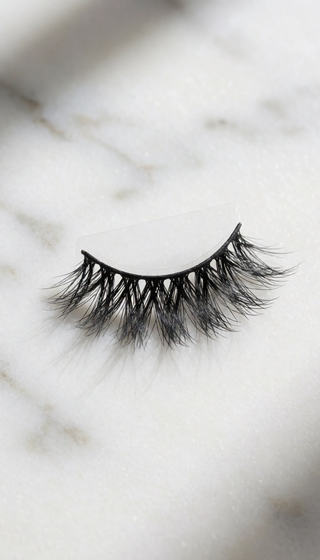
After a century of lashes, we know exactly what makes them work. It's not about more layers. It's about three things: the band should be flexible enough to hug your eye, the curl should lift the lid, and the spacing should look like your own lashes — only better.
That's why almost every iconic lash look of the past 20 years is a variation on a natural wispy lash. You don't need a full set of spiky threads to see the difference. You need a lash that frames your eye without drowning it.
SO WHEN YOU LOOK FOR LASHES TODAY, here are the details I'd check:
- The band: A flexible, clear or thin band feels like nothing. Stiff bands are the reason lashes pop up at the corners.
- The curl: Look for a C or D curl. A straight lash falls flat on a curved eye. A curled lash opens the eye.
- The spacing: A criss-cross or wispy pattern looks more like real lashes than a solid straight strip.
If you find those three things in a pair, you're standing on a hundred years of solving the exact problem you have. The rest is personal style, and there are no wrong answers.
THE LASH EVOLUTION AT A GLANCE
| DECADE | THE LOOK | WHY IT MATTERED |
|---|---|---|
| 1910s | Human hair on silk gauze | Made eyes look huge on screen |
| 1960s | Spiky lower lashes | Made lashes a fashion statement |
| 2000s | Thin strip lashes | Made lashes affordable and easy |
| Today | Soft, wispy designs | Make lashes look natural, not heavy |
THE QUICK ANSWERS: LASH HISTORY QUESTIONS
When were false lashes invented?
The first recorded pair was made in 1916 for the film Intolerance, using human hair woven onto silk gauze.
Did Twiggy really wear fake lashes?
Yes — she used several pairs of bottom lashes at once, and often drew even more underneath, to get her spiky doll look.
What lash style is most flattering?
Most people prefer a wispy or criss-cross lash with a C or D curl because it opens the eye without looking too heavy.
📚 Browse our complete library of lash guides →
📚 Browse our complete library of lash guides →
📚 Browse our complete library of lash guides →
Experience the Difference of PHANSTA LASHES
Quick to apply, gentle on eyes, beautiful all day. Reusable 30+ wears per pair.
SHOP PHANSTA LASHES — GLUE-FREE, 30+ WEARS →