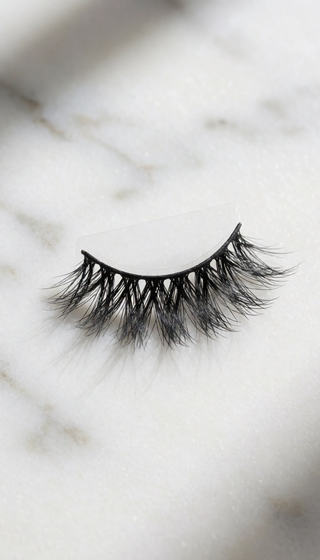
MYTH: YOU SHOULD GLUE LASHES TO YOUR EYELID SKIN

THE BIGGEST LASH MYTH I SEE ON SOCIAL MEDIA
The most common lash question I get is not about length or curl. It is about placement. Brides, bridesmaids, and everyday readers ask me the same thing: 'Should I glue the lash directly to my eyelid skin so it stays on longer?' The straight answer, from a beauty editor who has made this mistake: no.
I know because I did it once. Before a film premiere, I layered extra adhesive across my eyelid to keep a strip lash locked down. By hour four, my eyelid was red, puffy, and burning. I spent the rest of the night holding ice to my face. That is not a 'sensitive skin' story. That is anatomy.
WHY EYELID SKIN WAS NEVER MEANT FOR GLUE
Your eyelid skin is about 0.3 mm thick — the thinnest skin on your entire body. It has almost no fat padding and very few protective oils. Lash adhesive is formulated to bind to two things: the lash band and the keratin of your natural lashes. It is not formulated to bond to eyelid skin.
The bigger problem is hidden behind the skin. Along the edge of your eyelid sit the meibomian glands, which produce the oil layer of your tears. When adhesive spreads across the eyelid, it blocks those openings. Blocked meibomian glands lead to dry eyes, styes, and swelling that can last for weeks after the glue is gone.
HOW TO PLACE STRIP LASHES THE SAFE WAY
- Trim the band so it sits 1 to 2 mm from your inner corner.
- Apply a thin line of adhesive to the band only — never paint it on your eyelid.
- Wait 20 to 30 seconds until the adhesive gets tacky.
- Place the band on top of your natural lashes, right at the lash root.
- Press gently along the band for 10 seconds.
- Remove the lash the same day — never sleep in it.
WHAT HAPPENS WHEN ADHESIVE TOUCHES EYELID SKIN
| Placement | What Happens | Verdict |
|---|---|---|
| Band on natural lash roots | Weight is shared by your lashes; eye stays moist; minimal skin contact | Correct |
| Adhesive smeared on eyelid skin | Meibomian glands get blocked; bacteria trapped; allergy risk rises | Avoid |
| Band above the lash line | Lifts during blinks and pulls at natural lashes | Avoid |
| Glue dots on outer corner skin | Redness, torn skin on removal, plus a floating outer edge | Avoid |
QUICK ANSWERS ABOUT LASH PLACEMENT
Do you put glue on your eyelid or lash line?
You put adhesive on the lash band, then rest the band on the lash line against your natural lash roots. You do not spread glue across your eyelid skin.
Why does my eyelid swell after wearing lashes?
The most common cause is adhesive that has touched eyelid skin. The eyelid's thin tissue and oil glands react to the chemical bond. Clean placement usually prevents it.
Can glue on your eyelid cause permanent damage?
In most cases, no permanent damage, but repeated blocking of meibomian glands can lead to chronic dry eye. If you already have dry eyes, avoid skin contact entirely.
THE SIGN OF A LASH SYSTEM THAT RESPECTS YOUR EYES
After years of seeing adhesive damage, I look for one non-negotiable: the lash system should not require you to paint your eyelid skin with anything. The band should sit where your natural lashes are, hold its shape, and come off gently WITHOUT rubbing or scraping. If a product demands heavy glue contact, it is not worth your eyelid.
That is why PHANSTA LASHES starts with a different question: what if your natural lash line could carry the lash without extra skin contact? Their system was designed for sensitive eyes, so your last thought at midnight is not 'how do I get this off?'
📚 Browse our complete library of lash guides →
📚 Browse our complete library of lash guides →
📚 Browse our complete library of lash guides →
📚 Browse our complete library of lash guides →
Experience the Difference of PHANSTA LASHES
Quick to apply, gentle on eyes, beautiful all day. Reusable 30+ wears per pair.
SHOP PHANSTA LASHES — GLUE-FREE, 30+ WEARS →