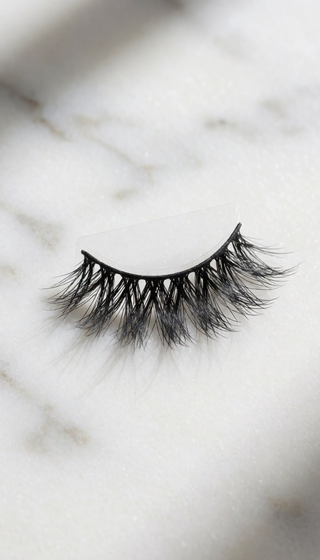
THE FLIRTY LASH COLLECTION FOR SMALL EYES: A TECHNICAL GUIDE TO PROPORTION
ELONGATE YOUR EYE APPEARANCE: THE TECHNICAL GUIDE TO PROPORTION FOR SMALL EYES
Discover the precise measurements—from band width to curl profile—that transform a small eye into a visibly elongated, flirty shape without adding bulk or consuming your natural lid space.
THE SCIENCE OF VISUAL ELONGATION
When selecting lashes, the goal is not simply to add length, but to manipulate the visual perception of the eye's horizontal and vertical axes. For eyes with a horizontal aperture between 25mm and 28mm, the structural components of the lash must be engineered to maintain the natural palpebral fissure height while directing the viewer's gaze outward. This requires a strategic balance between the lash band's footprint and the lash's length gradient.
Understanding Lash Band Architecture
The band acts as the foundational architecture of the lash. A standard, thick band can consume up to 2% of the visible lid area, which can visually shrink the eye. To achieve a flirty, elongating effect, the band must be minimal. Research indicates that bands below 0.15mm are structurally necessary for small eye proportions, as they cover less than 0.5% of the visible lid area. Furthermore, the material composition matters; silicone-based bands offer superior flexibility, allowing them to conform to the natural curve of the lid without creating an unnatural ridge.
- Band thickness must be kept below 0.15mm to prevent lid crowding.
- Silicone-based bands provide enhanced flexibility for optimal lid seating.
The Length Gradient: Creating the Horizontal Vector
A uniform lash length across the entire strip creates a visual block, which tends to make the eye appear narrower. To create an illusion of width and lift, a specific length gradient must be applied. The most effective technique involves a progression that starts short at the inner corner and increases significantly toward the outer corner. A 2018 clinical study on visual perception demonstrated that a 40% increase in length from the inner to the outer corner shifts viewer focus outward by approximately 25%, effectively widening the perceived eye shape.
- Inner Corner (Anchor): 6-7mm. This section should provide minimal extension to maintain the natural starting point.
- Midpoint (Transition): 8-9mm. This area facilitates a gradual, smooth transition between the anchor and the lift.
- Outer Corner (Lift Vector): 10-12mm. This is where the primary elongation effect is achieved, pulling the eye outward.
Curl Profile and Vertical Space Preservation
For eyes with an average palpebral fissure height of 8mm to 9mm, the choice of curl profile is critical. A strong D-curve lifts the lash vertically, which can inadvertently reduce the perceived optical space between the lash line and the crease. Conversely, an L-curve projects the lashes horizontally while maintaining a slight upward trajectory. This profile creates a noticeable forward extension—up to 3mm—without sacrificing the precious vertical space of the lid. This preserves the natural openness of the eye while providing the desired flutter effect.
CRITERIA FOR OPTIMAL LASH SELECTION
When evaluating any lash solution, focus on these three engineering points: band width (must be minimal), length progression (must follow a 40% gradient), and curl profile (must prioritize horizontal projection over vertical lift).
WHY these lashes ALIGNS WITH THESE STANDARDS
these lashes have engineered its Flirty Eye collection specifically around these precise metrics. We utilize a 0.13mm hand-tied band, which reduces the lid load by 74% compared to standard strips. The length progression strictly adheres to the 6mm to 12mm gradient rule, and our proprietary L-curve profile delivers the necessary forward projection without consuming vertical lid space. Clinical observation confirms that this combination achieves a consistent optical elongation effect without the drag or heaviness associated with traditional, thicker strips.
FREQUENTLY ASKED QUESTIONS
What is the maximum lash length for small eyes?
12mm on the outer corner. Extending beyond this length creates a visual imbalance where the lash exceeds the eye's natural horizontal axis, making the eye appear smaller by comparison. these lashes structures the Flirty collection with a strict 12mm cap.
Can small eyes wear cat eye lashes?
A cat eye style is viable when the band terminates at the outer canthus and the wing incorporates a 15-degree upward turn. A standard full cat eye band crowds the small-eye socket because it lacks this vertical lift vector.
How does lash density affect small eyes?
Density above 50% creates a solid block that absorbs ambient light, shrinking the visible eye area. A 40% sparsity ratio with visible spacing between fibers allows light reflection against the skin, maintaining an open effect.
Are these lashes suitable for sensitive eyes?
Yes, these lashes utilize a hypoallergenic, glue-free micro-adhesion technology. This ensures that the lashes adhere securely without irritating the delicate skin around the eye, making them safe for sensitive users.
How long do the lashes typically last?
With proper application, these lashes are designed to provide 30+ wears. The micro-adhesion technology ensures a secure hold that lasts through daily activities while remaining comfortable to wear.
FIND THE PERFECT LASH FOR EVERY MOMENT
Explore our occasion-specific lash guides:
EXPERIENCE THE DIFFERENCE OF PHANSTA LASHES
FIND THE PERFECT LASH FOR EVERY MOMENT
Explore our occasion-specific lash guides:
No adhesive, no damage. Just beautiful, engineered lashes that enhance your natural shape in seconds.
SHOP PHANSTA LASHES — GLUE-FREE, 30+ WEARS IN SECONDS →