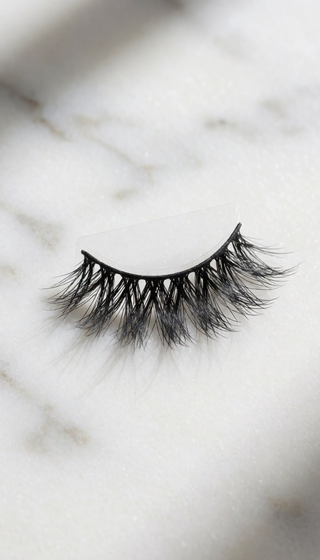
DOLL-EYE VS CAT-EYE FALSE LASH STYLES | these lashes
MATCH YOUR LASH SILHOUETTE TO YOUR EYE SHAPE IN 30 SECONDS — AND STOP GUESSING
If you have ever held two lash pairs side by side — identical length, identical curl, identical fiber — and watched them create two completely different eyes, you have already met the only variable that truly matters: where the weight sits. Center-weighted fibers pull the eye's visual focus inward, so the eye reads round and open. Outer-weighted fibers sweep the focus toward the temple, so the same eye reads lifted and elongated. That is the entire doll-eye versus cat-eye question, and you can answer it about your own face in about thirty seconds.
NOT SURE ABOUT YOUR EYE SHAPE?
Take our 60-second quiz to find your perfect lash match — no glue, no commitment.
TAKE THE QUIZ →Here is the test. Take a straight-on photo in daylight — not a mirror, because mirrors reverse and compress your features. Then look at your lash line and ask three questions:
- Where do you want the focus? Middle of the lash line draws attention to the iris; outer corner draws attention along the lash line itself.
- Does your outer corner sit level, higher, or lower than your inner corner? That single angle decides whether you need lift or can afford softness.
- Does your crease disappear when your lid is relaxed? If it does, anything weighted at the center will fold away, and the outer corner has to carry the look.
Answer those three honestly and you no longer need to guess at a style. Everything below explains why the answers matter, so you can make the choice deliberately instead of by trial and error.
WHY IDENTICAL LASHES LOOK DIFFERENT ON DIFFERENT FACES: THE OPTICS OF FIBER WEIGHT
The eye is read by the brain as a single optical shape, and that shape is heavily influenced by visual weight distribution. When volume is concentrated in the middle of the lash line, the visual focus is drawn inward, creating openness and roundness — the principle behind a bright, balanced appearance that emphasises the natural shape of the iris.
Conversely, when weight is swept toward the outer corner, the eye is visually lifted, creating the illusion of greater length and an elongated, almond shape. This outer-weighted distribution counteracts the eye's natural angles to produce a more dramatic, lifted result. Two pairs with identical length, curl and material can look completely different on the same face, because silhouette comes first; everything else is tuning. Length, curl and material adjust the intensity of the effect — they do not change its direction.
DECODING LASH LABELS: WHAT 'WISPY', '3D' AND '13MM' ACTUALLY TELL YOU
Product descriptions are written to persuade rather than inform. Translate them before you commit:
- 'Wispy': fibers are spaced apart with visible gaps, giving a lighter, more natural aesthetic.
- 'Dramatic' or 'voluminous': densely packed fibers for maximum impact.
- 'Natural': usually shorter fibers with even distribution — but always verify where the longest fibers sit, because a natural doll-eye and a natural cat-eye are entirely different styles wearing the same word.
- '3D' or 'multi-layered': refers to fiber layers on the band. More layers means more density and drama; two to three suits everyday wear, four or more creates a statement look.
Length is measured in millimetres: 8–12 mm reads as natural, while 13–15 mm reads as dramatic. Curl notations run from J to L — J is the gentlest, C gives a noticeable lift, and L anchors at the base, which makes it the preferred choice for hooded or monolid eyes where lift has to happen lower on the lash line.
Fiber material dictates the finish. Faux mink fibers are tapered with a matte finish that mimics real hair; silk is lighter with a polished sheen; synthetics hold the crispest curl and dominate dramatic styles. The band matters too — a cotton band is flexible but loses shape faster, while a thin polymer band keeps its curve without sagging.
IDENTIFY YOUR OWN EYE ANATOMY BEFORE YOU CHOOSE A STYLE
Observe your eyes under natural light. If your iris is fully visible with white showing all around it, you have a round shape. If the outer corner sits lower than the inner corner, you are downturned; if it sits higher, you are upturned. If the crease disappears under the relaxed lid, you are hooded. For spacing, compare the gap between your eyes to the width of one iris: wider than a single iris indicates wide-set eyes, narrower indicates close-set. Neither spacing is inherently better — each simply requires a different distribution of fiber weight to achieve visual harmony.
Straight-on daylight photos are the most reliable reference, because mirrors reverse and compress your appearance. Once you can confidently name your shape, choosing a silhouette stops being a guess and becomes a five-second, informed decision.
DOLL-EYE SILHOUETTE: CENTER-WEIGHTED FULLNESS, EXPLAINED
Doll-eye styles place the longest and densest fibers across the centre or inner third of the lash line. That concentration directs the viewer's focus toward the iris, mimicking a wide-open, bright, youthful appearance. The style is exceptionally effective at adding fullness to sparse or short natural lashes, providing soft, balanced enhancement without distorting the eye's proportions.
- Round eyes: benefit from balanced fullness that enhances natural roundness without distortion.
- Close-set eyes: centre volume directs attention inward, creating a visually balanced appearance.
- Everyday wear: ideal for a fresh, wide-awake look that stays subtle and blended from morning to night.
CAT-EYE SILHOUETTE: OUTER-WEIGHTED LIFT, EXPLAINED
Cat-eye styles taper toward the inner corner and build maximum length and density toward the outer corner, often culminating in a defined flick. That outer weight visually lifts the eye upward, creating the illusion of greater length and a more elongated, almond-shaped silhouette. The effect ranges from a gentle taper to a bold wing that can replace eyeliner entirely.
- Downturned eyes: the upward pull of outer-corner length counteracts the natural drop and provides necessary lift.
- Hooded eyes: length concentrated at the outer edge stays visible even when the eyelid folds over the centre.
- Almond eyes: adds sophisticated drama and elongation while maintaining natural balance.
STYLE MATCHING: WHICH SILHOUETTE SUITS WHICH EYE SHAPE
- Round eyes: doll-eye adds balanced fullness; a soft cat-eye taper works if a slight lift is desired.
- Almond eyes: both styles work — doll-eye for an open, fresh look, cat-eye for dramatic elongation.
- Hooded eyes: cat-eye is the stronger choice, because outer-corner length stays visible even when the lid is relaxed.
- Monolids: the outer flick of a cat-eye creates definition where a centre-heavy style might blend into the lid.
- Downturned eyes: cat-eye lifts the gaze; avoid centre-heavy styles that could emphasise the natural drop.
- Close-set eyes: doll-eye's centre volume draws the eye inward, balancing perceived spacing.
APPLICATION STEPS THAT KEEP YOUR SILHOUETTE INTACT ALL DAY
Even a perfectly matched silhouette fails without careful application. These four steps keep the shape secure, regardless of the adhesion method you use.
- Precision trimming: measure the band against your lid first, trimming only from the outer edge in small increments until it sits flush without tugging the corners. An overly long band lifts at the inner corner within the first hour.
- Activating the bond: with traditional adhesive, wait 30–60 seconds until it turns tacky before placement. With a pressure-activated band, press along the lash line and hold for 5–10 seconds — no tacky stage required.
- Placement angle: apply at a slight upward angle following the natural curve of your eye, rather than laying it perfectly flat. That angle is what lets the fibers lift and elongate exactly where the silhouette intends.
- Removal and storage: peel from the outer corner inward, never straight down, and return the pair to its original tray. Careful handling is what allows a quality band to keep its shape through repeated wears.
THE FIVE-POINT CHECKLIST FOR CHOOSING ANY LASH STYLE
Before you commit to a style, run it through these five filters. They separate a pair that works from a pair that merely photographs well.
- 1. Silhouette placement. Find the longest fiber on the band before anything else. If it sits at the centre, you are looking at a doll-eye; if it builds to the outer corner, it is a cat-eye. If the description does not make this obvious, the pair is a gamble.
- 2. Band behaviour. A good band curves to follow your lid without tugging, and springs back into shape when flexed. Stiff bands fight the eye and lift at the corners; flimsy bands sag by midday.
- 3. Weight on the lid. Heavier bands droop, especially on hooded or mature lids. The pair should feel nearly weightless once placed.
- 4. Adhesion method. Traditional glue, pressure-activated edges and magnetic bands each behave differently. Match the method to your routine, your sensitivity level and how much setup time you have.
- 5. Reusability and care. Check whether the pair comes with a storage tray and whether the band is designed to hold its curve across repeated wears. A pair that deforms after one night is a running cost, not a tool.
Any style you choose should pass all five checks — and it should come in enough silhouette options that you can actually match your eye shape rather than settle for what is left in stock.
THE SOLUTION THAT PASSES ALL FIVE: PHANSTA LASHES, IN 17 SILHOUETTES
Now that you know where the longest fibers belong on your eye, the only remaining problem is finding a range wide enough to cover both silhouettes — without glue, magnets or liner. PHANSTA LASHES was built for exactly that: 17 styles spanning centre-weighted doll-eye fullness and outer-weighted cat-eye lift, so you can match the shape to your anatomy instead of compromising.
The three things people hesitate over before trying a new lash system — irritation, longevity and cost — are the three things PHANSTA LASHES was designed to answer:
- 'Will it irritate my lids or refuse to stay?' PHANSTA LASHES use glue-free micro-adhesion — no glue, no magnets, no liner. The band is hypoallergenic and waterproof, so it stays put through heat, humidity and tears without the tacky wait or the latex.
- 'How many wears do I actually get?' Each pair is designed for 30+ wears with proper removal and storage in its tray — the same handling routine described in the application steps above.
- 'Is it worth it?' At $59 per pair and 30+ wears, every wear works out to under $2 — and you are matching a silhouette to your eye shape rather than buying pairs at random.
Start with your eye shape, pick the silhouette that solves it, and let the 17-style range do the rest.
SHOP PHANSTA LASHES — GLUE-FREE, 30+ WEARS →
17 styles. $59. Under $2 per wear. No glue, no magnets, no liner.

FREQUENTLY ASKED QUESTIONS
Which lash style is better for round eyes — doll-eye or cat-eye?
Doll-eye is the natural match. Centre-weighted fullness reinforces the eye's roundness and draws focus to the iris, giving a bright, open look. A soft cat-eye taper is only worth choosing if you specifically want lift rather than openness. Avoid heavy outer wings, which can fight an already round shape.
Can I wear cat-eye lashes if I have hooded eyes?
Yes — cat-eye is usually the stronger choice for hooded eyes. Because the longest fibers sit at the outer corner, they stay visible even when the crease folds over the centre of the lid. Centre-heavy doll-eye styles tend to disappear into the fold, so keep the weight at the outer third.
Where should the longest fibers sit on a lash band?
That placement defines the silhouette. Longest fibers at the centre or inner third create a doll-eye effect that reads round and open. Longest fibers tapering toward the outer corner create a cat-eye effect that reads lifted and elongated. Check this before you check length, curl or fiber material.
How do I stop lash bands lifting at the inner corner?
Almost always it is a trimming issue. Measure the band against your lid and trim from the outer edge in small increments until it sits flush without tugging. Then place at a slight upward angle following your natural lash curve, and press along the band for five to ten seconds to set the bond.
How many wears should a reusable lash pair last?
With careful handling — peeling from the outer corner inward, cleaning the band, and storing the pair in its original tray — a well-made pair should hold its curve for 30 or more wears. Bands that lose shape after one or two nights usually signal a flimsy material rather than user error.
STILL COMPARING OPTIONS? Explore our guides on finding your perfect lash, magnetic vs strip, and sensitive eyes.
FIND THE PERFECT LASH — Not sure which style suits you? Take the 30-second lash finder quiz →
NOT SURE ABOUT YOUR EYE SHAPE?
Find your eye shape and get personalized lash recommendations:
FIND THE PERFECT LASH FOR EVERY MOMENT
Explore our occasion-specific lash guides:
EXPERIENCE THE DIFFERENCE
Join thousands of women who have made the switch. No glue, no damage, no salon appointments — just beautiful lashes in seconds.
SHOP PHANSTA LASHES →