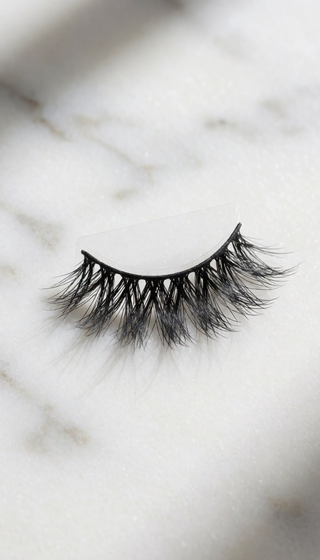
DEEP SET EYES LASHES THAT SHOW
LASHES THAT STILL SHOW WHEN YOU LOOK STRAIGHT AHEAD
If your strip vanishes the second you open your eyes fully, you are not applying it wrong — it was fitted for a closed lid. Three changes bring the lash line back into the light: set the band on the lash line with your eye open, weight the longest lashes over the outer third, and trim the outer end in 1 cm steps until the last lash lands at your corner.
NOT SURE ABOUT YOUR EYE SHAPE?
Take our 60-second quiz to find your perfect lash match — no glue, no commitment.
TAKE THE QUIZ →Choose a style with visible space between the lash points and its longest lashes over the outer third. Set the band on the lash line itself — not above it — while looking straight into a mirror held at eye level. Trim the outer end in 1 cm steps until the final lash stops at your corner.
Length at the outer half clears the brow shadow. Separation stops the band reading as a dark edge. Eye-open placement puts the lashes where people actually see them, instead of where they sit at rest.
One thing worth hearing before you spend another evening on this: a deep set eye is a bone structure, not a lash problem. Nothing you glue, press or trim will change the brow ridge. What you can change is where the length and the gaps sit, and that is entirely within your control. The rest of this page is the how — placement first, then length distribution, then trimming, then the three mistakes that quietly undo all of it.
WHY YOUR LASHES DISAPPEAR WHEN YOU LOOK STRAIGHT AHEAD
On a deep set eye the brow bone projects forward of the lash line. Closed, everything looks correct. Open, the bone shadows the lashes and the eye reads as a socket with a dark rim around it. That is not a lash failure, and no strip alters the bone. What a strip can do is put length where the shadow is thinnest — the outer half — and keep the lash line open enough that individual lashes catch light instead of merging into one flat band.
It helps to know which feature you are actually dealing with. A hooded eye has extra skin folding over the lid; a deep set eye has a recessed lash line behind a prominent brow ridge. Plenty of people are both. Look straight into a mirror in ordinary room light: if you see shadow sitting on the lid and your lash line sits behind the brow ridge, you are deep set. Overhead lighting makes the effect worse, which is why lashes that look fine in a bathroom mirror can disappear in a restaurant.
LENGTH, DENSITY AND SPACING: THE THREE VARIABLES THAT MATTER
Curl is not one of them. Almost every natural-looking strip on the market uses a similar soft curl, so treating curl as the decision is where most deep set shoppers go wrong. You are choosing three things: where the longest lashes sit, how much space is between them, and how much band the inner corner shows.
Length: run shorter at the inner corner and longest over the outer third. That puts the visual weight outside the deepest part of the shadow. Going longer than the shadow allows is a dead end — excess length curls back into the recess and reads as nothing at all. Stack length where the light reaches, not across the whole lash line.
Density: a dense strip is the wrong instinct here. Density fills the gaps between lashes, and in shadow a filled line looks like eyeliner. A style with more space between lash points gives light somewhere to land, which is the entire goal. The sparsest front-weighted style in any range is the safer first choice on this eye shape.
Spacing at the inner corner: the first three or four lash points decide whether the style looks like lashes or like a border. If they sit in a tight, even row, the inner corner reads as a line. Look for a band that steps up gradually instead.
HOW TO PLACE A STRIP WITH YOUR EYE OPEN
Most instructions tell you to look down and press the strip onto the closed lid. Do that on a deep set eye and the strip lands where the lashes sit at rest — not where they sit when anyone is looking at you. Work with the eye open instead.
- Set a mirror at eye level, not tilted down. Tilted mirrors change the angle of your lid and give you a false read on where the band is landing.
- Hold the strip by the outer corner, look straight ahead, and lower it onto the lash line until the band meets the base of your natural lashes.
- Press from the centre outward, then check the inner corner. If the band sits above your natural lashes, lift and reset lower — pressing harder does not fix height.
- Look down and check that no band is floating over bare skin, then look straight again. Both checks matter: one confirms contact, the other confirms visibility.
Expect the first two or three attempts to land a little high or a little long — on this eye shape that means the lashes disappear again. Peel off and reset rather than pressing down harder. Once you know your position, the routine drops to seconds per eye because there is no adhesive to dry or reposition.
TRIMMING THE OUTER END WITHOUT LOSING THE SHAPE
Measure before you commit to anything. Hold the strip against the lash line and trim in 1 cm steps, never in one confident cut, and keep the outer curve intact as you go. The outer end is the one that decides whether the style works: take it in until the last lash stops at your corner. A strip that runs past a deep set outer corner drags the eye downward instead of opening it.
Then check the inner end. If the band crowds the nose or lifts when you blink, trim there too, a little at a time. Symmetry matters less than comfort — a millimetre difference between sides is invisible; a band poking the inner corner is not.
THREE MISTAKES THAT MAKE DEEP SET LASHES VANISH
- Placing on the closed lid. The band ends up where the lashes sit at rest, tucked into the shadow.
- Choosing maximum density. A solid line of lashes in shadow reads as liner, not as lashes, and hides the separation that catches light.
- Letting the strip overrun the outer corner. Extra length past the corner weighs the eye down and pulls the whole line lower.
STRIP, MAGNETIC OR CLUSTER: WHICH SUITS A DEEP SET EYE
| Type | How it attaches | On a deep set eye | Watch for |
|---|---|---|---|
| Glue strip | Latex or clear adhesive on the band | Workable, but adhesive sets fast and punishes repositioning | Residue on the lash line; lifting at the outer corner |
| Magnetic | Magnets paired across the natural lashes or with a liner | Heavier band sits forward of the lash line, which can exaggerate the recess | Weight on the lid; liner required with many sets |
| Cluster / individual | Adhesive under the natural lashes | Very controllable for spacing, but slow to apply and hard to align in shadow | Time; uneven placement you cannot easily see |
| Glue-free band | Band presses onto the lash line, no glue or liner | Thin band allows eye-open placement and easy reset | Needs a genuinely separated lash line to look natural |
Magnetic lashes are a distinct category with their own trade-offs — the band is usually thicker to house the magnets, and a thicker band on a recessed lash line is exactly what you do not want. Clusters give the finest control over spacing but are the slowest to place, and slow placement in shadow is frustrating. A glue-free band is the most forgiving of the three, because you can lift and re-seat it until the height is right.
WHAT TO LOOK FOR BEFORE YOU CHOOSE A PAIR
Take this checklist to any product page, whatever the brand:
- Separated lash points visible in the product photo, not a solid dark fringe.
- Longest lashes over the outer third, with a shorter inner corner.
- A thin, flexible band that can sit on the lash line rather than above it.
- Enough length to trim without losing the shape at the outer curve.
- A wear count you can divide by — a per-wear figure tells you more than a headline number.
- Hypoallergenic materials and no adhesive if your eyes water easily or you wear contacts.
If a style fails two or more of those, it will most likely disappear on a deep set eye no matter how carefully you place it. The reverse is also true: a pair that meets all six gives you room to learn the eye-open placement without fighting the product at the same time.
THE LASH THAT STAYS VISIBLE WITH YOUR EYES OPEN — AND LASTS 30+ WEARS
Everything the checklist above asks for, in 17 styles that press onto the lash line with no adhesive, no magnets and no liner — so eye-open placement becomes a two-second habit instead of a wet, timing-dependent one.
Here are the three things people ask before they commit, in the order they ask them:
- Will it irritate my eyes or pull out natural lashes? Hypoallergenic materials and no adhesive at all — no latex sitting on the lash line and nothing to tug free at the end of the night. Waterproof, so a watery eye or a wet commute will not lift the outer corner mid-evening.
- How long does a pair actually last? 30+ wears with normal care — cleanse the band, store it in the case, keep oil-based products off the lash points. That is the number we publish, and it is the number the band is built for.
- What does it cost per wear? $59 for the pair, which works out under $2 per wear across those 30+ wears — less than a mascara replacement, and it does not expire in three months.
PHANSTA LASHES was built around exactly that spec list. All 17 styles share the same soft natural curl, which means the only decision left is the one this page has been about: where the length sits, how much space is between the lash points, and how much band the inner corner shows. The band is thin enough to press directly onto the lash line with the eye open, and because it uses glue-free micro-adhesion there is nothing wet to set and nothing sliding out of position while you check your reflection.
Seventeen styles means the length distribution is already decided for you: front-weighted, outer-weighted, and everything between, all with the separated lash points that let light through on a recessed lash line. If this is your first pair on a deep set eye, start with the sparsest outer-weighted style and trim the outer end in 1 cm steps exactly as described above.
FREQUENTLY ASKED QUESTIONS
Why do my lashes disappear when I open my eyes fully?
On a deep set eye the brow ridge projects further forward than the lash line, so an open eye puts the lashes into shadow. A strip fitted on the closed lid sits where the lashes rest, not where they are seen. Placing the band with the eye open moves it into the light.
Should deep set eyes wear shorter or longer lashes?
Neither across the whole lash line. Keep the inner corner short and put the longest lashes over the outer third, where the brow shadow is thinnest. Extra length that curls back into the recess reads as nothing, so stack length where light actually reaches the lash points.
Are magnetic lashes a good choice for deep set eyes?
They can work, but the band usually has to be thicker to house the magnets, and a thicker band sits forward of a recessed lash line — which exaggerates the shadow rather than lifting it. Many sets also need a liner, adding another step in low light.
How do I stop a strip poking my inner corner?
Trim the inner end a little at a time until the band clears the nose without lifting when you blink. A millimetre of asymmetry between sides is invisible; a band crowding the inner corner is not. Check it with the eye open, since that is the position it has to survive.
Can I wear lashes if my eyes water or I wear contacts?
Yes, but the adhesive is usually the culprit rather than the lashes. Latex and fast-setting glues trap residue on the lash line and sting when eyes water. Look for hypoallergenic materials and a band that attaches without glue or liner, and keep oil-based removers away from the lash points.
STILL COMPARING OPTIONS? Explore our guides on finding your perfect lash, magnetic vs strip, and sensitive eyes.
FIND THE PERFECT LASH — Not sure which style suits you? Take the 30-second lash finder quiz →
NOT SURE ABOUT YOUR EYE SHAPE?
Find your eye shape and get personalized lash recommendations:
FIND THE PERFECT LASH FOR EVERY MOMENT
Explore our occasion-specific lash guides:
EXPERIENCE THE DIFFERENCE
Join thousands of women who have made the switch. No glue, no damage, no salon appointments — just beautiful lashes in seconds.
SHOP PHANSTA LASHES — GLUE-FREE, 30+ WEARS →