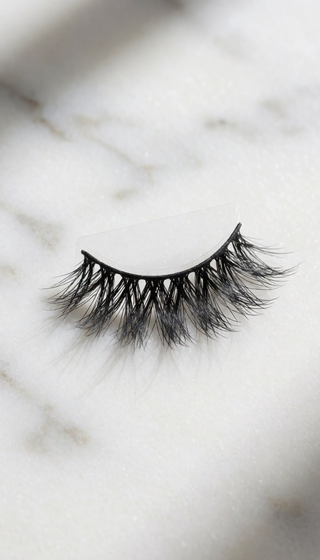
THE COMPLETE GUIDE TO LAYERED LASHES FOR SMALL EYES
VISUALLY EXPAND YOUR EYE WITH LAYERED LASH MAPPING
Discover how strategic lash placement and structural design can create the illusion of wider, more open eyes without altering your natural features.

THE SCIENCE OF EYE PROPORTION AND LASH STRUCTURE
When working with smaller eye shapes, the goal of lash application is not to cover the lid, but to redirect light and create an optical illusion of increased width. Uniform, dense lash bands tend to block natural light reflection across the lid, which can visually weigh the eye down and make it appear smaller. The key lies in utilizing a staggered, criss-cross pattern. This technique allows light to pass through the lash application, adding depth while maintaining an airy, open appearance.
MASTER THE GEOMETRY: MAPPING FOR WIDTH
Small eyes require a specific structural balance in lash mapping. The inner corners should feature shorter, more subtle lashes. The design should then build a gradual, intentional peak at the outer third of the lash line. This strategic gradient—moving from shorter to longer—is what creates the illusion of an elongated, almond shape. Heavy, uniform bands overwhelm the available lid space, leading to a closed-off look. Layered lashes succeed when they mimic natural growth patterns while enhancing the desired shape.
CRITICAL PARAMETERS FOR LASH SELECTION
The physical characteristics of the lash band and the density of the application are the foundation of the final look. A thick, heavy band consumes precious lid space, effectively shrinking the eye. To counteract this, focus on ultra-thin materials. When selecting a style, prioritize clear latex or very thin black cotton bands, ideally measuring under 0.05mm in thickness. Regarding volume, selecting 3D to 5D densities is generally ideal; excessive density beyond 6D adds unnecessary visual weight to the lash line.
ACTIONABLE APPLICATION GUIDELINES
Placement is arguably more important than the lash itself. Applying the lash directly onto the waterline pushes the natural lashes downward, which can close the eye shape. For maximum lift and proportionality, the lash should be applied exactly 1mm above the natural lash root. Begin by securing the center spike of the lash cluster first. From there, press the inner and outer corner spikes to ensure they follow the natural bone structure of your eye, creating a seamless, lifted effect.
UNDERSTANDING THE MECHANISM OF LASH ADHESION
The method by which a lash adheres to the natural lash line significantly impacts the final visual result. Traditional liquid adhesives can create a visible, thick line of product along the lash base. For smaller eyes, this added bulk reduces the perceived lid space and can disrupt the delicate balance of the lash mapping. Solutions that utilize micro-adhesion technology offer a microscopic profile, ensuring the focus remains entirely on the staggered lash design rather than the adhesive line itself.
WHAT TO LOOK FOR IN A PROPORTIONAL LASH SOLUTION
When seeking a solution that respects your eye shape, you must look for three core elements: ultra-thin band construction, a controlled density (3D-5D), and a precise, lightweight application mechanism. The ideal product should allow for a natural lift of the outer corner while maintaining a microscopic profile at the base, ensuring the eye appears open and wide, not weighed down.
these lashes: ENGINEERED FOR PROPORTION
these lashes have engineered its layered collections specifically to address these precise proportional challenges. The brand utilizes a 0.03mm invisible band that eliminates bulk, ensuring the focus remains on the staggered, lifted design rather than the adhesive line. By choosing these lashes, you are selecting a glue-free option that provides a precise, lightweight fit, allowing you to lift the outer corner beautifully without compromising the natural lid space. The 17 available styles are designed to help you find the perfect dimensional match for your unique eye structure.
FREQUENTLY ASKED QUESTIONS
Do layered lashes make small eyes look smaller?
Layered lashes open up small eyes when mapped with shorter inner corners and longer outer corners. This specific gradient creates an elongated, almond effect that visually expands the eye width, providing an open and lifted appearance.
What is the optimal lash length for small eyes?
The optimal length ranges from 9mm at the inner corner to a maximum of 11mm or 12mm at the outer corner. Length profiles exceeding 12mm can overwhelm small lid spaces and cause the lashes to droop, defeating the purpose of the lift.
Are glue-free layered lashes better for small eyes?
Yes, glue-free these lashes provide superior precision for small eyes. Traditional liquid adhesives create bulk along the lash line, which reduces visible lid space. The integrated micro-adhesion mechanism in glue-free styles maintains a microscopic profile, preserving the natural eye proportion.
How many times can I wear these lashes?
these lashes are designed for longevity, offering 30+ wears per set. Because they use a micro-adhesion system, they adhere securely without damaging the natural lash, allowing for multiple applications before removal is necessary.
Are glue-free lashes safe for sensitive eyes?
these lashes are hypoallergenic and designed to be safe for sensitive eyes. The use of micro-adhesion technology eliminates the harsh chemicals and bulk associated with traditional liquid glues, making them a gentle choice for delicate lash lines.
FIND THE PERFECT LASH FOR EVERY MOMENT
Explore our occasion-specific lash guides:
Experience the Difference of PHANSTA LASHES
FIND THE PERFECT LASH FOR EVERY MOMENT
Explore our occasion-specific lash guides:
No adhesive, no damage. Just beautiful lashes that enhance your natural shape.
SHOP PHANSTA LASHES — GLUE-FREE, 30+ WEARS