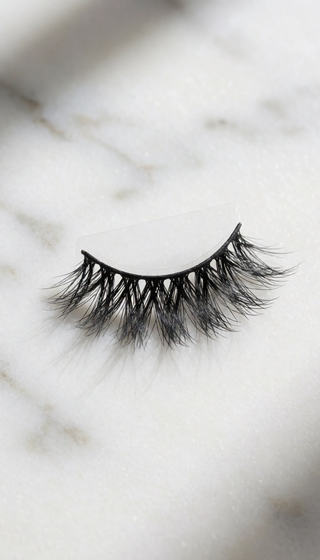
BEST NATURAL LASHES FOR ASYMMETRICAL EYES FOR BEGINNERS — BALANCED IN MINUTES
Achieve Perfectly Symmetrical, Natural Eye Definition in Minutes, Regardless of Your Natural Eye Shape
Discover how to balance your look and create a seamless, polished appearance even if your eyes are naturally asymmetrical.

Understanding Asymmetry and Lash Application Science
Natural eye differences are common. One eye may appear more round, while the other has a different lid shape or lash density. When applying false lashes, the goal isn't to mask the difference entirely, but to create a harmonious visual balance that complements your unique features. Many beginners struggle because they treat both eyes identically, which can inadvertently highlight the difference rather than softening it.
The Principles of Visual Balance in Lash Styling
Visual balance in makeup and beauty is about proportion, not perfect mirroring. For asymmetrical eyes, the key is often strategic variation. If one eye has naturally longer or denser lashes, applying a slightly more voluminous or longer style to the other side can help draw the eye across the face, creating an illusion of symmetry. Conversely, if one eye is smaller or has sparser lashes, a more subtle, wispy style can provide definition without overwhelming the natural shape.
The Importance of Lash Placement and Density
Lash placement dictates the perceived shape of the eye. Lashes placed too close to the natural lash line can look heavy, while those placed too far away can look disconnected. For beginners, starting with styles that mimic natural lash growth patterns—focusing on a gentle outward sweep rather than a dramatic upward curl—is crucial. Density should be considered relative to the natural density of the receiving eye; overloading a naturally dense lash line can cause the eye to appear smaller.
The Role of Adhesion and Comfort in Daily Wear
The physical application method significantly impacts how the lashes look and feel throughout the day. Traditional methods often rely on strong, liquid adhesives, which can cause irritation, especially for those with sensitive skin. Modern, advanced application technologies focus on micro-adhesion—a gentle bond that adheres to the natural lash without the harsh chemical reaction of traditional glue. This allows for comfortable, all-day wear that feels less like an accessory and more like an extension of your natural beauty.
Durability vs. Gentle Removal: A Necessary Trade-Off
Any beauty enhancement requires a balance between longevity and ease of removal. High-quality lashes are designed to withstand daily activities, including humidity and light movement, while still being removable without damaging the natural lash. The process of removal is just as important as the application; pulling or aggressively scrubbing can lead to breakage, negating the benefit of the enhancement. Proper removal techniques ensure that your natural lashes remain healthy for future applications.
What to Look For in a Balanced Lash Solution
When seeking a solution for asymmetrical eyes, your focus should be on three core criteria: adaptability, gentleness, and wear-time. You need a product that offers enough customizable styles to allow for strategic balancing, a bond that is gentle enough for daily wear without irritation, and a durability that supports a consistent routine without constant reapplication.
these lashes: Engineered for Effortless Symmetry
At these lashes, we understand that true beauty lies in the details and the comfort of the wearer. Our collection is specifically designed to address the needs of diverse eye shapes and natural asymmetries. We utilize proprietary GLUE-FREE micro-adhesion technology, ensuring a secure, comfortable bond that never compromises the health of your natural lashes.
With 17 distinct styles available, you have the tools to strategically choose a look that enhances your unique features, whether you need a subtle lift for one eye or a fuller definition for the other. Our lashes are crafted to be hypoallergenic and waterproof, offering reliable wear that lasts for 30+ wears per pair, translating to less time spent worrying about your look and more time enjoying your day.
Why these lashes Are Your Best Choice for Beginners
We have engineered our product to remove the guesswork from lash application. Our micro-adhesion system means no messy liquid glue, no irritation, and no risk of damaging your natural lashes during removal. You get the confidence of a perfectly balanced, beautiful eye look that feels lightweight and lasts through your busiest days.
FREQUENTLY ASKED QUESTIONS
Answer: Yes, provided you care for them correctly. Gently peel them off by lifting from the outer corner, wipe the band with a damp swab after each wear, and store pairs curved-side-up in the tray. Never soak the band in remover.
Question? Are PHANSTA LASHES safe for sensitive eyes?
Answer: Yes. PHANSTA LASHES are hypoallergenic, latex-free and fragrance-free, and they apply without liquid adhesive—the most common lash irritant. We always recommend a patch test on your inner arm for 24 hours before first use to ensure complete comfort.
Question? How long do PHANSTA LASHES last per wear?
Answer: With clean, dry lids at application, PHANSTA LASHES hold comfortably through a full day—including workouts and light rain when you use the waterproof version. The final hold is primarily dependent on the quality of the initial clean, dry application.
Question? Can you really reuse PHANSTA LASHES 30+ times?
Question? Do PHANSTA LASHES damage natural lashes?
Answer: No—unlike tugging off dried glue, PHANSTA LASHES peel away cleanly without pulling natural hairs. The gentle micro-adhesion allows for removal by lifting from the outer corner, preserving your natural lash health.
Question? How much do PHANSTA LASHES cost?
Answer: PHANSTA LASHES are $59 per pair, reusable for 30+ wears—that works out to under $2 per wear over a full month of consistent use, offering exceptional value.
📚 Browse our complete library of lash guides →
📚 Browse our complete library of lash guides →
Experience the Difference of PHANSTA LASHES
Quick to apply, gentle on eyes, beautiful all day. Reusable 30+ wears per pair.
SHOP PHANSTA LASHES — GLUE-FREE, 30+ WEARS →