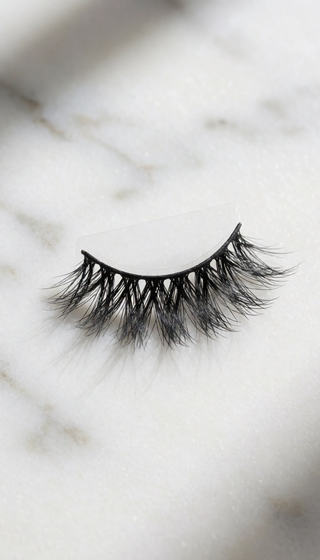
CLOSE-SET VS WIDE-SET: LASH PLACEMENT DIFFERENCES

You've tried on lashes that looked amazing on the model — but on you, something felt off. Your friends couldn't tell. You just knew. The problem isn't your eyes. It's the lash placement. Close-set and wide-set eyes need different maps for where lashes go. This guide shows you why — and how to fix it in minutes without a makeup artist.
What 'Close-Set' and 'Wide-Set' Actually Mean
Your eye spacing is about the distance between your eyes compared to the width of one eye. Grab a mirror. Look at your left eye. Now look at the gap between your right and left inner corners. If that gap is roughly the same size as your eye width, you have average-spaced eyes. Smaller gap? That's close-set. Larger gap? That's wide-set.
This matters because your brain reads eye spacing as a signal. Close-set eyes can feel intense, serious, or focused. Wide-set eyes can feel open, friendly, or calm. Neither is 'wrong' — but the right lash placement can bring balance.
Why Lash Placement Changes Everything
Here's the part that surprises people. Your lashes act like arrows. They point the viewer's attention in a direction. A lash strip that starts at the very inner corner pushes the eyes closer visually. A strip with heavy volume only on the outer edge pulls the eyes wider.
So the same lash can make you look tired, surprised, or harsh — just based on where the fluff lands. That's why generic 'one size fits all' lashes often fail. They don't know your spacing.
How to Tell Your Eye Spacing in 10 Seconds
- Stand in front of a mirror, face forward.
- Look straight ahead and place your index finger at the inner corner of your left eye.
- Keep it there, and use your other hand to trace the width of your left eye outward.
- Compare that width to the gap between your two inner corners.
If the gap is smaller than your eye width, you're close-set. If it's larger, you're wide-set. If they're about equal, you have balanced spacing — but you still need to know which side of the scale you lean toward.
Lash Looks That Flatter Each Spacing
For close-set eyes: Keep the inner half of the lash clean and short. The magic happens in the outer half. A cat-eye or winged shape creates the illusion of more space between your eyes. Avoid heavy volume on the inner corner.
For wide-set eyes: Bring the length and volume closer to the center. A kitten-eye or rounded even lash shortens the gap gently. Avoid dragging everything to the outer edge — that makes the gap even more obvious.
Close-Set vs Wide-Set Lash Cheat Sheet
| Placement Area | Close-Set Eyes | Wide-Set Eyes |
|---|---|---|
| Inner corner | Start lashes later | Keep lashes longer |
| Outer corner | Add length and volume | Keep it even and rounded |
| Curl level | Dramatic curl opens up | Soft curl keeps balance |
| Volume placement | Concentrate on outer third | Concentrate on center |
FAQs About Lash Placement
Can lash placement change how my face looks in photos?
Yes. It changes the optical balance of your face. Cameras pick up negative space between your eyes, and lashes alter that space.
Are there lashes made for close-set and wide-set eyes?
Some lash brands label their strips for eye spacing. But you can also trim or reposition a generic lash to flatter your shape.
Should I get a lash lift instead?
A lash lift works with your natural lashes and doesn't change placement. It won't fix an eye-spacing imbalance the way a full strip can.
Now here's the thing you learned: flattering lashes aren't about more glitter or more length. They're about placement.
What to look for in a lash style: length that matches your eye width, curl that lifts without hiding, and a band that can be adjusted to start where your eye spacing needs it.
📚 Browse our complete library of lash guides →
📚 Browse our complete library of lash guides →
📚 Browse our complete library of lash guides →
📚 Browse our complete library of lash guides →
📚 Browse our complete library of lash guides →
Experience the Difference of PHANSTA LASHES
Quick to apply, gentle on eyes, beautiful all day. Reusable 30+ wears per pair.
SHOP PHANSTA LASHES — GLUE-FREE, 30+ WEARS →