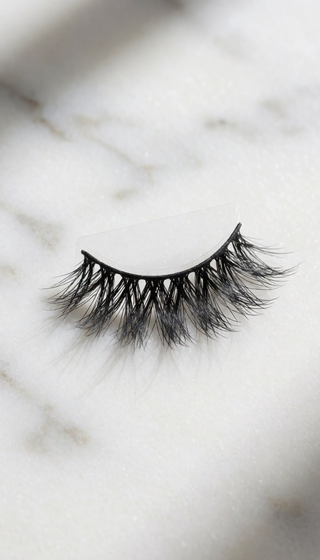
MORE GLUE DOESN'T MEAN BETTER HOLD — HERE'S WHAT ACTUALLY KEEPS LASHES ON
THE FALSE LASH MYTH SETTLED: WHY MORE GLUE DOESN'T IMPROVE HOLD

Short answer: no. Once a lash band has enough adhesive and full contact with clean, dry natural lashes, adding more does not reliably improve the bond. Excess can add weight, seepage, sticky residue, or an uneven edge—problems that make a lash feel less secure and less comfortable over time.
That distinction matters when wind suddenly exposes a lifted corner. The fix is usually not another coat; it is checking preparation, band placement, adhesive amount, and setting time. A heavy style can also magnify a poor fit because its weight pulls on the same spot repeatedly.
- Match the band: A style that is too long or sits away from the natural lashes cannot be rescued by excess adhesive.
- Use a controlled amount: More is not automatically better when the adhesive is already flooding the band.
- Allow the formula to set: Movement or moisture before setting can weaken the connection.
HOW LASH ADHESION ACTUALLY WORKS
Hold is not a volume contest. It depends on clean contact, the amount and formula of the adhesive, how evenly the band sits on the natural lashes, and the setting time allowed before movement. The adhesive's chemistry creates a bond at that interface. Because natural lashes vary in oiliness, dryness, curl, and spacing, the same application will not behave identically on every eye.
Heavy glue does not simply add secure points. Once adequate coverage and contact are present, extra material can weigh down the band, collect near the skin, or remain sticky. If a style sits too far from the natural lashes, added weight may increase pulling instead of correcting alignment.
WHAT EXTRA GLUE CAN CHANGE
- Weight: Excess material can pull unevenly on the lash band, making a lifted corner more likely to worsen.
- Residue: Adhesive that spreads or remains uncured may become tacky, crusty, or harder to remove.
THE THREE PILLARS OF LASTING LASHES
For lashes that feel secure without feeling cemented, focus on three controls rather than maximum glue:
- Surface preparation: Remove oils and residue, let the natural lashes dry, and allow the adhesive itself to reach the tacky stage directed by its formula.
- Application technique: Use a controlled amount and create even contact between the band and natural lashes. Saturation does not equal security.
- The right formula: Choose a purpose-made lash adhesive with clear application, setting, and removal directions. General-purpose glue is not an interchangeable substitute.
These factors work together. A suitable formula cannot compensate for a crooked band, and precise placement cannot perform well on an oily or damp surface. Fixing preparation, fit, and application together is more useful than repeatedly increasing the volume.
CONTROL ADHESIVE USE WITH A BETTER APPLICATION SEQUENCE
For glue-based strip lashes, a consistent sequence helps you avoid both loose bands and residue:
- Prepare the lashes: Remove mascara, eye cream, oil, and other residue, then let the natural lashes dry completely.
- Check the fit: Compare the band with the eye before applying. Trim only as directed by the style and avoid leaving excess material at the outer corner.
- Meter the adhesive: Use the smallest amount directed by the manufacturer. Avoid puddles or repeated layers that can spread beyond the lash line.
- Set the band: Wait for the adhesive to become tacky as directed. Press the center first, then the inner and outer corners, without repeatedly lifting or dragging the strip.
- Protect the set: Keep the lashes still until the adhesive has set according to its directions, especially before water, sleep, rubbing, or vigorous movement.
Comfort check: If adhesive touches the skin or causes burning, redness, itching, or swelling, stop using it and remove the lashes as directed. Seek advice from a qualified healthcare professional if symptoms persist.
GLUE VS. A CONTROLLED LASH SYSTEM
The useful comparison is not simply heavy glue versus light glue. It is uncontrolled saturation versus deliberate contact, fit, formula, and setting.
| Focus | Heavy or Excess Glue Approach | Controlled System Approach |
|---|---|---|
| Durability Source | Added mass and saturation | Contact, fit, formula, and setting |
| Comfort Level | May feel heavy, tacky, or uneven | Can feel lightweight when applied correctly |
| Potential Risk | Seepage, crusty residue, or pulling | Fit errors, movement during setting, or sensitivity remain possible |
Neither approach can guarantee identical results for every person. The lash band still needs to fit, the natural lashes need an appropriate surface, and all application directions must be followed. More adhesive cannot repair every variable at once.
WHY LASHES LIFT: FIX THE CAUSE, NOT THE SYMPTOM
A lifting edge is a signal to inspect the placement rather than evidence that the adhesive needs more volume. Common causes include:
- A band that is too long: Excess material beyond the outer corner has nothing to support it.
- Surface residue: Mascara, cream, oil, or moisture can interfere with the intended bond.
- Movement during setting: Adjusting a strip repeatedly can weaken contact before the adhesive stabilizes.
- Uneven or excessive adhesive: Puddles, dragging, or extra coats can shift the band or add uneven weight.
- A mismatched style: A rigid or heavy design may not sit naturally with the eye's curve and natural lash pattern.
Change one variable at a time: preparation, length, placement, amount, or setting time. That makes it easier to identify what improves the hold and prevents repeated coat-building that can make removal harder.
WHAT TO LOOK FOR IN A SECURE, COMFORTABLE LASH SOLUTION
Before choosing a lash system, use the same five questions regardless of the advertised wear:
- Attachment method: Understand what creates the hold. Check whether the design relies on wet glue, glue-free micro-adhesion, magnets, or a liner.
- Clear directions: A useful system explains positioning, setting or pressing, removal, cleaning, and storage.
- Specific durability guidance: Look for a clearly stated wear potential rather than an unsupported promise of many times the original use.
- Fit and weight: The band should match the eye, follow its curve, and avoid pulling on one concentrated area.
- Comfort and safety information: Ingredient lists, warnings, and sensitivity guidance should be easy to find and follow.
If your priority is avoiding wet glue, compare glue-free systems using these same criteria rather than assuming every no-glue design works identically. Confirm what creates attachment, whether magnets or a liner are involved, how the band is positioned, and what care it requires.
Each pair offers 30+ wears and is waterproof and hypoallergenic; the collection includes 17 styles. At $59, the stated wear works out to under $2 per wear. Apply to clean, dry lashes, follow the positioning and care directions, and gently remove and store the pair between uses.
THE THREE BIGGEST CONCERNS, FROM MOST COMMON TO LEAST
- Glue and irritation: Micro-adhesion avoids glue, magnets, and a liner, reducing dependence on wet adhesive near the eye.
- Durability: The stated wear is 30+ wears, supported by waterproof construction and careful removal, cleaning, and storage.
- Cost: At $59, 30+ wears works out to under $2 per wear.
PHANSTA LASHES: GLUE-FREE MICRO-ADHESION FOR CONTROLLED, REUSABLE WEAR
The criteria above lead to a clear need: stable attachment without flooding the lash line with wet glue. PHANSTA LASHES use glue-free micro-adhesion technology, so the system does not rely on glue, magnets, or a liner. The focus shifts from adhesive volume to clean placement, an even lash band, and repeatable care.
FREQUENTLY ASKED QUESTIONS
DOES MORE GLUE MAKE STRIP LASHES STAY ON BETTER?
No. Extra adhesive does not reliably strengthen a strip-lash bond once the band has enough contact with the natural lashes. Excess can add weight, seepage, residue, or an uneven fit, which may reduce comfort and useful wear. Use the amount directed by the adhesive maker, prepare the lashes properly, and allow the full recommended setting time.
WHY DOES EXTRA GLUE CREATE LIFTING OR RESIDUE?
Excess adhesive can do more than create a heavier feeling. It may run near the skin, remain tacky, form crusty residue, or make removal more difficult. The added weight can also pull unevenly on the lash band and natural lashes when the style sits longer. A controlled, even layer is more useful than repeatedly adding adhesive after lifting begins.
HOW SHOULD NATURAL LASHES BE PREPARED BEFORE ADHESIVE APPLICATION?
Remove mascara, eye cream, oil, and residue, then let natural lashes dry. Keep the band clean and compare its length with the eye before applying. Follow the adhesive's directions for amount and drying time. If the band lifts, correct fit or technique before adding another coat; extra product rarely fixes a band placed incorrectly.
WHAT IS GLUE-FREE MICRO-ADHESION?
Glue-free micro-adhesion is an attachment method that uses a precision-engineered band surface to grip natural lashes without wet glue, magnets, or a liner. The bond forms through direct contact between the micro-textured band and the natural lash, creating a secure hold that can be released and reapplied with proper care.
HOW DO YOU REMOVE AND STORE REUSABLE LASHES?
Gently peel the band away from the natural lashes, starting at the outer corner. Clean the band with a residue-free cleanser or as directed, allow it to dry completely, and store the pair in its original case to protect the band shape and adhesion surface. Proper removal and storage help maintain the stated 30+ wears.
Ready for lashes that stay put without the glue mess?
NOT SURE ABOUT YOUR EYE SHAPE?
Find your eye shape and get personalized lash recommendations:
FIND THE PERFECT LASH FOR EVERY MOMENT
Explore our occasion-specific lash guides:
EXPERIENCE THE DIFFERENCE
Join thousands of women who have made the switch. No glue, no damage, no salon appointments — just beautiful lashes in seconds.
SHOP PHANSTA LASHES — GLUE-FREE, 30+ WEARS →