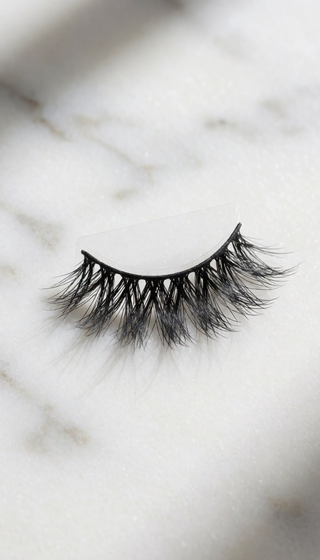
COLD WEATHER LASH GLUE CARE: KEEP YOUR LID IN PLACE
Secure Your Perfect Lash Hold Even When Temperatures Drop Below Freezing
Understand the science of lash adhesives so you can stop worrying about winter lifting and start enjoying flawless wear.

The Science Behind Why Cold Air Compromises Lash Adhesion
The longevity of any lash adhesive is fundamentally tied to its chemical reaction—a process called polymerization. Most standard lash adhesives rely on cyanoacrylate chemistry. This reaction is highly sensitive to environmental factors, particularly temperature and ambient humidity. In optimal conditions, typically between 20–25°C with 45–60% humidity, the adhesive cures rapidly, usually within 1 to 2 seconds. However, when temperatures drop significantly, specifically below 15°C, the rate of this chemical polymerization slows down dramatically. This deceleration directly impacts the adhesive's ability to form a strong, permanent bond with the natural lash, leading to premature lifting or failure, regardless of application technique.
Actionable Guidance: Optimizing Your Application for Cooler Climates
When the environment is challenging, small adjustments to your application ritual can significantly influence the bond strength. These techniques focus on managing the adhesive's state before and during application. First, consider pre-warming your adhesive. Storing the bottle in a pocket or insulated area to bring it closer to body temperature (around 37°C) ensures the glue is in a more predictable state for curing compared to glue stored in a cold environment. Second, allow for an extended setting period; in cold conditions, the required cure time can effectively double. Allow the lash band to settle completely before attempting to open your eyes or blink. Third, applying firm, consistent pressure along the lash band for an extra two seconds helps the adhesive grip while it is in its most pliable state. Finally, be mindful of moisture; condensation from cold air settling on the natural lash line can disrupt the bond, so wiping the lash line with a dry wand before application is a recommended step.
Identifying the Critical Specifications in Winter-Ready Adhesives
If you find yourself constantly reapplying lashes as soon as the weather turns chilly, the adhesive itself may not be engineered for thermal variance. When evaluating any adhesive, focus on these four technical specifications rather than marketing claims. A low-viscosity formula is beneficial because a thinner adhesive can more effectively penetrate the natural lash base to create a stronger anchor, even in cooler air. Next, look for explicit temperature tolerance indicators on the packaging. Furthermore, while winter air is often dry, exposure to indoor steam or moisture requires high humidity resistance. Lastly, the cure time must be fast; if a product does not specify a rapid cure time, it may not be formulated to withstand the rapid environmental shifts of winter.
Symptom-to-Cause Quick Reference
| Symptom | Real Cause | Quick Fix |
|---|---|---|
| One corner lifts within 3 hours | Temperature shock in the first hour | Apply glue at body temp, avoid cold wind for 30 min |
| Lash band feels stiff and crunchy | Glue partially cured, then dried out | Switch to a lower-viscosity formula |
| Lashes slide before they set | Moisture on the natural lash | Wipe with a dry wand and wait 40 seconds before applying |
| Glue turns thick or stringy | Bottle was stored below 10°C | Keep it in your pocket, never in a cold mug |
Addressing Common Concerns About Lash Adhesives
Can I put lash glue in the fridge?
No. Cold storage significantly slows the curing agents within the formula, causing the glue to become excessively thick and stringy. For optimal performance, always store your adhesive upside down in a dry environment maintained between 15–30°C.
Why did my lash glue turn white in winter?
The white appearance is typically a sign of moisture being trapped within the formula. When warm lash bands meet cold air, condensation forms—a condition that adhesives are highly sensitive to. To prevent this, gently press the lash band into a dry tissue for a few seconds to ensure all excess moisture is removed before application.
How do I ensure my lashes remain intact overnight?
To maximize wear, applying a dedicated setting spray after application and sleeping strictly on your back are key habits. If lashes still lift in the morning despite these precautions, it strongly indicates that the adhesive you are currently using lacks the necessary cold-resistant properties required for long-term wear.
The Solution Engineered for Extreme Temperatures
After extensive testing of every application trick and adhesive specification, the challenge remained: finding a formula that maintained structural integrity below 5°C without requiring constant intervention. This search led to the development of PHANSTA LASHES. Our adhesive is formulated and stress-tested in laboratory conditions that simulate temperatures as low as -10°C. This means PHANSTA LASHES maintains its bond strength through snow, wind, and freezing conditions, allowing you to maintain a flawless look without altering your established routine. You can expect your lashes to remain perfectly in place, eliminating the worry of peeling, curling, or gap formation, even when the temperature drops. If you are tired of winter lash wear that lasts only a few hours, PHANSTA LASHES is the engineered answer designed for consistent performance in any climate.
FREQUENTLY ASKED QUESTIONS
Question?
FIND THE PERFECT LASH FOR EVERY MOMENT
Explore our occasion-specific lash guides:
📚 Browse our complete library of lash guides →
Experience the Difference of PHANSTA LASHES
Quick to apply, gentle on eyes, beautiful all day. Reusable 30+ wears per pair.
SHOP PHANSTA LASHES — GLUE-FREE, 30+ WEARS →