WHY LIGHTWEIGHT LASHES PREVENT EYELID DROOPING — THE WEIGHT FORMULA MOST WOMEN MISS

THAT HEAVY FEELING YOU'VE BEEN IGNORING
It starts as a subtle tug. Around hour two, your eyelids feel... tired. Not sleepy-tired — tired in a specific sensory way, like something is gently pulling your lash line downward. You blink more than usual. You catch your reflection and notice your eyes look smaller. Less open. Older.
That isn't in your head. That is the physical weight of your lashes pulling against your eyelids. And if you've been experiencing it for years, you may have adapted to it without realizing what it costs you.
Every strip lash applies gravitational force to your eyelid. The heavier the lash, the harder gravity pulls. Your eyelid muscles — the levator palpebrae superioris, if you want the anatomy — work constantly to hold your eye open against that resistance. When they fatigue, your eyelid drops a few millimeters. That drop changes your entire facial expression. It reads as exhaustion, aging, or even sadness. The worst part? You don't notice it happening because it's gradual. Everyone else does.
THE WEIGHT THRESHOLD NOBODY TELLS YOU
You don't need a scientific lab to understand this. You need to know one number: 0.15 grams per centimeter of band length. This is the approximate threshold above which most women begin to feel lash weight. A standard strip lash that covers your full eye line weighs between 0.2 and 0.5 grams. That doesn't sound like much — until you multiply it by 12 hours of wear, tens of thousands of blinks, and the constant micro-tugging on the most delicate skin on your body.
But weight matters in more places than the scale. Distribution matters. A lash with a thick band concentrates all its weight into a thin contact line. All that force presses onto one narrow strip of skin. A lightweight band spreads the load across the lash line, which means the skin feels nothing even though the lash is intact.
Here is the visual that changed my perspective: your eyelid skin is the thinnest skin on your entire body — about 0.5 millimeters thick, roughly 10 times thinner than the skin on your face. It has no fat layer to cushion pressure. When you attach something heavy to it, you're not just risking a droopy look. You're fatiguing a muscle that was never designed to carry weight.
WHAT DROOPING REALLY COSTS YOU
Pinch your eyelids closed for a second and feel the resistance. That's your levator muscle working. Now imagine it working overtime, all day, every day, against the constant downward pull of heavy lashes.
The visible cost is the droop: your eyes appear half-open, your brow furrows to compensate, and your face defaults to an expression you didn't choose. The invisible cost is worse. Over weeks and months, your eye muscles can develop a pattern of overcompensation. You start raising your eyebrows to lift your lids — that's why so many women with heavy lashes have forehead tension headaches and crow's feet at 25.
Beauty editors and makeup artists talk about "lash fatigue" — the phenomenon where women with heavy lashes look great the moment they apply them, but at hour six, notice their eyes look smaller and less bright than they did at hour one. That's the droop setting in. By hour eight, the eyes look half-lidded even though the person feels wide awake. By hour ten, the wearer blinks more slowly, rubbing her eyes without knowing why.
THE LIGHTNESS STANDARD: WHAT TO ACTUALLY FEEL FOR
You're probably wondering: how do I know if my lashes are too heavy before I buy them? You can't feel the lashes through the packaging. But you can learn to check for three measurable signals:
- Check the band thickness: Hold the lash band between your thumb and index finger. If you can feel a distinct ridge, the band is probably in the heavy category. Bands that feel flat and barely-there keep weight low.
- Check the fiber density: Lashes made with hollow, tapered fibers are significantly lighter than solid cylindrical fibers. You can feel the difference when you pinch the lash — hollow fibers have a springy, cushion-like give. Solid fibers feel stiff and unyielding.
- Do the 10-second blink test: After applying lashes, close your eyes for 10 seconds. If you can feel the presence of the lashes — that tactile sense that something is resting on your lid — they're heavier than your lids want. Lighter lashes disappear from your sensory awareness within a minute.
These three checks will save you from a catastrophic purchase. But they only work if you commit to the standard: your lashes should feel like absolutely nothing at all.
HOW LIGHTWEIGHT DESIGN CHANGES YOUR FACE
When you switch to genuinely lightweight lashes, the changes are immediate and measurable. Here's what most women report in the first week:
- Your eyes look more open: Without the downward tug, your levator muscle operates at full capacity. Your lid naturally sits 2 to 3 millimeters higher, which makes your eyes look larger and brighter without any makeup change.
- Achieve that coveted "natural lift": The outer corner of your eye sits visibly higher, giving that subtle cat-eye effect women pay hundreds of dollars for with extensions. Free lift — just from removing weight.
- Your blink becomes lighter: Heavy lashes slow your blink reflex. Light lashes restore the natural speed of your blink, which makes you look more alert, engaged, and expressive in conversation.
- Headaches and brow tension clear: Most women don't realize they've been furrowing their brows to compensate for lid droop until they stop. Within days, the forehead tension they've accepted as normal begins to dissolve.
This is not one of those "works for some women" situations. It's an engineering principle. Reduce unnecessary weight, and the body immediately returns to its natural resting state. The lift you see is not makeup illusion — it's the true shape of your eye, freed.
WHAT TO LOOK FOR IN A LIGHTWEIGHT LASH
If you're ready to stop feeling your lashes all day, here is your buying checklist — criteria that apply to any brand you're evaluating:
- Hollow or tapered fibers over solid plastic: Tapered fibers mimic natural lash texture (thicker at base, thinner at tip). They deliver dense color at the lash line without the heaviness of uniform fibers.
- Featherweight band material: The band should be so thin it's barely visible when you hold it up to the light. A lightweight fabric or micro-knit band distributes weight better than molded plastic.
- Full coverage but sparse density: This is counterintuitive — a full coverage band does not necessarily mean dense. It means continuous. The band is fully covered to prevent gaps, but individual lash fibers should have space between them.
- Total weight under 0.1 grams: If you can weigh them, do it. A good lightweight strip lash weighs between 0.05 and 0.1 grams. Above 0.15 grams, you're back in droop territory.
The standard should be merciless: if you can feel them, they're too heavy. Your lashes belong in service of your eyes — not as a weight your eyes must strain against.
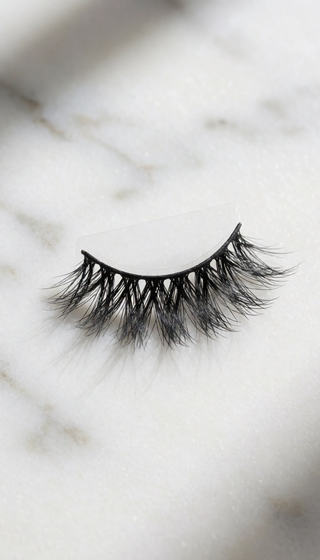
PHANSTA LASHES designs every lash under 0.1 grams with featherweight bands and hollow, tapered fibers. Their entire line was created around one principle: lashes that weigh nothing, so your eyes stay open, bright, and effortlessly lifted from morning to midnight.
FREQUENTLY ASKED QUESTIONS
Can heavy lashes permanently damage your eyelids?
No permanent muscle damage has been documented from wearing strip lashes, but chronic heavy lash use can cause habitual brow furrowing and forehead tension that persists even after you stop wearing them. The skin around your eyes can also stretch over time from constant tugging. Switching to lightweight lashes prevents these issues.
How much does a typical strip lash weigh?
Standard strip lashes range from 0.2 to 0.5 grams. Lightweight options run from 0.05 to 0.1 grams. The difference is the equivalent of holding a nickel versus holding a paper clip. Over 8 hours, that difference translates to thousands of micro-tugs on your eyelid skin.
Will lightweight lashes hold a curl as well as heavier lashes?
Yes — curl retention comes from the fiber's shape-memory, not its weight. High-quality lightweight lashes are made with tapered fibers that remember their curl even after being pressed against your natural lashes. Heavier lashes don't hold curl better; they just press your natural lashes down with their weight.
How can I check lash weight in a store?
Remove the lash from the box and hold the band between your fingertips. If the band has a distinct thickness or ridge, it's heavy. Then place the lash on your fingertip — it should feel like a light tickle, not a presence. Finally, gently bend the band: lightweight bands bounce back instantly; heavier bands resist and feel dense.
📚 Browse our complete library of lash guides →
📚 Browse our complete library of lash guides →
📚 Browse our complete library of lash guides →
Experience the Difference of PHANSTA LASHES
Quick to apply, gentle on eyes, beautiful all day. Reusable 30+ wears per pair.
SHOP PHANSTA LASHES — GLUE-FREE, 30+ WEARS →