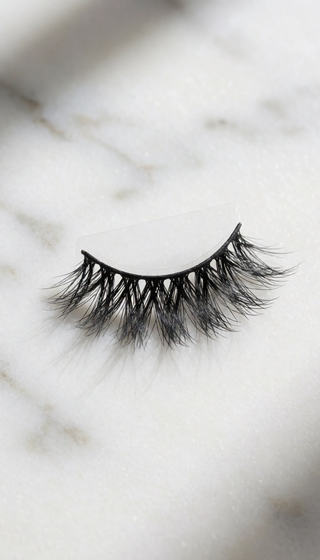
WATER-RESISTANT LASHES FOR SWIMMING DAYS

You're at the pool. You've got the towel, the sunglasses, the whole summer-afternoon setup. You jump in. When you come up, half your lashes are on your cheek, and the other half are clinging to the corner of your eye like a sad little flag.
If you've lived this, you know the specific annoyance. I once lost a strip lash at the deep end of a friend's pool party. The bride still tells the story. Learn from my floating embarrassment — it's fixable.
WHY STANDARD LASHES FAIL AT THE POOL
Most strip lashes are built for dry land. The adhesive bonds used for daily wear hold up to sweat, maybe, but not to chlorinated water, saltwater, or the physical force of a surface dive. Two specific things happen underwater:
- The bond weakens. Water molecules work their way between the lash band and your skin. The more movement, the faster it lets go.
- The band warps. Many bands are polyester-based and curl or twist when wet. Once warped, even a re-glued lash won't lie flat.
Does that mean you have to choose between swimming and lashes? Not at all. It means choosing lashes designed for the water, and applying them with that end in mind.
WHAT "WATER-RESISTANT" ACTUALLY MEANS
The FTC doesn't regulate "water-resistant" claims for cosmetics, so brands throw the term around. For lashes, real water-resistance comes down to three structural things:
- Band material. Latex-free, rubber-based or nylon bands hold their shape when wet. Cotton or woven polyester bands absorb water and stretch.
- Adhesive compatibility. The lash bond needs to pair with a water-resistant seal — meaning the adhesive should be one that sets firm within 30–60 seconds.
- Sealed edges. The inner and outer corners are the first to lift. A lash with slightly tapered ends has less surface area for water to work against.
| Lash Type | Band Material | Water Survival | Best Setting |
|---|---|---|---|
| Everyday strip | Polyester | 1–2 splashes max | Office, dates, dinners |
| Water-resistant strip | Nylon / rubber-based | 45–60+ minutes in pool | Swimming, beach, sweaty events |
| Waterproof seal topcoat | N/A (added layer) | Adds 30–45 min to any lash | Backup for long pool days |
POOL-DAY PROTOCOL THAT LASTS
Even with the right lash, how you apply determines how long it stays. Here's the routine I recommend for pool days:
- Apply lashes at least 20 minutes before water. The bond needs time to set. Right-before-a-dive application is where failures happen.
- Seal with a water-resistant lash sealant or waterproof mascara layer. One thin layer over the band can add 30–45 minutes of wear.
- Press the corners for 10 full seconds. Outer corners lift first. Pressing them longer gives them extra adhesion.
- Pat, don't rub. When you're out of the water, dab your lashes with a towel. Rubbing twists the band and breaks the seal.
After a swim, remove lashes as soon as practical. Chlorine and salt break down adhesives over time, and a lash that's been fully soaked will rarely re-bond flat again.
So what separates a lash that survives a swim from one that surrenders? Water-resistant band material, tapered edges, a secure adhesive set, and a seal layer. Those four elements are the difference between a pool day ruined and a pool day that feels totally normal. You can get in and out of the water, enjoy your day, and come home with both lashes still put together — without spending the whole pool day worrying about your face.
That's the standard we set at PHANSTA LASHES. Our lashes are designed to hold their shape, keep their bond, and stay wherever you put them — so you can be in the water without thinking about your face. Because the best outcome is always the same: you're living your day, not managing your lashes.
How long do water-resistant lashes last in a pool?
With a water-resistant band and a sealant layer, expect 45–60 minutes of continuous water exposure before corners start to lift. Without sealant, 20–30 minutes.
Can I swim with any lash if I add waterproof mascara?
Waterproof mascara can help seal the lash fibers, but it won't help the band. If the band itself isn't water-safe, the strip will still lift. Start with the right band, then seal.
What's the best way to remove lashes after swimming?
Use an oil-based remover or cleansing balm, let it sit for 30 seconds, and gently peel from the outer corner inward. Never pull — especially after chlorine exposure, which can make bands brittle.
📚 Browse our complete library of lash guides →
📚 Browse our complete library of lash guides →
📚 Browse our complete library of lash guides →
Experience the Difference of PHANSTA LASHES
Quick to apply, gentle on eyes, beautiful all day. Reusable 30+ wears per pair.
SHOP PHANSTA LASHES — GLUE-FREE, 30+ WEARS →