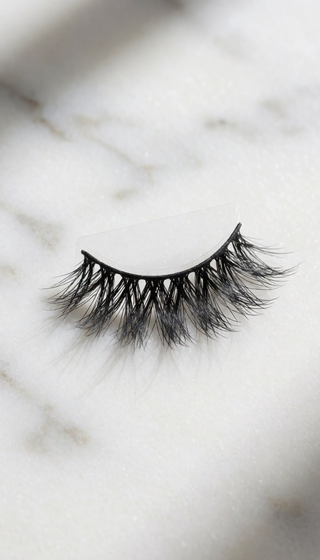
CLASSIC VS VOLUME LASHES: WHICH SUIT YOUR EYE
PICK THE DENSITY YOUR EYE ACTUALLY CARRIES — AND GET IT RIGHT THE FIRST TIME
The short answer: classic lashes read as a clean, defined line along the lid. Volume lashes read as a dense, dark band. Which of the two looks polished on you rather than heavy is decided by three things — the spacing of your own lashes, how much visible lid space you have, and the length you choose. The occasion you are dressing for does not enter into it.
NOT SURE ABOUT YOUR EYE SHAPE?
Take our 60-second quiz to find your perfect lash match — no glue, no commitment.
TAKE THE QUIZ →That is why the same volume set can look lush on one person and overdone on another. If you have ever applied a strip and felt it swallowed your eye, or left a set feeling underdone, the density was mismatched to your lash line — the lashes were not "too much". Density is a proportion question, and proportion is measurable before you commit to anything.
Do this check first. Sit by a window in daylight with a relaxed face (no squinting, no raising the brows) and look straight into a mirror. Note two things: whether your natural lashes sit in an even, close-set row or in visible clumps with gaps between them, and how much bare lid you can see between the lash roots and the crease. Those two observations answer the classic-versus-volume question more accurately than any photo of someone else wearing either style.
Everything below breaks those variables down one at a time, so you can choose once and choose correctly instead of guessing through three pairs.
CLASSIC VS VOLUME: WHAT THE TWO STYLES ACTUALLY ARE
Classic lashes: a single, well-defined lash placed at each point along the strip. The visual result is a clean, separated line that mimics the look of individual, perfectly placed lashes. Classic excels at definition without overwhelming the natural lash line.
Volume lashes: multiple fine lashes clustered together at each point on the strip. The effect is high density and darkness — the strip reads as a fuller, solid band of lashes before the individual hairs are perceived.
The practical difference between them is negative space. A classic strip leaves the gaps between lash points open, so your own lid and skin show through the line. A volume strip fills those gaps. Everything that follows comes down to whether filling those gaps helps or hurts the way your specific eye reads.
| WHAT CHANGES | CLASSIC | VOLUME |
|---|---|---|
| Visual effect | Separated, defined line | Dense, dark band |
| Best on | Sparse or fine natural lashes | Full lashes, generous visible lid |
| Risk if mismatched | Reads underdone on a full lash line | Closes the eye on a sparse or hooded lid |
HOW YOUR NATURAL LASH LINE DECIDES THE ANSWER
Look at your bare lashes in daylight with a relaxed face. The density of your natural lashes is the most critical factor in whether a style will look natural on you, so assess the spacing rather than the total number of hairs — a lash line can have plenty of hairs and still leave wide gaps between clusters.
If your lashes are sparse, with visible gaps along the lid, a dense volume strip sits directly on top of those gaps. The eye then reads as heavily lined rather than naturally lashed, because the strip has covered the negative space the eye needs in order to look open.
If your lashes are already full and closely grouped, a volume strip has a surface to merge with. The clusters blend into the existing lash line, so the density reads as an extension of your own fullness rather than an addition sitting on top of it.
The construction of the strip matters too. Styles built on a more separated lash line present less solid dark coverage, which is more forgiving on fine or gappy lashes and keeps the eye looking bright. A useful shortcut: squint at the strip from arm's length. If you see distinct points of dark with breathing room between them, it will behave like a classic on the lid. If you see an unbroken dark bar, it will behave like a volume.
LENGTH AND PROPORTION: WHERE MOST PEOPLE OVERSHOOT
Length is the second lever in this decision, and it is far easier to overshoot than to correct. Styles in a standard range are built around lengths between 13 mm and 18 mm paired with a natural curl, and the density you pick should be read against the length you pick, not in isolation.
When you are testing a density for the first time, start at the lower end of the available length range. A dense strip at maximum length on a smaller or narrower eye produces lashes that look disproportionately long for the eye they are on — the density gets blamed, but the length caused it.
If the strip is too long, the fix is trimming, done incrementally — a couple of millimetres at a time — while preserving the natural outer curve of the lash line. Over-trimming costs you the taper at the outer corner, and that taper is what keeps the eye looking open and lifted rather than blunt.
EYE SHAPE AND LID SPACE: HOW MUCH DENSITY YOUR EYE CAN CARRY
Visible lid space is the budget you are spending against. A larger, more open eye gives a dense lash line room to sit without crowding the brow bone, so clustered volume reads as lush and full rather than as a solid, heavy edge.
Hooded eyes and deep-set eyes have less visible lid, and a very dense band can visually pull the lid down. On those shapes, a separated lash line — classic, or a volume strip with air between the clusters — holds the lift better than a solid wall of density.
Round eyes tend to carry volume best when the weight sits toward the outer corner, where extra density lengthens the shape. Almond eyes are the most flexible and can go either way, so decide using your natural lash spacing rather than your eye shape. Monolid eyes usually do better starting with definition and adding density in a second pair, because a fully dense strip can flatten the lid's natural curve.
One more variable worth naming: the distance between your lash line and your brow. Short forehead-to-lid distances make dark density feel heavier, because there is less visual room above the lashes to balance it.
APPLICATION AND WEAR: WHAT EACH STYLE DEMANDS OF YOU
Application itself should not be the deciding factor. Glue-free strips built on micro-adhesion go on in roughly five seconds per eye with no glue, no magnets, and no liner, which means the mechanism of adhesion does not change when you move from a lighter style to a denser one. The density lives in the strip, not in the effort.
Removal and upkeep is where the two styles genuinely diverge. Denser lash lines trap more makeup and oil through the day, so they need an oil-free makeup remover applied carefully along the band rather than scrubbed across the lashes. Lighter, separated styles need less of that attention but still benefit from the same routine.
Position matters as much as density on a dense strip. Seat the band as close to your natural roots as the shape allows without pressing onto the waterline; a volume set sitting even a millimetre high loses contact along the inner corner and starts to lift within the hour. Press the band down along its full length, inner corner first, then hold for a second at the outer edge.
CLEANING AND STORAGE: HOW TO KEEP EITHER STYLE LOOKING NEW
Store strips flat in a clear case. A dense strip that becomes bent or misshapen while stored will not sit evenly again, and an uneven strip reads as a badly chosen density even when the density was right.
Clean the band with an oil-free remover and leave the hairs alone. If adhesion begins to weaken, gently rinsing the band with warm water and drying it with a hairdryer restores the hold — a technique that works the same on both density types. With that care, a reusable pair can be worn 30+ times, which changes the arithmetic on how much density you can reasonably keep in rotation.
Keep oils and heavy creams off the band entirely. They are the most common reason a strip that applied perfectly on day one starts sliding by week three, and the problem is almost never the density you chose.
WHAT TO LOOK FOR IN A SOLUTION
With the variables clear, the criteria become simple. You want a bond that is gentle on the skin and lid while still holding reliably through a full day. You want a range that offers both a separated, classic-style lash line and a clustered volume strip, so the density decision is yours to make rather than fixed by the pack you happened to find.
You want lengths that span roughly 13 mm to 18 mm so you can start low and move up only when the eye can carry it. You want a strip that is reusable, comes with a case that keeps it flat, and states its care instructions plainly. And you want the adhesion mechanism to stay the same whether you choose definition or density — so the only thing that changes between your classic pair and your volume pair is the look, not the learning curve.
Finally, you want materials that suit sensitive skin. Hypoallergenic fibres and a waterproof finish mean the lash holds its shape through humidity, tears and a long day without the band softening — which matters more on a dense strip than a light one.
MEET PHANSTA LASHES: 17 STYLES, ONE GLUE-FREE MECHANISM
PHANSTA LASHES was built around exactly that brief. The range covers 17 distinct styles, spanning the clean definition of a classic line through to clustered volume, so you can match the density to your lash spacing and lid space instead of settling for whatever a single pack offers. Every style uses the same glue-free micro-adhesion technology — no glue, no magnets, no liner — so moving between a classic and a volume pair never means relearning application.
Each set is hypoallergenic and waterproof, sized across that 13 mm to 18 mm range with a natural curl, and reusable for 30+ wears. At $59 a pair, that works out to under $2 per wear — the arithmetic that makes it reasonable to own one classic set and one volume set and let your lash line decide which goes on.
The three things people ask before their first pair:
- Will it pull or irritate my lash line? Micro-adhesion holds along the band rather than bonding hair to hair, and the lashes are hypoallergenic — so there is nothing to glue to your skin or tug off at the end of the day.
- How many wears will I actually get? 30+ wears per pair with flat storage and an oil-free clean. Rinse the band with warm water and dry it when the hold softens, and it comes back.
- Is it worth it if I only wear lashes sometimes? At under $2 per wear across 30+ wears, one pair costs less over a season than repeated single-use strips.
Start with the density your own lash line earned in the mirror check above. If you are between two, take the lighter one and add a volume pair second — that is the order that avoids the overdone set.
FREQUENTLY ASKED QUESTIONS
Which suits small eyes — classic or volume?
Small or narrow eyes usually carry a classic, separated lash line better, because density fills the negative space that makes an eye look open. If you want volume, choose a clustered strip with visible air between clusters and keep the length at the lower end of the 13-18 mm range.
Can I trim volume lashes without ruining them?
Yes, if you trim incrementally — a couple of millimetres at a time — and follow the natural outer curve. Take too much off the outer corner and you lose the taper that keeps the eye lifted, which makes the set look blunt rather than lighter. Trim before applying, never while worn.
How do I know if my natural lashes are sparse?
Judge the spacing, not the count. In daylight, with a relaxed face, look for visible gaps between clusters along the lid. Plenty of hairs can still leave wide gaps. Gaps mean a dense band will read as a solid line, so a separated strip gives a more natural result.
Do denser lashes feel heavier on the lid?
Rarely the weight — usually the length and the seating. A long, dense strip that sits slightly high feels noticeable within an hour. Seat the band close to your natural roots along its full length and the difference between classic and volume is far less dramatic than people expect.
How long does a pair last, and how should I clean it?
With flat storage in a case and an oil-free remover applied along the band, a reusable pair lasts 30+ wears. Never scrub the hairs or use oil-based cleansers. If the hold weakens, rinse the band with warm water, dry it with a hairdryer, and it grips again.
STILL COMPARING OPTIONS? Explore our guides on finding your perfect lash, magnetic vs strip, and sensitive eyes.
FIND THE PERFECT LASH — Not sure which style suits you? Take the 30-second lash finder quiz →
NOT SURE ABOUT YOUR EYE SHAPE?
Find your eye shape and get personalized lash recommendations:
FIND THE PERFECT LASH FOR EVERY MOMENT
Explore our occasion-specific lash guides:
EXPERIENCE THE DIFFERENCE
Join thousands of women who have made the switch. No glue, no damage, no salon appointments — just beautiful lashes in seconds.
SHOP PHANSTA LASHES — GLUE-FREE, 30+ WEARS →