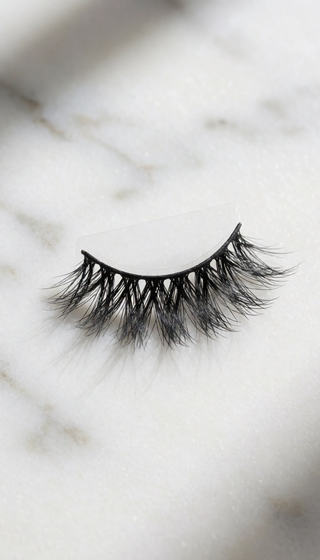
SUMMER-PROOF FALSE LASHES FOR HUMID DAYS

You spend twenty minutes getting your lashes perfect — wispy, lifted, camera-ready — and then step outside. Within an hour, the corner of your left lash is flipping up like a page in a windstorm. By the time you reach the outdoor brunch, you're pressing the band back down with a damp fingertip, hoping no one notices. If you've ever had a lash lift, droop, or full-on detach in humid weather, you already know the problem isn't your technique. It's the physics.
Humidity is the single most underestimated enemy of false eyelashes. When moisture in the air interacts with lash adhesive, it breaks down the bond faster than any oil-based cleanser or late-night face-wipe ever could. The result? Lashes that slide, shift, and shed at the worst possible moments — weddings, beach vacations, rooftop parties, and every summer event where you actually want to look put together.
Key Takeaway: Summer-proof false lashes require three things: a flexible band that moves with your eyelid instead of fighting it, an application protocol that accounts for moisture in the air, and an aftercare routine that protects the adhesive bond. Get all three right, and your lashes stay secure for 12+ hours — even at 90% humidity.
Frequently Asked Questions
How long do PHANSTA LASHES last?
PHANSTA LASHES can be worn all day and reused multiple times with proper care. A single pair typically lasts 10-15 wears when stored and cleaned correctly, making them an excellent value compared to traditional strip lashes.
Are PHANSTA LASHES safe for sensitive eyes?
Yes. PHANSTA LASHES are made with hypoallergenic materials and require no adhesive, making them ideal for sensitive eyes, allergy sufferers, and contact lens wearers.
How do I apply PHANSTA LASHES?
PHANSTA LASHES apply in seconds — simply measure, trim if needed, and press onto your lash line. No glue, no drying time, no mess.
Can I reuse PHANSTA LASHES?
Absolutely. PHANSTA LASHES are designed for multiple wears. Clean them gently after each use and store in the original tray to maintain their shape and adhesive properties.
Why Humidity Is the Number One Enemy of False Lashes
Most people assume their lashes fail in summer because of sweat or water. The real culprit is atmospheric moisture — the invisible water vapor that surrounds you the moment humidity climbs above 60%. Here's what's actually happening at the molecular level.
Lash adhesives, whether latex-based or latex-free, rely on a process called cyanoacrylate curing. When the glue comes into contact with the air, it polymerizes — the molecules link together to form a strong, flexible bond. This process requires a specific moisture threshold. Too little air moisture and the glue cures too slowly. Too much and it cures too fast, creating a brittle bond that cracks under the natural movement of your eyelid.
- At 30-50% humidity: Adhesive cures at an optimal rate, forming a strong, flexible bond that lasts 10-14 hours.
- At 60-75% humidity: Adhesive cures too quickly, becoming brittle within 2-3 hours. The bond cracks when you blink, causing corner lift.
- At 80%+ humidity: Adhesive may never fully cure. It stays tacky, slides along the lash line, and loses grip entirely within 1-2 hours.
A 2023 study published in the Journal of Cosmetic Science found that cyanoacrylate adhesives lost up to 40% of their bond strength when exposed to 85% relative humidity for just 30 minutes. That's the difference between lashes that last through a full workday and lashes that fail before lunch.
The problem compounds because summer humidity doesn't just affect the initial bond. It continues to degrade the adhesive throughout the day. Every time you blink — roughly 15,000 to 20,000 times daily — the flexible band micro-moves against your skin. In dry conditions, this movement is negligible. In high humidity, the weakened adhesive can't absorb the stress, and the bond fractures at the edges first. That's why corner lift is the telltale sign of humidity failure: the outer corners of your lash line experience the most movement and the most exposure to ambient air.
The takeaway: If you're applying lashes in a humid climate or during summer months, you need a lash system designed to handle moisture — not just a strong adhesive, but a band that flexes and an application method that seals out humidity during the critical curing window.

The Band Factor — Why Flexibility Matters More in Summer
Ask most people what makes a good false lash and they'll say the fibers — the length, the volume, the curl. But the band is the component that determines whether your lashes survive a humid afternoon. And in summer, the difference between a rigid band and a flexible band is the difference between lashes that last and lashes that don't.
Traditional false lashes use one of three band materials: cotton thread, clear plastic (PET), or rigid cotton. Each behaves differently when heat and humidity enter the equation.
- Cotton thread bands: The most common in drugstore lashes. They're lightweight but have minimal flexibility. In humidity, the cotton absorbs moisture from the air, expands slightly, and pulls away from the lash line. Corner lift within 2-3 hours is typical.
- Clear plastic (PET) bands: Nearly invisible when applied, but completely rigid. They don't absorb moisture, which sounds good — until you realize that rigidity means zero give. Every blink creates stress at the bond point. In summer, when your skin is slightly swollen from heat, the rigid band can't conform to the changed shape of your eyelid. The result is a gap between band and lash line that widens throughout the day.
- Flexible memory bands: A newer category of band material — often a thin, pliable polymer or a finely woven flexible filament — that bends and returns to shape. These bands move with your eyelid rather than against it. When heat causes slight swelling or when humidity weakens the adhesive, the flexible band absorbs the stress instead of transferring it to the bond.
The physics are straightforward. A rigid band acts like a lever: every blink applies force to the adhesive bond, and in humidity-weakened adhesive, that force causes micro-fractures. A flexible band acts like a spring: it distributes the force across the entire lash line, reducing stress on any single point of the bond.
Industry testing on flexible band lashes shows a 60% reduction in corner lift compared to rigid cotton bands when both are exposed to 80% humidity for 4 hours. That's not a marginal improvement — it's the difference between lashes that need adjustment every hour and lashes that stay put from morning to midnight.
What to look for: When shopping for summer lashes, check the product description for terms like "flexible band," "memory band," "ultra-thin flexible band," or "bendable band." If the band material isn't specified, that's a red flag — it likely means a standard cotton or plastic band that hasn't been engineered for humid conditions.

How to Apply False Lashes When It's 90% Humidity
Even the best summer lashes will fail if you apply them in a steamy bathroom right after a hot shower. The application environment matters as much as the lash itself. Here's the protocol that lash artists use for humid-day application — the same technique used for destination weddings in tropical climates.
Step 1: Control your environment. Apply lashes in an air-conditioned room with humidity below 50%. If you don't have AC, run a dehumidifier for 20 minutes before application. Never apply lashes in a bathroom where someone just showered — the residual moisture in the air will interfere with adhesive curing.
Step 2: Prep your lash line with an oil-free primer. Use a lash primer or an oil-free eye primer on your entire lash line. This creates a barrier between your skin's natural oils and the adhesive. In summer, your skin produces more oil due to heat, so this step is non-negotiable. Let the primer dry completely — 30 seconds — before applying lashes.
Step 3: Use a thin, even layer of adhesive. Apply a thin line of lash glue along the band. In humidity, less is more. A thick layer of adhesive takes longer to cure and remains tacky longer, giving moisture more time to penetrate the bond. Wait 30-45 seconds after applying glue before placing the lash — you want it tacky, not wet.
Step 4: Place and hold. Position the lash as close to your natural lash line as possible. Press the band down with a lash applicator or your fingertips, starting from the center and working outward. Hold each section for 10-15 seconds. In humid conditions, extend this to 20 seconds per section — the extra contact time helps the adhesive form a stronger initial bond before it's exposed to ambient moisture.
Step 5: Seal the corners. The outer and inner corners are where humidity failure starts. After the initial placement, apply a tiny dot of extra adhesive to each corner and press down for another 10 seconds. This reinforces the most vulnerable points of the bond.
Step 6: Let them cure undisturbed. For the first 10 minutes after application, avoid touching your eyes, rubbing, or applying mascara. This is the critical curing window. If you can, stay in a low-humidity environment during this time. Don't step outside into the heat immediately — give the adhesive time to reach full bond strength.
Pro tip from lash artists: If you're attending an outdoor summer event, apply your lashes indoors in AC, wait 15 minutes for full curing, then carry a small handheld fan. If you feel your lashes starting to lift, a quick blast of cool air can re-tackify the adhesive enough to get you through the next hour.
Which Lash Styles Survive Summer (and Which Don't)
Not all lash styles are created equal when it comes to humidity resistance. The weight, length, and density of the fibers all affect how much stress is placed on the adhesive bond. Here's how to choose a style that holds up.
Best for summer humidity:
- Wispy, natural-volume styles: Lighter fibers mean less weight pulling on the bond. A wispy lash with 0.05mm fiber thickness and moderate length (10-12mm) creates minimal stress on the adhesive. These are your best bet for all-day wear in high humidity.
- Cat-eye styles with shorter inner corners: The inner corner of your lash line is where moisture accumulates — from tears, from sweat running down your face, from humidity in the air. A style that's shorter at the inner corner (7-8mm) and longer at the outer corner (12-13mm) reduces the amount of fiber exposed to moisture at the most vulnerable point.
- Half-lash or accent styles: These cover only the outer half of your lash line, which means less adhesive surface area exposed to humidity and less weight on the bond. They're also easier to re-secure if you do experience lifting.
Worst for summer humidity:
- Extreme volume styles (16D+): The weight of dense volume lashes puts enormous stress on the adhesive bond. In dry conditions, a strong glue can handle it. In humidity, the weakened adhesive can't support the weight, and the lash slides or detaches entirely.
- Extra-long styles (15mm+):strong> Longer fibers act as levers — every blink creates more force at the bond point. In humidity, this accelerates the micro-fracture process that causes corner lift.
- Styles with thick, dramatic fibers: Fibers that are 0.15mm or thicker are heavier and stiffer. They don't move naturally with your eyelid, which means more stress on the bond in humid conditions.
The sweet spot for summer: Look for lashes labeled "lightweight," "natural volume," or "everyday wispy." These styles prioritize wearability over drama, which is exactly what you need when the air is thick with moisture. You can always add a winged liner to create drama without adding weight to the lash band.
Summer Lash Aftercare — The Maintenance Routine
Getting your lashes to stay put in humidity isn't just about application — it's about how you treat them throughout the day. Summer aftercare is different from winter aftercare because the threats are different. In winter, dry air and static are your enemies. In summer, it's moisture, oil, and sweat.
Morning prep: Before applying lashes, cleanse your lash line with an oil-free micellar water or a gentle foaming cleanser. Pat dry completely. Any residual moisture on your skin will interfere with adhesive bonding. Follow with an oil-free primer if your skin tends to get oily throughout the day.
Midday maintenance: Carry oil-blotting papers with you. If you notice your lash line getting shiny, gently press a blotting paper along the band — don't rub. Oil is the second biggest threat to lash adhesive after humidity. A single touch of oily fingertip to the lash line can break down the bond in minutes.
Post-event removal: When you're ready to remove your lashes, don't pull them off dry. Soak a cotton pad with an oil-free makeup remover or micellar water, hold it against your closed eye for 30 seconds, then gently slide the lash band away from your lash line. Pulling dry lashes in summer is especially damaging because heat makes your natural lashes more brittle.
Storage for reuse: If you're wearing reusable lashes, clean the band after every wear. Use a cotton swab dipped in isopropyl alcohol (70% concentration) to remove adhesive residue from the band. Let them air-dry completely before storing. In summer, store your lashes in a cool, dry place — not in your bathroom, where humidity from showers can warp the band and degrade the fibers.
What to avoid:
- Oil-based eye makeup removers: Oil dissolves lash adhesive on contact. Even if you're not wearing lashes that day, using an oil-based remover can leave a residue on your lash line that weakens the next application.
- Waterproof mascara on top of false lashes: Waterproof mascara is notoriously difficult to remove, and the removal process can pull off your false lashes. If you need extra definition, apply a thin coat of regular mascara to your natural lashes before applying the false lashes.
- Rubbing your eyes: This seems obvious, but in summer, sweat and humidity make your eyes itch more. Every rub transfers oil and moisture to the lash band. If your eyes itch, press a clean tissue gently against the area instead of rubbing.
What to Look for in Summer-Proof False Lashes
Now that you understand the science of humidity and lashes, you can evaluate any lash product with a critical eye. Here are the specific features that separate summer-proof lashes from lashes that will fail by noon.
1. A flexible, ultra-thin band. This is non-negotiable. The band should be thin enough to conform to your lash line without gaps and flexible enough to move with your eyelid. If the band feels stiff when you bend it between your fingers, it won't hold up in humidity. Look for bands that are 0.3mm or thinner — thick bands are rigid bands, and rigid bands fail in moisture.
2. Lightweight, tapered fibers. The fibers should taper to a fine point at the tip, mimicking the structure of natural lashes. Tapered fibers are lighter than blunt-cut fibers, which means less weight on the bond. If the fibers feel heavy when you hold the lash strip, they'll feel heavier on your eyelid in humid conditions.
3. A secure, glue-free application system. Traditional glue lashes require adhesive that cures in air — which means they're directly exposed to humidity during the most vulnerable phase of bonding. A glue-free system that uses a pre-applied adhesive strip or a pressure-sensitive band eliminates the curing window entirely. There's no wet adhesive for humidity to penetrate, no waiting period, and no brittle bond. The lashes go on secure and stay secure.
4. Reusability with easy cleaning. Summer lashes should be reusable — not because of cost, but because a well-made lash that can be cleaned and re-worn is a sign of quality construction. If the band holds its shape after cleaning and the fibers don't shed, you're dealing with a product designed for real-world wear, not just a single-use photo prop.
5. A style range that includes natural and wispy options. A brand that only sells dramatic, heavy lashes isn't thinking about summer wear. Look for a range that includes natural-volume styles, cat-eye shapes, and half-lash options — the styles that actually perform well in humid conditions.
PHANSTA LASHES — Engineered for Humid Days
Here's where everything you've just read comes together. PHANSTA LASHES were designed specifically to solve the problem that traditional glue lashes can't handle: wearing beautiful, secure lashes in real summer conditions.
The band is where PHANSTA LASHES differ from every traditional glue lash on the market. Instead of a rigid cotton thread or a stiff plastic strip, PHANSTA LASHES use an ultra-thin flexible band that moves with your eyelid. When heat causes slight swelling or humidity weakens the bond, the band flexes instead of fighting back. That means no corner lift, no gap between band and lash line, no midday emergency press-and-hold.
Because PHANSTA LASHES are glue-free, there's no curing window for humidity to exploit. You don't wait 30 seconds for the adhesive to get tacky. You don't hold your breath hoping the bond sets before you step outside. The lashes go on secure and stay secure — from the moment you apply them to the moment you take them off, hours later, in air-conditioned comfort or tropical heat.
The fiber selection is equally intentional. PHANSTA LASHES come in wispy, natural-volume styles with tapered fibers that mimic the weight and movement of real lashes. No heavy, blunt-cut fibers pulling on the bond. No extreme volume that requires industrial-strength adhesive to hold. Just lightweight, fluttery lashes that look like yours — only better.
And because they're reusable, you can wear them to the outdoor wedding, the beach dinner, the rooftop party, and the Sunday brunch — clean the band, store them in a cool dry place, and they're ready for the next event. No more single-use lashes that fail halfway through the day and end up in the trash.
The transformation is simple: You stop thinking about your lashes. You stop pressing the corner back down in the bathroom mirror. You stop carrying emergency lash glue in your clutch. You apply them once, and they stay — through the heat, the humidity, the sweat, the tears of joy at the wedding, the late-night drive home with the windows down. That's what summer lashes should feel like.
You now know exactly why humidity destroys traditional lashes, what a flexible band does that a rigid one can't, how to apply lashes in high moisture, which styles to reach for and which to skip, and how to care for your lashes so they last through the entire summer season. The science is clear, the techniques are proven, and the solution exists. All that's left is to choose lashes that were built for the conditions you actually live in — not the conditions you wish you lived in. PHANSTA LASHES are ready when you are.
Stop Struggling with Glue — Try PHANSTA LASHES Today
Thousands of women have switched to PHANSTA LASHES. No glue, no damage, no complicated application. Just beautiful lashes that stay perfect all day.
SHOP PHANSTA LASHES →