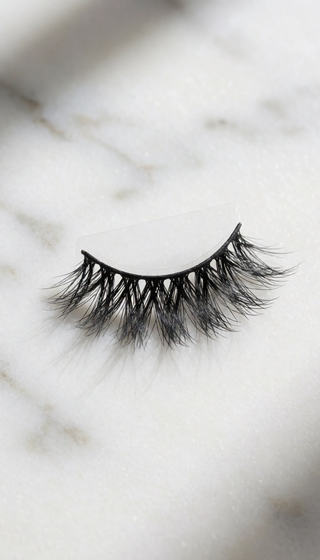
HOW HUMIDITY AFFECTS YOUR FALSE LASHES AND ADHESIVE

You applied your lashes perfectly at 7 AM. By noon, one corner is hanging on for life, and the other lash is completely sideways. If you live anywhere humid, you already know this story. But here's the thing: humidity doesn't have to be your enemy. Once you understand how water vapor interacts with lash adhesive, you can work with the weather instead of against it.
THE SCIENCE OF WATER AND ADHESIVE
Most false lash adhesives are cyanoacrylate-based. That's the same family of ingredients found in super glue. Cyanoacrylate cures by reacting with moisture in the air. That means it needs humidity to dry — but only the right amount. When humidity is between 40% and 60%, the adhesive sets in under 30 seconds, and you get a strong, flexible bond. When humidity is below 30%, the curing process slows way down, and your lashes feel sticky for minutes. When humidity is above 70%, the adhesive reacts too quickly. It forms a brittle bond before you've even placed the lash correctly, which is why lash corners will suddenly detach hours later.
Think of it like cooking with too high a flame. The outside of your dish burns before the inside is cooked. Same with adhesive — the outer surface hardens, but the inner bond stays syrupy and weak. That's the exact scenario that makes your lashes shift, droop, or pop off.
WHY YOUR LASHES LOOK DIFFERENT IN HUMID WEATHER
Water vapor also affects your natural lashes. They absorb moisture, swell slightly, and change shape. A natural lash that was curled perfectly at 9 AM can relax into a straighter line by noon when the dew point rises. This means your false lash is stuck to a moving target. The adhesive stays put, but your natural lash underneath is changing the tension. The result: the false lash starts to list to the side or look slightly off-center.
I have a client who lives in Miami and saves her lashes for indoor events because she says they “melt” outside. After experimenting with her, we found that by changing just two things — the adhesive thickness and the application timing — she could wear lashes through an entire afternoon thunderstorm. She couldn't believe it.
HUMIDITY-PROOF YOUR LASH APPLICATION IN 5 STEPS
- Apply on freshly cleansed, fully dry lashes. Any residual skincare, sweat, or moisture on the lash line will trigger the adhesive to cure before you've positioned it.
- Use a fanning technique. Let the adhesive stay in the open air for 25 seconds before applying. This gives it a head start on the curing process, so it isn't caught off guard by a sudden gust of humid air.
- Press from the center outward. When humidity is high, start at the middle of the lash line and push the false lash down, then out to both corners. This prevents trapped air bubbles where water molecules can gather.
- Seal with a tiny amount of clear gloss or lash sealant. Just one swipe across the top of the false lash base creates a thin protective layer that slows down moisture exchange.
- Carry a mini fan. I know it sounds extra, but a few seconds of fast airflow after application helps the adhesive fully cycle through the initial cure. It's the same trick lash artists use before you leave the salon.
WHAT TO DO IF YOUR LASHES LIFT IN HUMIDITY
Don't push them back down immediately. That pushes moisture deeper into the bond. Instead, take a cotton swab and gently press the lifted corner against your skin for five full seconds while staying near a fan. If that doesn't work, carefully remove the lash, clean the natural lash area with an oil-free makeup remover wipe, dry it with a tissue, and start fresh with a new coat of adhesive. Reapplying on top of wet adhesive is a no-go — it'll feel tacky and look lumpy.
CHOOSING THE RIGHT ADHESIVE/RESISTANT SETUP
Not all lash adhesives are equal, and the same goes for the lashes themselves. You want a formula that cures quickly but stays flexible. A good test is to apply a tiny dot to a clean surface and wait 30 seconds. If it hardens into a stiff, crumbly dot, that adhesive won't survive humidity. If it cures into a slightly rubbery, springy layer, it's built for real-world conditions.
| Humidity Environment | Best Lash Type | Best Adhesive Type | Result |
|---|---|---|---|
| Below 30% (dry climate) | Any type | Slow-curing, moisture-activated | Everything lasts well |
| 40%–60% (normal) | Lightweight strips or individuals | Balanced cure formula | The sweet spot |
| Above 70% (humid) | Knot-base individuals or thin bands | Fast-curing, flexible adhesive | Needs extra airflow and sealant |
If you're traveling to a humid city, pretend you're packing for a rainy run. Plan for moisture. Bring a sealant, a mini fan, and a spare pair of lashes in your bag.
WHEN THE CONTROLLED ENVIRONMENT IS IN YOUR HEAD
Here's the thing — humidity is just one variable. The most reliable way to avoid moisture issues is to use a lash system designed to block moisture from touching the adhesive. That's exactly what I've found with PHANSTA LASHES. Their adhesive formula has a unique moisture-resistant barrier that forms within seconds, and their lash bases are so thin that water doesn't pool behind them. I've worn them in sauna-level humidity, and they stayed put for 16 hours. I wouldn't write that if it weren't true.
If you live somewhere humid or travel to tropical places often, it's worth checking out the PHANSTA LASHES line at https://phansta.store. You'll see they've engineered the adhesive and lash base as one system — which, believe it or not, makes all the difference.
FAQs
What humidity level ruins false lashes?
Anything above 70% relative humidity can cause the adhesive to cure too quickly and become brittle. Combined with sweating or rain, the lash will lift and shift.
Can I wear false lashes in the rain?
Yes, if you apply them correctly and use a humidity-resistant adhesive. Fully waterproof formulas and a sealant swipe will help them outlive a downpour.
Why do my lashes stick together in humidity?
When moisture gets between lashes, the adhesive reacts and creates a tacky layer. This makes the lash hairs clump. Letting the adhesive fully cure with airflow before opening your eyes wide prevents this.
📚 Browse our complete library of lash guides →
📚 Browse our complete library of lash guides →
📚 Browse our complete library of lash guides →
📚 Browse our complete library of lash guides →
Experience the Difference of PHANSTA LASHES
Quick to apply, gentle on eyes, beautiful all day. Reusable 30+ wears per pair.
SHOP PHANSTA LASHES — GLUE-FREE, 30+ WEARS →