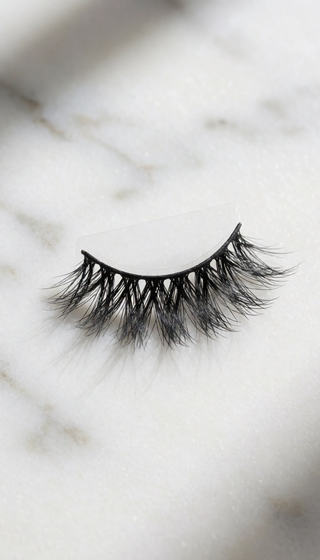
BEST FALSE LASH TIPS FOR ASYMMETRICAL EYE SHAPES

You know the feeling: you spend twenty minutes on your lashes, one eye looks darty and open, the other looks sleepy. You reapply. Same problem. It's not your technique — it's that your face is naturally asymmetrical. According to a 2018 study in the Journal of Craniofacial Surgery, nearly 80% of people have noticeable facial asymmetry. Your right eye and left eye are different. That's normal.
Here's the thing: false lashes actually make asymmetry worse if you pick the wrong style or put them on the same way on both eyes. The fix is not to abandon lashes. The fix is to make the lash work around your unique eye shape. If your eyes are also heavy-lidded, check our guide to heavy-lidded eyes.
THE REAL REASON YOUR LASHES LOOK OFF-BALANCE
When you put the same strip lash on both eyes, you're asking two different canvases to wear identical makeup. On a hooded eye, a thick band can disappear into the fold. On a rounder eye, the same band can stretch wide. So you end up with one eye feeling “open” and one eye feeling “hidden.”
Think of it this way: your left eye may be wider, your right eye may be more upturned. The lash is a straight line — and straight lines highlight every difference.
FIVE ADJUSTMENTS THAT FIX ASYMMETRY IN MINUTES
- Trim the outer corner on the smaller-looking eye. If one eye feels “droopy,” cut 3-4mm from the outer edge of that lash. That lifts the corner and helps the eye look more open.
- Bend the band before you apply. Hold the lash between your fingers for 10 seconds and curve it to match your natural lid shape. This prevents the corners from popping off.
- Place the lash slightly lower on one eye. Use the lash as a lift, not a mask. On the side that feels “heavy,” position the band 1mm closer to your lash line. It changes everything.
- Use a half lash on one side. For asymmetrical eyes, a half-strip on the outer corner balances things without over-covering.
- Check with a hand mirror. In a normal mirror, you see yourself reversed. A hand mirror shows the real way others see you. Use it before you finalize.
HOW TO MEASURE YOUR EYES FOR A PAIR OF LASHES
Take a soft tape measure and measure both eye widths from inner corner to outer corner. Most people have a difference of 2-3mm. Then measure each lash. If the lash is shorter than your eye on one side, add a lighter layer of mascara to blend. If it's longer, trim only the outer edge.
Measuring five minutes before you apply saves you twenty minutes of frustration.
WHAT TO LOOK FOR IN A SOLUTION
After trying dozens of lash styles, I realized three things matter: a thin, flexible band that follows the curve of each eye; natural flare lengths that you can customize; and a design that lets you trim without losing the shape. You want something that feels like a base — not a haircut you can't edit.
So when I use PHANSTA LASHES, I know I can trim, bend, and shape them to match my two different eyes. They don't fight the asymmetry — they follow it. That's the outcome you actually want: lashes that look like they were made for your both eyes.
Do I need to use the same lash on both eyes?
No. You can use a different style or length per eye. The goal is balance, not identical twins.
Can I cut false lashes for an asymmetrical eye?
Yes. Trim from the outer edge to keep the inner corner defined. Never trim the inner corner, or it will pull your eyes together.
Are these tips good for hooded asymmetrical eyes?
Yes, the bend-and-hold step and the low placement really help hooded eyes feel more open.
Browse our complete library of lash guides →
📚 Browse our complete library of lash guides →
📚 Browse our complete library of lash guides →
📚 Browse our complete library of lash guides →
📚 Browse our complete library of lash guides →
📚 Browse our complete library of lash guides →
📚 Browse our complete library of lash guides →
📚 Browse our complete library of lash guides →
Experience the Difference of PHANSTA LASHES
Quick to apply, gentle on eyes, beautiful all day. Reusable 30+ wears per pair.
SHOP PHANSTA LASHES — GLUE-FREE, 30+ WEARS →