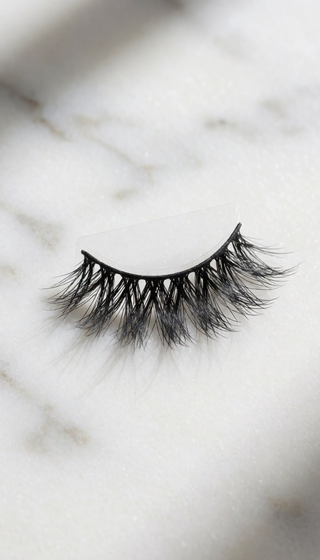
FLARED LASH STRATEGIES FOR ASYMMETRICAL EYES: CORRECTION TECHNIQUES
Achieve Visually Symmetrical Eyes Even If Your Natural Lashes Are Not
Learn the precise techniques to balance eye shape differences using tailored lash distribution, without the need for heavy makeup.
UNDERSTANDING THE SCIENCE OF EYE ASYMMETRY
Perfectly symmetrical eyes are a biological rarity. Most individuals possess natural variations—one eye may appear rounder, more hooded, or set slightly differently than the other. When applying a single, uniform lash style to both eyes, these inherent differences are often amplified, leading to an unbalanced appearance.

The key to correcting this visual imbalance lies in the ability to customize the lash application for each eye independently. Flared lashes are particularly effective because they allow for precise control over the length and density distribution on one eye versus the other, enabling a tailored correction.

DIAGNOSING YOUR ASYMMETRY TYPE
Before selecting a lash map, a diagnostic assessment of your eye shape is necessary. This determines the foundational requirements for achieving visual harmony.
- Round vs. Almond Shape: A rounder eye benefits from a flared lash profile (typically 8-14mm) to add definition. An almond shape generally requires a standard wispy lash (8-12mm) to maintain its natural elegant curve.
- Hooded vs. Non-Hooded: For hooded eyes, a tapered D curl lash is often required to lift the visual weight. Non-hooded eyes respond well to a standard flared B/C curl lash for maximum impact.
- Set Height (Low vs. High): If one eye is set lower, a longer flare is necessary to provide an optical lift. Conversely, a higher-set eye requires a shorter, more natural lash to prevent appearing disproportionately heavy.
THE PRINCIPLES OF INDIVIDUAL PAIR CORRECTION
The only technically accurate method for correcting ocular asymmetry is the use of individually selected lash pairs for each eye. This allows for a bespoke solution that addresses specific structural needs.
- Lengthening the Under-Eye: Select a longer flare (13-15mm) for the smaller or lower-set eye. This adds necessary visual length and lifts the perceived lid position.
- Balancing the Over-Eye: For the larger or higher-set eye, opt for a medium flare (10-12mm) to maintain overall facial balance without over-emphasizing the difference.
- Optical Placement Differential: For the lower eye, the lash band should be placed fractionally higher (1mm to 2mm) on the lash line than the natural growth. This subtle shift creates an optical lift that aligns the eyes visually.
MASTERING THE PLACEMENT TECHNIQUE FOR OPTICAL TRUTH
The placement of the lash band is arguably more critical than the lash map itself. A lower-set eye requires the band to sit slightly elevated from the natural lash line to achieve the desired optical lift. Conversely, for a higher-set eye, the band must sit precisely on the natural lash line to ensure a seamless, non-disruptive look.
This necessary 1mm to 2mm differential in placement is difficult to maintain with traditional wet adhesives, which can cause slippage. A high-quality micro-liner system is essential because it secures the bands at these precise, differential heights without the risk of sliding or migration.
THE SPECTRUM OF CORRECTION: FLARE INTENSITY
A comprehensive lash system must offer a wide spectrum of flare intensities. This range allows the wearer to move beyond simple 'natural' or 'dramatic' labels and instead match a specific lash map to the specific structural need of an individual eye. This precision corrects asymmetry without the need for heavy contouring or reliance on lash curlers.
Can I use the same lash on both eyes if they are asymmetrical?
No. Using the same lash on both eyes will inevitably highlight the existing asymmetry rather than correct it. Two distinct lash maps, tailored to each eye's unique needs, are required for a balanced outcome.
How do I determine which eye needs a stronger flare?
Generally, the eye that appears smaller, or the one with less visible lid space, requires the longer, stronger flare to add necessary visual length and lift. This compensates for perceived lack of volume.
Can a precise lash system correct asymmetry?
Yes. The precise placement capabilities afforded by a specialized micro-liner system are fundamental to asymmetry correction, as they maintain the required height differential between the two eyes for the entire duration of wear.
THE PHANSTA LASHES SOLUTION: PRECISION ENGINEERING FOR YOUR UNIQUE FACE
Correcting asymmetry demands a diagnostic, professional approach—and PHANSTA LASHES was engineered to deliver that precision at home. We provide the individual lash units and the specific, varied lash maps necessary to bring asymmetrical eyes into perfect visual balance.
Our GLUE-FREE micro-adhesion technology allows you to apply custom, tailored lash pairs for each eye with unmatched control.
FIND THE PERFECT LASH FOR EVERY MOMENT
Explore our occasion-specific lash guides:
FREQUENTLY ASKED QUESTIONS
STILL COMPARING OPTIONS? Explore our guides on finding your perfect lash, magnetic vs strip, and sensitive eyes.
FIND THE PERFECT LASH — Not sure which style suits you? Take the 30-second lash finder finder →
STILL COMPARING OPTIONS? Explore our guides on finding your perfect lash, magnetic vs strip, and sensitive eyes.
FIND THE PERFECT LASH — Not sure which style suits you? Take the 30-second lash finder finder →
Experience the Difference of PHANSTA LASHES
Quick to apply, gentle on eyes, beautiful all day. Reusable 30+ wears per pair.
SHOP PHANSTA LASHES — GLUE-FREE, 30+ WEARS →